Some links on this page are affiliate links. If you purchase through them, we may earn a small commission at no extra cost to you. This does not affect our recommendations.
Quick answer:
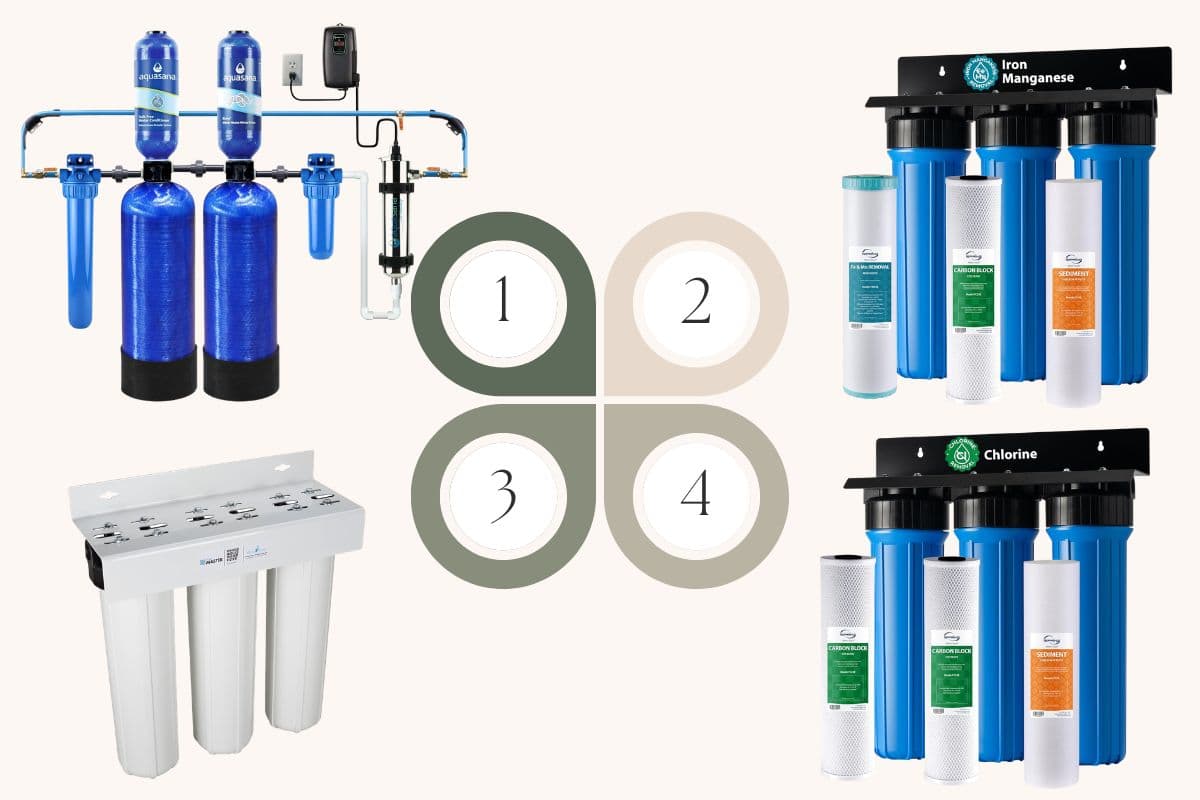
The right whole house water filter depends entirely on what your water test shows. There is no single best system for all wells. For iron and sulfur, the Home Master HMF3SDGFEC handles up to 3 ppm combined at an honest price. For bacteria plus general filtration, the Aquasana Rhino EQ-WELL-UV-PRO-AST pairs carbon and KDF filtration with UV disinfection in one package. For budget sediment and chlorine on mild well water, the iSpring WGB32B delivers solid cartridge-based filtration without the price tag of tank systems. For severe iron and sulfur above 7 ppm, a purpose-built air injection system is needed. This guide covers the best option for each scenario, what each system actually removes, what it cannot, and the honest trade-offs no product page will tell you.
One rule before buying anything: Get your well water tested at a certified lab first. A system purchased without test results is a guess. See the how to test your well water guide for the full testing protocol, or the best well water test kits review for at-home options.
For wells with iron contamination specifically, a general whole-house filter is often not the right choice. Iron requires specialized treatment technology such as air injection oxidation, catalytic media, or ion-exchange fine mesh resin, depending on iron type and concentration. Generic whole-house sediment or carbon filters will not effectively remove dissolved iron and may foul rapidly when exposed to iron-rich well water. For dedicated iron filter recommendations organized by iron type, see our best iron filters review.
How We Selected These Products
Every product in this guide was verified as currently available through major retailers and distributors. Specifications were confirmed against manufacturer documentation and independent testing data where available. We evaluated each product on five criteria:
Verified contaminant removal: Does the system actually remove what it claims? We prioritized systems with third-party testing or NSF certification to back their claims. We noted where manufacturer claims lack independent verification.
Honest limitations: Every system has contaminants it does not address. We state these explicitly. A system that removes iron but not bacteria is only appropriate for wells without bacterial contamination.
Flow rate vs. household size: A system rated for 7 GPM is adequate for a 2-bathroom home drawing peak demand of about 4 to 5 GPM. A 4-bathroom home during morning rush needs 10 to 12 GPM minimum. We matched each pick to appropriate household sizes.
Annual ownership cost: Purchase price is not total cost. We calculated annual cartridge or media replacement costs for each system.
Installation complexity: Some systems require only basic plumbing. Others need electrical work for UV lamps or programming of backwash controllers. We flagged which require professional installation.
For a complete cost breakdown by system type including installation costs, annual maintenance costs, and the 10-year total cost of ownership, see the whole house water filter cost guide.
At a Glance: Top Picks by Contaminant
| Best For | System | Purchase Price | Annual Upkeep | Iron Limit | Bacteria | Warranty |
|---|---|---|---|---|---|---|
| Iron + sulfur + manganese | Home Master HMF3SDGFEC | ~$220 to $260 | $150 to $250/yr | 3 ppm combined | No | 2 year |
| Bacteria + broad contamination | Aquasana EQ-WELL-UV-PRO-AST | ~$700 to $900 | $190 to $280/yr | 0.3 ppm max | Yes (Class A UV) | 10yr tank / 1yr UV |
| Budget sediment + chlorine | iSpring WGB32B | ~$160 to $200 | $60 to $100/yr | Not rated | No | 1 year |
| Budget iron + manganese | iSpring WGB32BM | ~$185 to $230 | $80 to $130/yr | ~1 to 2 ppm | No | 1 year |
| Sediment pre-filter only | iSpring WSP-50 Spin Down | ~$40 to $60 | $0 (reusable) | N/A | No | 1 year |
The Five Best Whole House Water Filters
Home Master HMF3SDGFEC
Best for: Iron, manganese, and sulfur up to 3 ppm combined, wells without bacteria
Model: HMF3SDGFEC · Purchase price: approximately $220 to $260
The Home Master HMF3SDGFEC is the most honest cartridge-based system for well water with moderate iron and sulfur problems. Where most competitors use undersized housings that create pressure drops and require frequent cartridge changes, Home Master built this system around oversized radial-flow filter cartridges that maintain up to 15 GPM flow with less than 1 PSI pressure drop and need replacement only once per year for most households.
What it removes: Sediment down to 1 micron (four-gradient depth filter in Stage 1), iron and manganese up to 3 ppm combined and hydrogen sulfide up to 1 ppm (radial flow iron filter in Stage 2), herbicides, pesticides, and organic chemicals (granular activated coconut shell carbon in Stage 3).
What it cannot remove: Bacteria and viruses — this is not a disinfection system. Iron bacteria (biological iron contamination) will defeat the iron filter over time without upstream disinfection. Hardness minerals are not removed. Arsenic, nitrates, and PFAS are not addressed. Water pH must be between 7.0 and 10.0 — acidic wells with pH below 7.0 require pH correction upstream before this system.
Three ppm limit: The 3 ppm combined iron, manganese, and hydrogen sulfide ceiling is a real constraint. If your iron alone is 2 ppm and your hydrogen sulfide registers 1 ppm, you are at the limit and filter life will be shorter than the rated 12 months. If your iron is above 3 ppm, you need a higher-capacity system.
Verified specifications
Annual ownership cost: Replacement filter set is approximately $100 to $150 per year. Steel mounting bracket and housing wrench are included. No electricity required.
Installation: DIY-capable for homeowners with basic plumbing experience. The 1-inch ports require planning if your home plumbing is 3/4-inch — budget for adapters. Dimensions are 27 inches tall by 24 inches wide by 9 inches deep. Verify installation space before ordering.
The honest limitation no product page mentions: This system is not appropriate for wells with iron bacteria. If you see reddish-brown slime inside toilet tanks or notice a viscous reddish film on fixtures, you have iron bacteria. Install this system into an iron bacteria problem and the bacteria will colonize the filter media within months, defeating the iron removal capability. Shock chlorinate the well first, address iron bacteria, then install the Home Master. See the shock chlorination guide for the procedure.
Check Current PriceAquasana Rhino EQ-WELL-UV-PRO-AST
Best for: Wells with bacteria risk, broad chemical contaminants, moderate hardness, and households wanting one integrated system
Model: EQ-WELL-UV-PRO-AST · Purchase price: approximately $700 to $900 depending on configuration
Aquasana configuration guide:
The Aquasana Rhino well water line comes in four configurations that differ by tank size and included components. EQ-WELL-UV includes the filter tanks and UV but no conditioner. EQ-WELL-UV-PRO adds a larger pro-size filter tank. EQ-WELL-UV-AST includes the filter tanks, UV, and the salt-free SCM conditioner. EQ-WELL-UV-PRO-AST is the largest configuration with the pro tank, UV, and conditioner. For most households, the EQ-WELL-UV-PRO-AST reviewed here is the recommended choice because the SCM conditioner protects the UV lamp sleeve from scale. If hardness is below 5 gpg and you do not want the conditioner, the EQ-WELL-UV-PRO saves approximately $100 to $150. Do not confuse any of these with the EQ-1000 series, which is designed for city water, not well water.
The Aquasana Rhino EQ-WELL-UV-PRO-AST is the most comprehensive all-in-one well water system available at the consumer level. It combines carbon and KDF media filtration with a Class A UV disinfection unit (Sterilight UV system) and a salt-free scale control conditioner in a single integrated package. For well owners who have confirmed bacteria in their water and also want whole-house chemical filtration, this system eliminates the need to purchase and integrate separate components.
What it removes: Up to 97 percent of chlorine (from shock-chlorinated wells), sediment, rust, silt, pesticides, herbicides, water-soluble metals, industrial solvents, and VOCs through carbon and KDF media. UV unit removes 99.9 percent of bacteria and viruses including E. coli, Giardia, and Cryptosporidium. Salt-free SCM conditioner reduces scale buildup in pipes without removing minerals.
What it cannot remove: Iron above 0.3 ppm — the KDF media has limited iron removal capacity and the UV lamp's quartz sleeve will scale rapidly if iron is present above this threshold. Hardness minerals are not removed (the SCM conditioner reduces scale formation but does not soften water in the traditional ion-exchange sense). Arsenic, nitrates, and PFAS require a point-of-use RO system added downstream.
The iron limitation matters: The 0.3 ppm iron ceiling is the EPA's aesthetic standard — this is a very low limit. A well with 1 ppm iron, which is not unusual and often not considered severe by well owners, will cause the Aquasana's UV lamp sleeve to scale within months, dramatically reducing UV transmittance and disinfection effectiveness. Do not install this system if your iron exceeds 0.3 ppm without iron removal upstream. This is the single most important purchase decision for this system.
Verified specifications
Annual ownership cost: Pre-filter cartridges ($30 to $50 every 3 months) plus post-filter ($20 to $30 every 6 months) plus UV lamp replacement ($50 to $80 annually) totals approximately $190 to $280 per year.
Installation: More complex than cartridge systems. The integrated package includes filter tank, conditioner tank, UV unit, pre-filter, post-filter, brass fittings for 1-inch or 3/4-inch pipes, shutoff valves, and bend supports. UV requires electrical connection. System footprint is approximately 69 inches wide for the PRO-AST configuration. Professional installation strongly recommended to ensure UV is correctly positioned and electrical work is code-compliant.
Why the 7 GPM flow rate is often misunderstood: The 7 GPM rating reflects the UV disinfection contact time requirement — water must move slowly enough through the UV chamber to receive the minimum 40 mJ/cm² dose required for Class A disinfection. At higher flow rates, contact time is insufficient and bacteria survive. If your household peak demand exceeds 7 GPM, you need a UV system with a higher-rated lamp or supplemental storage, or you accept that peak demand moments may receive lower UV doses.
Check Current PriceiSpring WGB32B
Best for: Mild well water with primarily sediment and taste/odor concerns, or city water on a well-connected supply
Model: WGB32B · Purchase price: approximately $160 to $200
The iSpring WGB32B is the most straightforward entry point into whole-house cartridge filtration. Three stages of filtration — 5-micron polypropylene sediment, coconut shell carbon block, second coconut shell carbon block — address the basic aesthetic concerns of sediment, rust, chlorine, taste, and odor. It is the correct system for wells where testing shows no bacteria, no significant iron (under 0.3 ppm), and the primary concern is turbidity and general water quality.
What it removes: Sediment, rust, sand, and particles above 5 microns in Stage 1. Up to 99 percent of chlorine, herbicides, pesticides, industrial solvents, and organic chemicals in Stages 2 and 3. Two carbon stages provide redundancy and extended chlorine contact time versus single-stage systems.
What it cannot remove: Iron, manganese, bacteria, viruses, hardness minerals, arsenic, nitrates, fluoride, PFAS, or dissolved heavy metals beyond limited carbon block performance. This is explicitly not a well water treatment system for wells with significant iron or bacterial contamination.
Where it makes sense for well owners: Many rural homeowners on well water also use shock chlorination periodically or continuous chlorination as their disinfection method. In these cases, the WGB32B downstream of the disinfection system addresses chlorine taste, any remaining sediment, and chemical contaminants — providing a genuinely useful final polish without the cost of a comprehensive well water system. It is also appropriate as a downstream carbon stage following a dedicated iron removal system.
Verified specifications
Annual ownership cost: Replacement filter set runs approximately $60 to $100 per year. Lowest annual cost of any system on this list.
Installation: The most DIY-friendly system on this list. Pre-assembled housing, push-in connection fittings, standard 1-inch NPT. iSpring provides YouTube installation guides. Most homeowners with basic plumbing tools complete installation in 2 to 3 hours.
Check Current PriceiSpring WGB32BM
Best for: Wells with moderate iron and manganese alongside sediment, at budget price
Model: WGB32BM · Purchase price: approximately $185 to $230
The WGB32BM is the iron-specific variant of the WGB32B. Stage 3 replaces the second carbon block with an iron and manganese reduction filter, addressing the most common aesthetic well water complaints (orange staining, metallic taste, black manganese deposits) in a cartridge system that costs significantly less than tank-based iron removal systems.
What it removes: Sediment (Stage 1), chlorine, pesticides, herbicides, organic chemicals (Stage 2 carbon), iron and manganese reduction (Stage 3 iron/manganese filter).
The iron limit: The Stage 3 iron/manganese cartridge is effective at low to moderate iron levels but is not a high-capacity iron removal system. At iron concentrations above 1 to 2 ppm, filter life will be shorter than the rated 12 months and iron breakthrough may occur before the cartridge is replaced. For wells with iron above 2 ppm, the Home Master HMF3SDGFEC (rated to 3 ppm) or a dedicated tank-based iron filter is a better fit.
What it cannot remove: Bacteria, viruses, hardness, arsenic, nitrates, PFAS. Same limitations as the WGB32B.
Verified specifications
Annual ownership cost: Replacement filter set approximately $80 to $130 per year — slightly higher than the standard WGB32B due to iron/manganese cartridge cost.
Check Current PriceiSpring WSP-50 Spin-Down Sediment Pre-Filter
Best for: Primary sediment protection before any other filter, reusable without cartridge cost
Model: WSP-50 · Purchase price: approximately $40 to $60
The WSP-50 is not a complete whole-house filtration system. It is a 50-micron spin-down sediment filter that physically separates sand, silt, rust, and coarse sediment from the water flow via centrifugal action, collecting debris in a clear bowl that is flushed by opening a valve — no cartridge replacement required. It is the correct upstream pre-filter for any well system with significant sediment loading.
Why a spin-down pre-filter matters: The single most common reason whole-house filter cartridges fail before their rated capacity is sediment overload from well water. A 50-micron spin-down filter upstream of the main system catches coarse particles before they reach the more expensive main cartridges, extending those cartridges' service life by months and significantly reducing annual maintenance costs. For wells in sandy or silty formations, this is not optional — it is essential.
Verified specifications
Annual ownership cost: Near zero after purchase. No consumables. Occasional flush maintenance only.
Not a substitute for main filtration: The WSP-50 removes coarse sediment only. It does not address iron, bacteria, chemicals, or fine particles. It belongs at the beginning of a treatment stack, not as a standalone solution.
Check Current PriceWhen These Systems Are Not Enough
Every product above has scenarios where it is the wrong tool. These are the situations where you need to look beyond what consumer retail systems offer.
Iron above 3 to 5 ppm: Cartridge-based systems including the Home Master cannot reliably handle sustained high iron concentrations. You need a dedicated tank-based air injection oxidizing filter. These are available from water treatment specialists and typically cost $1,200 to $2,500 installed. They automatically backwash to self-clean on a programmed cycle and are sized for your specific iron concentration and household flow rate.
Confirmed E. coli: E. coli in your well indicates fecal contamination and a structural problem with the well. UV disinfection kills E. coli effectively, but the Aquasana's 7 GPM flow limit means any demand spike above that rate receives insufficient UV dose. For E. coli wells, the more important steps are shock chlorination, structural well inspection, and potentially casing or cap repair. See the shock chlorination guide and the well water contaminants guide. UV treatment is an ongoing safety net, not a substitute for fixing the source.
Arsenic, nitrates, or PFAS: None of the whole-house systems above address these health contaminants effectively. The correct solution is an NSF/ANSI 58-certified reverse osmosis system at the kitchen tap. See the well water treatment options guide for the complete decision framework.
High hardness above 15 grains per gallon: The Aquasana's SCM conditioner reduces scale at hardness below 15 gpg. Above that, a traditional water softener is required. See the treatment options guide for softener selection guidance.
What If My Well Has Multiple Problems?
This is the most common real-world scenario and the one no single product on this list handles completely.
Iron + bacteria + hardness
This is the trifecta many Midwest and Northeast well owners face. No single consumer retail system addresses all three simultaneously without trade-offs. The correct treatment stack is:
- Sediment pre-filter (iSpring WSP-50 or equivalent) to protect everything downstream
- Iron removal (Home Master HMF3SDGFEC for iron under 3 ppm, or a dedicated tank-based air injection system for higher concentrations)
- Water softener to remove hardness before the UV lamp accumulates scale
- UV disinfection (NSF/ANSI 55 Class A) for bacteria
The Aquasana EQ-WELL-UV-PRO-AST cannot serve this stack because its 0.3 ppm iron ceiling is incompatible with the iron levels that trigger this combination. It is an excellent system for wells with very low iron and bacteria — not for the high-iron, high-bacteria scenario.
Total installed cost for the full four-component stack: approximately $1,800 to $4,500 depending on iron concentration, household size, and whether you use the Home Master cartridge approach or a tank-based iron filter. See the well water treatment options guide for the complete multi-component treatment sequences.
Iron + PFAS
The Home Master handles the iron. An NSF P473-certified under-sink reverse osmosis system at the kitchen tap handles the PFAS for drinking and cooking. These two systems do not interfere with each other. Total investment: $220 to $260 for the Home Master plus $200 to $500 for a quality RO system.
Bacteria only (iron under 0.3 ppm, no hardness issues)
The Aquasana EQ-WELL-UV-PRO-AST is the correct and complete solution. This is the scenario it was designed for.
How to Choose: The Three Questions
Question 1: What does your water test show?
The specific contaminants and their concentrations determine everything. Iron at 0.8 ppm, manganese at 0.04 ppm, no bacteria, pH 7.2: the iSpring WGB32BM is appropriate. Iron at 2.5 ppm, sulfur detected, pH 7.5, no bacteria: the Home Master HMF3SDGFEC. Iron at 0.2 ppm, total coliform present, hardness 8 gpg: the Aquasana Rhino EQ-WELL-UV-PRO-AST.
Question 2: What is your peak flow demand?
Count bathrooms and appliances. A typical 3-bedroom, 2-bathroom home draws 4 to 6 GPM peak. A 5-bedroom, 3-bathroom home with irrigation draws 8 to 12 GPM peak. The Aquasana's 7 GPM UV limit is a real constraint for larger households.
Question 3: What are you willing to maintain?
Cartridge systems (Home Master, iSpring) require annual filter changes — a 30-minute task once a year. Tank systems require programming of backwash cycles but no cartridge changes. UV systems require annual lamp replacement regardless of visible function. Honest maintenance expectations prevent system failures from neglect.
What Whole House Filters Cannot Do
Every whole house filter review article should include this section. Most do not.
Whole house filtration addresses what it touches. Water that bypasses the system, water stored in the pressure tank before the filter, or water from fixtures connected upstream of the filter receives no treatment. Installation location matters.
Standard whole house filters do not remove: arsenic, nitrates, fluoride, total dissolved solids, PFAS (unless specifically equipped with certified GAC or RO stages), or hardness minerals. If your well water test shows any of these at concerning levels, a point-of-use reverse osmosis system at the kitchen tap is the appropriate additional layer.
UV disinfection does not filter. A UV system that kills bacteria does not remove the dead bacteria cells from the water. A sediment post-filter downstream of UV ensures that inactivated organisms do not reach the tap.
Carbon media exhausts silently. When activated carbon reaches its adsorption capacity, contaminants break through without warning, with no change in water appearance or taste. The only protection is replacing cartridges on schedule. Setting a calendar reminder at installation is the most practical safeguard.
Frequently Asked Questions
What is the best whole house water filter for well water?
There is no single best system for all wells. The correct system depends on your specific water test results. For iron and sulfur up to 3 ppm without bacteria, the Home Master HMF3SDGFEC is the best cartridge-based option at a reasonable price. For wells with bacteria plus general chemical contamination, the Aquasana EQ-WELL-UV-PRO-AST provides the broadest single-package coverage. For mild wells with primarily sediment concerns on a tight budget, the iSpring WGB32B is the most cost-effective starting point.
Do I need a whole house filter or just a drinking water filter?
For iron and manganese that cause staining on laundry and fixtures, a whole house filter is necessary — the problem affects every water use. For health contaminants like arsenic, nitrates, and PFAS that are concerns only when consumed, a point-of-use reverse osmosis system at the kitchen sink costs far less and is equally protective for drinking and cooking. Many well owners use both: whole-house treatment for iron and bacteria, point-of-use RO for drinking water purity.
How often do whole house water filter cartridges need to be replaced?
Most cartridge systems recommend annual replacement for a family of four under normal contamination levels. Wells with very high sediment, iron, or organic matter will exhaust cartridges faster. Monitoring water pressure is the practical indicator — a significant pressure drop from inlet to outlet (more than 15 PSI) indicates a clogged cartridge requiring replacement regardless of calendar schedule.
Can I install a whole house water filter myself?
Cartridge-based systems like the iSpring WGB32B and Home Master HMF3SDGFEC are DIY-capable for homeowners comfortable with basic pipe cutting and threaded fitting work. UV systems require electrical connections and professional installation is recommended. Complex multi-tank systems benefit from professional installation to ensure correct sequencing, flow rates, and backwash programming.
What flow rate do I need for a whole house water filter?
A standard 3-bedroom, 2-bathroom home requires 8 to 10 GPM peak capacity from the filtration system. Larger homes or homes with irrigation need 12 to 15 GPM minimum. The Aquasana Rhino's 7 GPM limit is a constraint for larger households, particularly those using it for well water disinfection where UV contact time cannot be compromised.
Does a whole house water filter remove bacteria?
Standard carbon and sediment whole house filters do not reliably remove bacteria. UV filtration systems disinfect by inactivating bacteria with ultraviolet light. If your well water tests positive for bacteria, you need a UV system with NSF/ANSI 55 Class A certification. The Aquasana EQ-WELL-UV-PRO-AST includes a Class A UV unit. Shock chlorination should also be performed before relying on UV as the sole disinfection method for an established bacterial problem.
What is the difference between a whole house water filter and a water softener?
A whole house water filter removes contaminants — sediment, iron, bacteria, chemicals — by physical filtration, adsorption, or UV disinfection. A water softener removes hardness minerals (calcium and magnesium) through ion exchange and does not remove other contaminants. They serve different purposes and are often used together. A water softener upstream of a whole house filter protects carbon and iron filter media from hardness fouling. The two systems are not interchangeable.
How long do whole house water filter systems last?
Tank-based systems (media tanks, backwashing iron filters) last 10 to 20 years with proper maintenance. Media may need replacement every 5 to 10 years depending on contamination levels and usage. Cartridge housing systems last indefinitely with proper maintenance — the housings themselves rarely fail. UV units last 5 to 10 years on the controller and lamp housing, with annual lamp replacement throughout. Control valves on backwashing systems typically last 10 to 15 years before requiring replacement.
Glossary
Radial Flow Filter
A filter design in which water enters the filter cartridge from the outside and flows radially inward through the filter media to exit through the center. Compared to axial flow (water flows straight through end to end), radial flow provides greater contact surface area with the media and produces lower pressure drop at equivalent flow rates. The Home Master HMF3SDGFEC uses radial flow design in its iron and carbon stages specifically to maintain high flow rate while allowing adequate contact time.
KDF Media
Kinetic Degradation Fluxion — a high-purity copper-zinc alloy granular media that uses a redox (oxidation-reduction) reaction to remove chlorine, chloramines, and heavy metals from water. Used in the Aquasana Rhino systems as a complement to activated carbon. Effective against chlorine, hydrogen sulfide, and some heavy metals. Does not remove bacteria or dissolved inorganic compounds like nitrates or arsenic.
NSF/ANSI 55 Class A
The NSF International certification standard for ultraviolet water treatment systems designed to disinfect potentially microbiologically unsafe water. Class A systems deliver a minimum UV dose of 40 mJ/cm² at the rated flow rate and are verified to inactivate bacteria, viruses, and cysts including Cryptosporidium and Giardia. Class B UV systems deliver lower doses intended only for reduction of non-pathogenic nuisance bacteria. For well water with confirmed bacterial contamination, Class A certification is required.
Backwash
An automatic self-cleaning cycle in which a tank-based filtration system reverses the water flow direction through the filter media for a programmed period, flushing accumulated contaminants and oxidized particles down the drain. Backwashing prevents media channeling (where water finds preferential paths through the media rather than flowing evenly), maintains media porosity, and extends media life. Cartridge-based systems do not backwash — they are replaced instead of cleaned.
Salt-Free Conditioner (SCM)
Scale Control Media technology, used in Aquasana systems, that converts dissolved calcium and magnesium into inactive crystalline form that does not adhere to pipe surfaces and appliance components. Unlike ion exchange water softeners, SCM does not remove hardness minerals from the water and does not add sodium. It prevents scale formation rather than removing the minerals. Effective at hardness levels below approximately 15 grains per gallon. Not a water softener.