Quick answer:
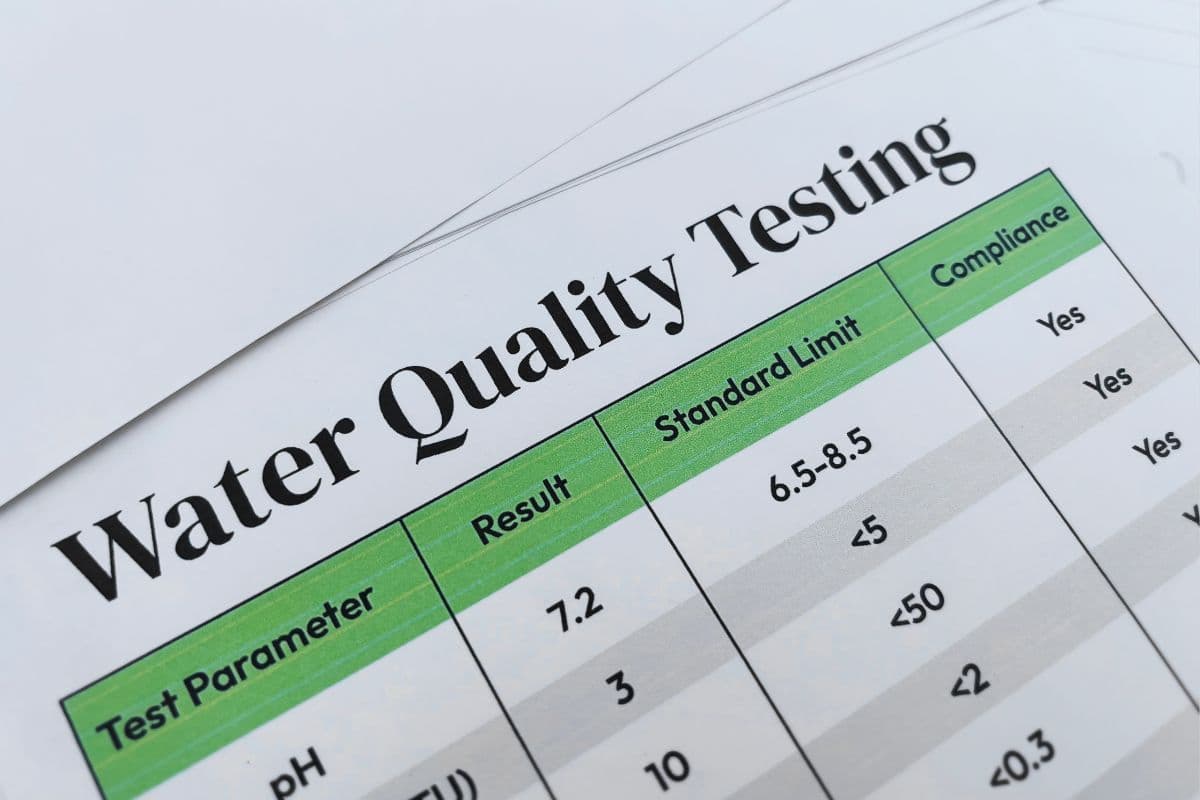
Test your well water every year at minimum for total coliform bacteria, E. coli, nitrates, pH, and total dissolved solids. Use a state-certified laboratory — not home test strips — for anything health-related. Bacteria samples must reach the lab within 24 hours of collection, kept cold. Lead samples must be collected before flushing — first draw only. Do not rinse the sterile bottle or touch the inside of the cap. If your results show any E. coli, stop drinking the water immediately and call a well contractor. If you have not tested in the past year and you are reading this, that is your sign to do it this week.
The EPA rules that protect public water systems do not apply to private wells. No government agency monitors, tests, or treats water from your well. That responsibility belongs entirely to you as the well owner. The CDC recommends annual testing as the minimum. The USGS has found that roughly one in four private wells contains at least one contaminant at an unsafe level. Most of those homeowners had no idea.
The stakes are higher than most people realize because the most dangerous contaminants — bacteria, nitrates, arsenic, PFAS — are completely invisible. Your water can look crystal clear, smell fine, and taste normal while containing levels of bacteria that will make an infant seriously ill or arsenic concentrations that increase cancer risk with every glass. There is no substitute for testing.
This guide covers everything a well owner needs to know: what to test for and when, how to find a certified lab, how to collect a sample correctly so the results are valid, how to interpret what comes back, and what to do when something is wrong.
Before You Order Tests: What Obvious Changes in Water Quality Tell You
If your water has recently changed in appearance, smell, or taste, that change can help narrow down what to test for. This does not replace testing — it adds context:
Water that looks, smells, or tastes obviously wrong
Still requires a lab test to identify the cause precisely, but some problems give immediate clues. Brown or orange water typically means iron or manganese. Rotten egg smell means hydrogen sulfide — see our well water sulfur smell guide. Blue-green staining on fixtures means corrosive, low-pH water dissolving copper pipes. Cloudy white water that clears from the bottom up when you fill a glass is usually dissolved air — harmless. Cloudy water that does not clear is a concern and warrants an immediate test.
You just moved into a home with a well
Test immediately and comprehensively before drawing conclusions about water quality. Previous owner test results from more than a year ago tell you very little about current conditions.
Your water has tested fine for years
Annual testing is still mandatory. Groundwater conditions change. Septic systems age and develop leaks. Agricultural activity shifts. New construction upgrades the local drainage pattern. A well that tested clean in 2021 may not be clean today.
What to Test For and When: The Annual Testing Schedule
The Baseline Four: Test Every Year
The CDC and EPA both recommend testing these four parameters at a minimum every year for every private well:
Total coliform bacteria
The broadest indicator of contamination pathways. Coliform bacteria are found in soil, surface water, and animal waste. Their presence in a well does not necessarily mean the water will make you sick, but it means a pathway exists for contamination to enter the well. Any positive result requires immediate follow-up.
E. coli
A specific coliform that comes only from fecal matter (human or animal). Any detection of E. coli in drinking water is a serious health emergency. Stop drinking the water immediately and contact your county health department and a licensed well contractor. There is no safe level of E. coli in drinking water.
Nitrates
Enter groundwater from fertilizer runoff, septic system effluent, livestock waste, and decaying organic matter. The EPA maximum contaminant level for nitrates is 10 mg/L. Concentrations above this level are particularly dangerous for infants under six months — high nitrate levels cause methemoglobinemia, known as blue baby syndrome, which reduces the blood's ability to carry oxygen and can be fatal. Pregnant women and immunocompromised individuals are also at elevated risk.
pH
Measures whether your water is acidic or alkaline on a scale of 0 to 14. The EPA recommends 6.5 to 8.5 for drinking water. Low pH (acidic water) is corrosive — it leaches lead and copper from plumbing, causes blue-green staining on fixtures and sinks, and can damage water heaters and appliances. Many wells in the Northeast and Mid-Atlantic have naturally low pH. High pH is less common but can cause scaling and bitter taste. pH is a cheap test that provides important context for everything else in your water.
Total dissolved solids (TDS)
A general measure of the total concentration of dissolved minerals, metals, salts, and compounds in the water. The EPA secondary guideline is 500 mg/L. TDS above this level does not necessarily indicate a health problem, but it signals that mineral content is high enough to affect taste, create scale buildup, and potentially stress water treatment equipment.
Extended Testing: Every Three to Five Years
Beyond the annual baseline, the EPA recommends more comprehensive testing every three to five years. These parameters do not change as rapidly as bacterial contamination, but they need periodic baseline documentation:
Hardness
The concentration of calcium and magnesium. Hard water (above 120 mg/L) causes scale buildup in pipes, water heaters, and appliances. It dramatically reduces the effectiveness of soaps and detergents. Not a health risk but a significant quality-of-life and equipment-life issue. Knowing your hardness level tells you whether a water softener makes sense.
Iron and manganese
Natural groundwater minerals that cause staining (red-orange from iron, black-brown from manganese), clogging of well screens and pipes, and bitter or metallic taste. The EPA secondary standard for iron is 0.3 mg/L. For manganese the secondary standard is 0.05 mg/L — but new research has linked manganese exposure above 0.1 mg/L to neurological effects in children, making this one worth testing even if your water does not stain.
Arsenic
A naturally occurring carcinogen found in certain rock formations, particularly in the Northeast, Southwest, and Midwest. The EPA MCL is 10 micrograms per liter (10 ppb). Long-term exposure above this level is associated with bladder, lung, and skin cancers. Arsenic is completely invisible in water — no color, no smell, no taste. Wells in New England, parts of the Southwest, and the Upper Midwest have elevated natural arsenic more frequently than other regions, but arsenic can appear in any geology.
Lead
Does not come from the aquifer in most cases. Lead in well water typically comes from lead solder in older plumbing (pre-1986 homes), lead service lines, or brass fittings. The EPA action level is 15 ppb, but the EPA's own MCLG (the health goal) is zero — there is no safe level of lead exposure for children. Lead testing requires a specific "first draw" collection method — see the sample collection section below.
Radon
A naturally occurring radioactive gas that dissolves into groundwater from uranium-bearing rock. Particularly common in granite regions of New England, the Appalachians, and parts of the Southeast. The EPA has not set a final MCL for radon in drinking water, but the proposed standard is 300 picocuries per liter (pCi/L) with an alternative of 4,000 pCi/L if states implement programs to address airborne radon. Radon dissolved in well water is released into indoor air when you shower or run the tap — ingestion risk is real but inhalation from water releases is also a concern.
Arsenic testing deserves special attention among well water tests because arsenic has no taste, smell, or color and home test kits cannot reliably detect it at dangerous levels. Always use a certified laboratory test for arsenic rather than a home test strip. For a complete guide to testing for arsenic specifically, including how to interpret results and the arsenic III vs arsenic V distinction that matters for treatment selection, see our dedicated article on arsenic in well water.
PFAS: Test at Least Once, Then Based on Risk
PFAS (per- and polyfluoroalkyl substances) are man-made chemicals used in industrial processes, food packaging, firefighting foam, and many consumer products since the 1940s. They are called "forever chemicals" because they do not break down in the environment. In April 2024, the EPA set enforceable maximum contaminant levels for six PFAS compounds in public water systems — the first federal regulation of PFAS in drinking water. PFOA and PFOS are regulated at 4 parts per trillion (ppt), individually. Private wells are not regulated, but the same health-based thresholds apply as guidance.
A 2025 USGS study found that PFAS were detectable in groundwater samples from across the country, with higher concentrations near military bases, industrial facilities, airports, and areas where firefighting foam has been used. PFAS have also been detected in agricultural areas where PFAS-containing biosolids (sewage sludge) have been applied as fertilizer.
Test for PFAS at least once as a baseline. Test annually if you live within 10 miles of a military installation, airport, industrial facility, or agricultural area known to use biosolid application. Your county health department or state environmental agency may have local PFAS groundwater data that can tell you whether your area is a higher-risk zone before you spend money on testing.
PFAS testing requires a specialized lab and specific sample containers — not all certified labs offer it. Request specifically "PFAS in drinking water by EPA Method 533 or 537.1" when contacting labs.
When to Test Immediately — Outside the Annual Schedule
Test your well right away, regardless of when you last tested, after any of these events:
Flooding
Any flood that reaches the wellhead or the area surrounding the well. Floodwater carries surface contamination directly into the wellhead, casing, and potentially the well itself. Test for bacteria and nitrates before resuming normal use after any flood event. Do not turn the pump back on until the well has been inspected.
Pump replacement or any well repair
Opening the well for any maintenance introduces potential contamination from tools, hands, new components, and atmospheric exposure. Test for total coliform and E. coli after any well work, after allowing the system to run for 24 hours.
New septic system nearby or evidence of septic failure
Failing septic systems are a leading source of coliform bacteria and nitrate contamination in private wells. If a neighbor installs a new septic system within 100 feet of your well, or if you notice sewage odors or unusually lush green patches in your yard near the septic field, test immediately.
Moving into a home with an existing well
Previous owner test results may be outdated, fabricated, or limited in scope. Test comprehensively before concluding the water is safe.
New baby or pregnancy
Nitrates are acutely dangerous for infants under six months. Test specifically for nitrates when pregnant and again before feeding formula to a newborn.
Sudden change in taste, odor, or appearance
A well that ran clean for years and then develops a new smell, taste, or color is signaling something has changed. Test immediately and do not assume the change is harmless.
New industrial or agricultural activity nearby
A new industrial facility, a change in nearby land use, or the beginning of agricultural chemical application on adjacent land can all shift local groundwater chemistry. Test within a season of any significant nearby land use change.
Drought followed by heavy rainfall
Extended drought concentrates contaminants in the remaining water column. The first heavy rains after drought flush surface contaminants into shallow wells. Test after this pattern.
Home Test Kits vs Certified Lab: Which One Do You Need
This is the question most people get wrong, and the answer has real consequences.
Home Test Strips and DIY Kits
Home test kits — the color-changing strips sold at hardware stores and online — are suitable for one narrow use case: quick monitoring between annual lab tests for parameters like pH, hardness, iron, and chlorine. They are not suitable for any health-critical decision.
What home strips cannot do:
- Detect bacteria reliably. Strip-based bacteria tests have high false-negative rates and are not accepted by any health authority as confirmation that water is safe to drink.
- Detect PFAS, arsenic, lead, radon, or VOCs at health-relevant concentrations.
- Detect nitrates accurately at low concentrations — the range that matters most for infant safety (5 to 10 mg/L) is often below the reliable detection range of consumer strips.
- Produce results that are consistent — results vary with water temperature, mineral content, and the technique of the person running the test.
When home strips are appropriate:
Checking whether your iron filter is working between annual tests. Monitoring pH after installing an acid neutralizer. Checking chlorine residual after shock chlorinating the well. Screening for gross changes in water chemistry that would prompt you to order a lab test.
Certified Laboratory Testing
A state-certified laboratory uses validated analytical methods, calibrated instruments, and accredited quality control procedures. Results from a certified lab are legally defensible, accepted by health departments, and accurate to the precision relevant for health decisions.
Mail-in lab kits
Tap Score from SimpleLab is one of the most convenient options for most well owners. You order the test package, receive sterile sample containers and detailed collection instructions, collect and ship the samples, and receive results within 5 to 14 business days. Their well water packages cover bacteria, nitrates, heavy metals, and other parameters appropriate for private wells and include plain-English interpretation of results.
State and county health department labs
Often offer basic bacterial and nitrate testing at low or no cost for private well owners. Contact your county health department first — many offer free annual testing or heavily subsidized testing and can provide sample containers and collection instructions specific to their lab's requirements.
Local certified labs
Delivering samples in person is the best option for bacteria testing because of the 24-hour delivery requirement. Find labs in your state through the EPA certified laboratory directory.
What Well Water Testing Costs
| Test Type | What It Covers | Typical Cost | Best Source |
|---|---|---|---|
| Basic bacteria + nitrates | Total coliform, E. coli, nitrates | Free to $50 | County health department |
| Annual baseline panel | Bacteria, nitrates, pH, TDS, hardness | $50 to $120 | Health dept or mail-in lab |
| Comprehensive metals panel | Above plus arsenic, lead, iron, manganese, copper | $150 to $300 | Certified mail-in lab |
| PFAS only | 6 to 40 PFAS compounds by EPA Method 533 or 537.1 | $150 to $300 | Specialized certified lab |
| Full well water panel | Bacteria, metals, PFAS, VOCs, radiologicals | $300 to $500 | Mail-in certified lab |
| VOCs and pesticides | Volatile organic compounds, agricultural chemicals | $100 to $250 | Certified lab |
Some states offer free or subsidized comprehensive testing for private well owners — check with your state department of health before spending money. Many county health departments offer basic annual testing at no charge. The well water testing cost guide covers pricing in detail, including how to find free testing programs in your state.
How to Collect a Water Sample Correctly
Sample collection is where most homeowners make mistakes that invalidate their results. An improperly collected sample can produce a false positive (causing unnecessary alarm and expense) or a false negative (falsely reassuring you that your water is safe). Follow these steps precisely.
Three Things That Will Invalidate Your Bacteria Sample Before You Even Begin
Read these before touching anything. These are the mistakes most likely to ruin the test:
Do not rinse the bacteria bottle. The bottle contains sodium thiosulfate — a white powder or tablet — that neutralizes chlorine and protects the sample. Rinsing removes it and the test is worthless. The bottle should be used exactly as received.
Do not touch the inside of the cap or bottle opening. Bacteria live on your skin. A single touch of a finger to the inside of the cap introduces contamination. Hold the cap by its outside edges only, with the inside facing down, for the entire time it is off the bottle.
Deliver the sample within 24 hours, kept cold. Bacteria multiply or die at room temperature, changing the count. A sample older than 30 hours is rejected by most labs. Collect on a Tuesday, Wednesday, or Thursday so it reaches the lab before the weekend.
Everything else is detail. If you remember only these three rules, your bacteria sample will be valid.
Before You Start
Order your test kit from a certified lab and use only the bottles they provide. The containers are pre-sterilized and may contain a preservative (sodium thiosulfate, a white powder or tablet inside the bacteria bottle). That preservative neutralizes chlorine and protects the sample integrity. Do not rinse the bottle. Do not remove or disturb the preservative. Using any other container will invalidate the test.
Plan your collection day carefully. Bacteria samples must reach the lab within 24 to 30 hours of collection, kept cold (but not frozen) during transport. This means you must collect on a day when you can deliver the sample or ship it with overnight service. Most labs do not accept bacteria samples that arrive on weekends or holidays — collect Tuesday through Thursday if shipping, or call ahead if hand-delivering. Do not collect late on a Friday.
Collecting the Bacteria (Total Coliform and E. coli) Sample
This is the most contamination-sensitive collection of any standard water test. Follow every step.
Step 1: Select the right faucet. Choose a cold-water tap you use regularly for drinking — typically the kitchen cold tap. Do not sample from a tap with an aerator attached, a point-of-use filter, or a touchless sensor tap. Remove the aerator before sampling.
Step 2: Wipe the faucet opening. Use a clean cloth or alcohol wipe to clean the outside of the faucet opening. Some labs recommend briefly flaming the tap opening with a lighter to sterilize it — check your lab's instructions before doing this.
Step 3: Flush the line. Run the cold water for five minutes at full flow. This draws fresh water from the well and clears standing water from the household pipes. Reducing flush time is the most common collection mistake.
Step 4: Reduce the flow to a gentle stream, about pencil width. Turbulent flow can splash bacteria from the faucet surface into the sample.
Step 5: Open the sterile bottle. Hold it in one hand. With the other hand, twist off the cap but do not set the cap down on any surface. Hold the cap with your fingers, with the inside of the cap facing down. Do not touch the inside of the cap with your fingers. Do not touch the inside of the bottle opening. Do not let the bottle touch the faucet.
Step 6: Fill the bottle to the indicated line — typically 100 mL. Do not overfill and do not underfill. Do not rinse the bottle first.
Step 7: Cap immediately and tightly.
Step 8: Label the bottle with your name, date, time, and sample location (for example: "kitchen cold tap").
Step 9: Keep cold. Place the sample in a cooler with ice packs (not frozen ice that may crack the bottle). Deliver to the lab or ship with overnight service within 24 hours.
Collecting the Lead Sample: First Draw Only
Lead testing requires a completely different approach. Lead accumulates in water that has been sitting in pipes — particularly in lead solder joints, lead service lines, or brass fittings. To capture this lead exposure, you need a "first draw" sample: water that has been sitting in the pipes for at least six hours without any water use.
Step 1: Do not use any water from the test tap for at least six hours before collecting. The best time is first thing in the morning before anyone runs any water.
Step 2: Collect the first water that comes out of the tap without flushing. This is the standing water that has been in contact with your plumbing the longest.
Step 3: Use the bottle provided by the lab for lead testing — it is a different container from the bacteria bottle, usually smaller and with a different preservative.
Step 4: Fill to the indicated line and cap. Ship or deliver to the lab promptly.
Note: A lead test from a flushed sample will often show zero or very low lead even in a home with lead plumbing, because flushing removes the standing water where leaching has occurred. The first-draw method captures the actual exposure your household is experiencing.
Collecting the Nitrate and Chemical Sample
For nitrate and most chemical tests, the procedure is simpler than bacteria collection:
- Flush the tap for five minutes (if you already collected the bacteria sample, skip the flush — the water is already fresh from the well).
- Rinse the chemical sample bottle three times with tap water before filling. This is the opposite of the bacteria bottle — rinsing is required here to displace any residue.
- Fill to the top and cap tightly.
- Chemical samples are less time-sensitive than bacteria samples but should still be kept cool and delivered within the lab's specified holding time. Chemical sample holding times range from 24 hours to several weeks depending on the parameter.
Common Mistakes That Invalidate Results
- Rinsing the bacteria bottle (the preservative inside is destroyed)
- Touching the inside of the cap or bottle with bare hands
- Collecting from a filtered tap, softener output, or refrigerator water line (these reflect treatment, not the well)
- Not flushing for the full five minutes before the bacteria sample
- Delivering a bacteria sample more than 24 to 30 hours after collection
- Collecting the lead sample after flushing (misses the actual lead exposure)
- Collecting on a Friday when the sample cannot reach the lab before the weekend
How to Find a Certified Lab in Your State
Option 1: Your county health department
Call your county health department and ask whether they offer well water testing for private wells. Many counties provide free or low-cost basic testing (bacteria and nitrates) and will supply you with sample bottles and collection instructions at no charge. This is the best starting point before spending money on a commercial lab.
Option 2: EPA certified laboratory directory
The EPA maintains a searchable directory of state-certified drinking water laboratories at epa.gov/dwlabcert. Search by state to find labs certified to perform the specific tests you need. For PFAS testing, look specifically for labs certified for EPA Method 533 or EPA Method 537.1.
Option 3: Mail-in certified lab services
Tap Score (SimpleLab) is one of the most widely recommended national mail-in services for private well owners. Their Well Water Test packages are priced by scope — starting with basic bacteria and common parameters and scaling up to comprehensive panels including metals, PFAS, and VOCs. SimpleLab uses EPA, NELAC, and state-certified laboratories and provides detailed, plain-English reports with specific treatment recommendations.
Option 4: Your state's department of health or environment
Most state environmental or health agency websites maintain lists of certified labs in the state, along with information on any free or subsidized testing programs for private well owners. Some states offer free comprehensive testing in certain regions based on known groundwater issues.
How to Read Your Results: What Every Number Means
When your results arrive, the report will list each parameter tested, your result, and a reference value or maximum contaminant level. Here is how to read the critical ones.
Bacteria Results
Bacteria results are reported as Present or Absent (for E. coli and total coliform) or as colony-forming units per 100 milliliters (CFU/100 mL).
Total coliform — Absent: No concern. File the result and retest next year.
Total coliform — Present (with E. coli Absent): Coliform bacteria have entered the well. The source is likely surface water infiltration, a compromised well cap, or nearby agricultural runoff. Shock chlorinate the well and retest. If total coliform is present on a retest after chlorination, have a licensed well contractor inspect the casing and cap for structural issues.
E. coli — Present: Stop using the water for drinking and cooking immediately. Use bottled water. Contact your county health department. Have a licensed well contractor inspect the well and perform shock chlorination. Retest after chlorination — do not resume drinking the water until a lab test confirms E. coli is absent. Any presence of E. coli indicates fecal contamination and represents an immediate health risk.
Nitrate Results
Nitrate is reported in mg/L (milligrams per liter, equivalent to parts per million). Note that some labs report nitrate as nitrogen (NO3-N) while others report total nitrate (NO3). The EPA's 10 mg/L limit is for nitrate-nitrogen (NO3-N). If your result is reported as total nitrate (NO3), the equivalent limit is 44 mg/L. If you are unsure how your lab is reporting nitrate, call them and ask — this is a normal question.
Below 5 mg/L: Low. No action needed.
5 to 10 mg/L: Elevated. The source is likely nearby — septic system, agricultural runoff, or livestock. Do not use for infant formula. Test quarterly and investigate potential sources.
Above 10 mg/L: Exceeds EPA limit. Do not use for infant formula, cooking infant food, or drinking by infants under six months. Use bottled water or a certified reverse osmosis system for infant use. Install point-of-use treatment — reverse osmosis or distillation — for the tap used for drinking and cooking. Boiling does not remove nitrates and actually concentrates them as water evaporates.
pH Results
6.5 to 8.5: Normal range. No action needed.
Below 6.5: Corrosive water. Likely dissolving lead or copper from plumbing. Test for lead, copper, and iron alongside pH. Consider an acid neutralizer (calcite filter) to raise pH into the safe range.
Above 8.5: Alkaline. Usually not a health concern but can cause bitter taste and scale. Consult a water treatment professional if above 9.0.
Lead Results
Lead is reported in micrograms per liter (µg/L), also written as parts per billion (ppb). The EPA action level is 15 µg/L for public water systems. The EPA health goal (MCLG) is zero — there is no safe exposure level for children.
Below 5 µg/L: Low. Monitor periodically.
5 to 15 µg/L: Elevated. Run the tap for 30 to 60 seconds before using water for drinking or cooking to flush standing water. Consider replacing lead solder connections if your home was built before 1986.
Above 15 µg/L: Action required. Use certified point-of-use treatment (NSF/ANSI 58 certified reverse osmosis or NSF/ANSI 53 certified filter) for all drinking and cooking water. Do not use unfiltered water for infant formula, drinking, or cooking. Investigate the source — likely old plumbing rather than the well itself.
Arsenic Results
Arsenic is reported in micrograms per liter (µg/L) or parts per billion (ppb). The EPA MCL is 10 µg/L.
Below 5 µg/L: Low. Retest every three to five years.
5 to 10 µg/L: Approaching the limit. Increase testing frequency to annually. Consider certified treatment.
Above 10 µg/L: Exceeds EPA limit. Install certified arsenic treatment — point-of-use reverse osmosis, distillation, or a whole-house arsenic-specific filter. Use treated water for all drinking and cooking. Long-term exposure above the MCL is linked to bladder, lung, and skin cancers.
Quick Reference: Results at a Glance
| Parameter | Safe Level | Concern Level | If Over Limit: Do This |
|---|---|---|---|
| Total coliform | Absent | Present | Shock chlorinate well; retest within 1 to 2 weeks |
| E. coli | Absent | Any detection | Stop drinking immediately; call county health dept and well contractor same day |
| Nitrates | Below 5 mg/L | Above 10 mg/L | No tap water for infants; install point-of-use RO; test quarterly |
| pH | 6.5 to 8.5 | Below 6.5 | Test for lead and copper; install acid neutralizer (calcite filter) |
| Lead | Below 5 µg/L | Above 15 µg/L | Install NSF/ANSI 53 certified filter; flush tap 60 sec before use |
| Arsenic | Below 5 µg/L | Above 10 µg/L | Install NSF/ANSI 58 certified RO; do not boil (concentrates arsenic) |
| Iron | Below 0.3 mg/L | Above 0.3 mg/L | Install iron filter; aesthetic issue but accelerates appliance wear |
| Manganese | Below 0.05 mg/L | Above 0.05 mg/L | Install oxidizing filter; above 0.1 mg/L is neurological concern for children |
| TDS | Below 500 mg/L | Above 1,000 mg/L | Identify dominant mineral; comprehensive retest for metals and hardness |
| PFAS (PFOA/PFOS) | Below 4 ppt | Above 4 ppt | Install NSF/ANSI 58 certified RO or NSF 177 certified carbon block |
What to Do When Something Comes Back Wrong
E. coli detected
Stop using the water for drinking, cooking, and baby formula immediately. Use bottled water. Call your county health department the same day. Contact a licensed well contractor to inspect the well casing and cap for structural compromise and perform shock chlorination. Retest with a certified lab 24 to 48 hours after shock chlorination is complete and the well is flushed. Do not resume drinking the water until a post-treatment test confirms absence. If E. coli returns on the second test, there is a structural problem allowing continuous contamination — the well cap, casing, or pitless adapter needs professional inspection and likely repair or replacement.
Nitrates above 10 mg/L
Do not panic but do act immediately if infants or pregnant women are in the household. Use bottled water or certified point-of-use reverse osmosis for drinking and cooking. Investigate the source — septic system proximity, nearby agriculture, livestock. Nitrate contamination often fluctuates seasonally (higher after fertilizer application and spring rains). Test quarterly to understand the pattern.
Arsenic above 10 µg/L
Use certified treatment immediately for drinking and cooking water. Reverse osmosis certified to NSF/ANSI Standard 58 is effective. Arsenic cannot be removed by boiling, carbon filters, or standard sediment filters. This is a long-term health concern requiring a permanent treatment solution.
Lead above 15 µg/L
The source is almost certainly your home's plumbing rather than the aquifer. Flush the tap for 60 seconds before any use of water for drinking or cooking. Install a certified point-of-use filter (NSF/ANSI 53 for lead reduction). Test again using the first-draw protocol to confirm the level.
Total coliform present without E. coli
Shock chlorinate and retest. If a second test is positive after chlorination, have the well professionally inspected for casing or cap issues that allow surface water entry.
Results you cannot interpret
Call the lab directly. Lab scientists are available to explain results and standard interpretation is part of the service at most certified labs. Your county health department is also a resource — they interpret private well results regularly and can guide you on next steps specific to your location and water chemistry.
Frequently Asked Questions
How often should I test my well water?+
What is the most important thing to test for in well water?+
Can I use a home test kit for my annual well water test?+
How do I find a certified lab to test my well water?+
Why does my bacteria sample have to arrive at the lab within 24 hours?+
What does a positive coliform test mean?+
Should I test my well water for PFAS?+
Does boiling water remove nitrates or other chemical contaminants?+
Glossary
Maximum Contaminant Level (MCL)
The highest level of a contaminant that the EPA allows in public drinking water systems. MCLs are legally enforceable for public systems. Private well water is not regulated, but EPA MCLs serve as the primary health-based reference points for evaluating private well test results. MCLs are set as close to health goals as is technically and economically feasible.
Total Coliform Bacteria
A broad group of bacteria found in soil, surface water, and animal and human intestines. In drinking water testing, total coliform serves as an indicator organism — their presence signals a pathway for contamination to enter the well rather than a direct health threat. Any positive total coliform result requires follow-up testing for E. coli and likely remediation.
E. coli
A specific coliform bacterium that originates only from fecal matter. Any detection of E. coli in drinking water indicates fecal contamination and represents an immediate health risk. The EPA health goal for E. coli in public drinking water is zero. E. coli detection requires stopping water use for drinking and cooking immediately and contacting health authorities.
Nitrate-Nitrogen (NO3-N)
The form in which many labs report nitrate results. The EPA MCL of 10 mg/L applies to nitrate-nitrogen. If a lab reports nitrate as total nitrate (NO3), the equivalent limit is 44 mg/L. Confirm with your lab which form they are reporting to interpret results correctly.
First Draw Sample
A water sample collected from water that has been sitting in the plumbing for at least six hours without use. Used specifically for lead testing because lead accumulates in standing water through contact with lead solder, service lines, and brass fittings. A flushed sample will typically show lower lead levels and misrepresents actual daily exposure.
PFAS (Per- and Polyfluoroalkyl Substances)
A group of more than 7,000 man-made chemicals that have been used in industrial and commercial applications since the 1940s. PFAS do not break down in the environment, accumulate in human tissue, and are linked to cancer, immune disruption, reproductive harm, and developmental effects in children. In April 2024, the EPA set MCLs for six PFAS compounds at 4 parts per trillion (ppt) for PFOA and PFOS individually.
Certified Laboratory
A laboratory that has been certified by the state or by a recognized accreditation body (NELAC/TNI) to perform specific drinking water analyses using validated methods. State certification ensures that a lab's procedures, equipment, and quality controls meet the standards required for results to be used in health and regulatory decisions. The EPA maintains a directory of state-certified drinking water laboratories at epa.gov/dwlabcert.
Sodium Thiosulfate
A chemical preservative included in sterile bacteria sample bottles as a white powder or tablet. It neutralizes chlorine, which can kill bacteria in the sample and produce a false-negative result. Do not rinse the bottle before collecting a bacteria sample — the sodium thiosulfate must remain in the bottle to protect sample integrity.
Related Guides
Get Expert Well Help
Connect with qualified well professionals in your area. Free quotes, no obligation.
Get Homeowner Tips in Your Inbox
Well maintenance tips, water quality guides, and seasonal reminders from The Well Guide. Free to your inbox.
By subscribing you agree to receive emails from The Home Guide Network. We respect your privacy. Unsubscribe anytime. Privacy Policy