Quick answer:
A standard well inspection costs $250 to $550 for most residential wells in 2026. Add water testing and the total runs $350 to $800. A combined well and septic inspection costs $400 to $900. The biggest cost variable is how much water testing is included. A basic visual inspection with flow rate testing costs $150 to $300, while a comprehensive inspection with full lab water testing costs $400 to $800. FHA and VA loans require a well inspection before closing. Even if your lender does not require one, skipping a well inspection when buying a home with a well is one of the most expensive mistakes a homebuyer makes.
You are buying a house. The listing mentions a private well. Your agent says the inspection is optional. Your lender says it is required. The seller says the well has never had a problem. The inspector's quote is $450 and you are already stretched on closing costs.
This is the moment most well inspection mistakes happen.
A well that looks fine can have bacteria in the water, a pump that is three months from failure, a pressure tank with a waterlogged bladder, or a casing crack that allows surface runoff to contaminate the water supply. None of these show up in a standard home inspection. None of them are visible without specific equipment and tests. And all of them cost significantly more to fix after closing than the $450 inspection costs before it.
This guide covers exactly what a well inspection includes, what it costs broken down by type, what add-ons are worth paying for, and when an inspection is not optional regardless of what your agent says.
The Pre-Purchase Rule
Before getting into costs, establish this principle: The Pre-Purchase Rule: if you are buying a home with a private well, a professional well inspection is not optional. It is the single most important inspection on the property.
A standard home inspector is not trained or equipped to assess a well system. They look at visible components and note obvious problems. They do not pull pump performance data, test flow rate under load, check water quality at a certified lab, or evaluate the condition of a submersible pump that is 200 feet underground. That requires a licensed well contractor or water systems professional with specific equipment.
The cost of fixing a contaminated well, replacing a failed pump, or drilling a new well after closing ranges from $1,500 to $15,000 or more. A well inspection costs $250 to $550. The math is straightforward.
What a Well Inspection Includes
A standard professional well inspection covers five components. Understanding what each involves helps you evaluate what your inspector is actually doing and whether the price is reasonable.
A well inspection performed by a licensed water systems professional is different from a well mention in a standard home inspection report. If your home inspection report simply says "well present, no visible issues," you have not had a well inspection. You have had a home inspector look at the wellhead from a distance. Schedule a dedicated well inspection with a licensed well contractor before closing.
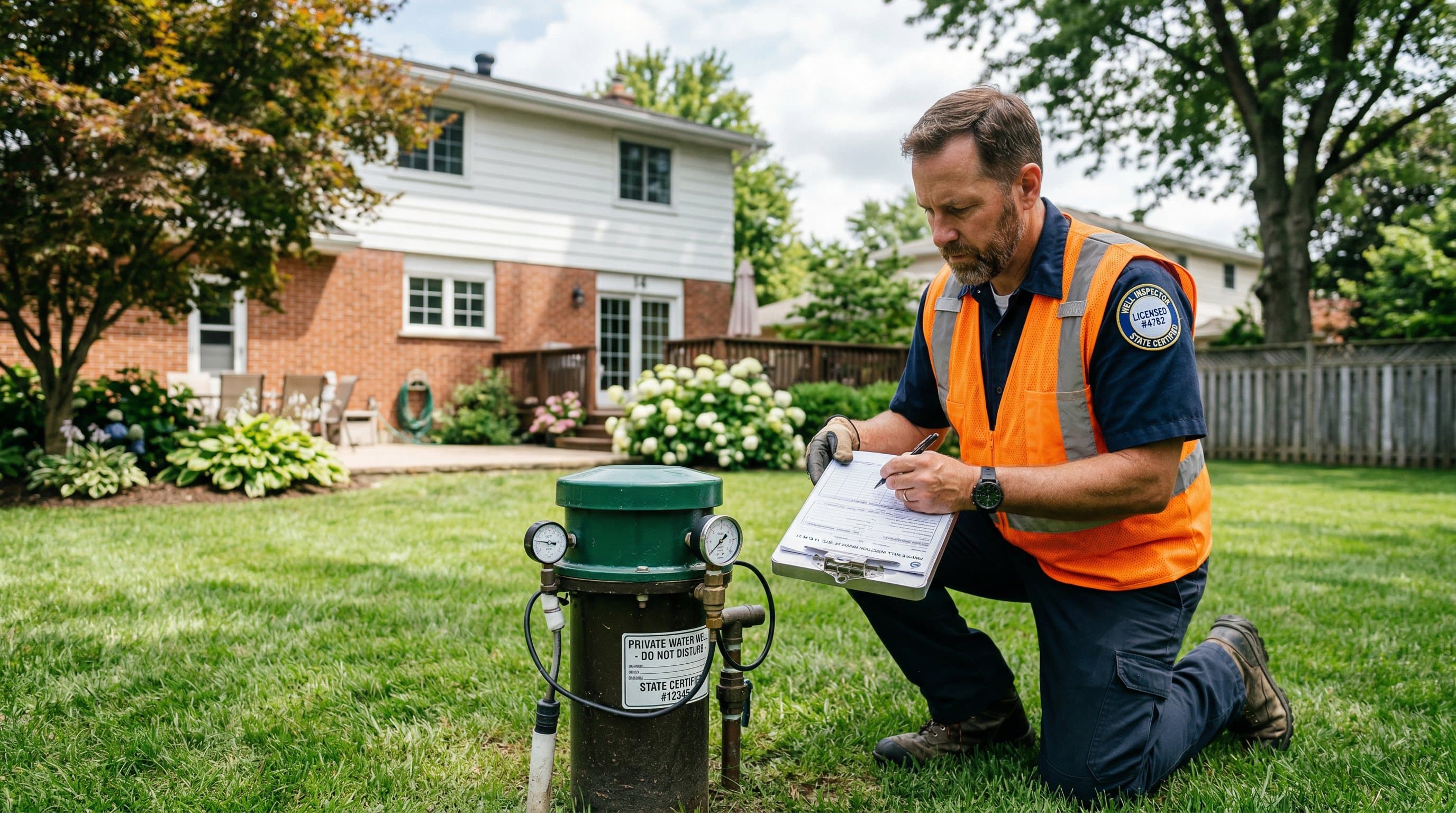
Visual inspection of the wellhead: The inspector examines the well casing above ground for damage, corrosion, or improper sealing. The well cap should be intact with no cracks or gaps. The area around the wellhead should slope away from the casing and be free of contamination sources. The casing itself should be above grade with no signs of surface water intrusion.
Pressure system evaluation: The pressure tank, pressure switch, and associated plumbing are checked for proper operation. The inspector tests the pump cycling behavior, including how often it starts and stops, how quickly pressure builds and drops, to identify waterlogged tanks, failing pressure switches, or pumps that are short cycling or running continuously.
Flow rate testing: The inspector runs water at multiple fixtures simultaneously and measures the gallons per minute the well delivers under load. Most households require a minimum of 3 to 5 GPM for adequate function. FHA and VA loan programs require a minimum flow rate of 3 to 5 GPM depending on the number of bedrooms. A well that cannot meet minimum flow rate may require pump replacement, well rehabilitation, or in worst cases, a new well.
Electrical components: The pump circuit, pressure switch wiring, and control box are checked for proper function, correct amperage draw, and any signs of electrical problems that could indicate a pump running in distress.
Water quality testing: This is where inspection costs vary most significantly. Basic inspections include a visual assessment of water color, odor, and clarity. Comprehensive inspections include laboratory water testing for bacteria, nitrates, and other contaminants. Lab results typically take 3 to 7 business days and are the only reliable way to know whether the water is safe to drink.
Well Inspection Cost by Type
| Inspection Type | What Is Included | Typical Cost |
|---|---|---|
| Basic visual inspection | Wellhead, cap, visible components only | $150 to $250 |
| Standard inspection | Visual plus flow rate test and pressure system evaluation | $250 to $400 |
| Standard with basic water testing | Above plus bacteria and nitrate lab test | $350 to $550 |
| Comprehensive inspection | All of the above plus extended water panel (heavy metals, VOCs, pH) | $500 to $800 |
| Well and septic combined | Standard well inspection plus septic inspection in same visit | $400 to $900 |
| Camera inspection (borehole) | Drops camera into well to inspect casing and screen condition | Add $200 to $500 |
Most homebuyers purchasing a home with a well should budget for a standard inspection with basic water testing, the $350 to $550 range. This covers the minimum components needed to evaluate whether the well is functioning correctly and whether the water is safe.
Water Testing Add-Ons: What Is Worth Paying For
Water testing is sold in panels, which are groups of tests run together at a certified lab. The price increases with the number and complexity of tests included. Here is what to know about each tier:
Basic bacteria and nitrate panel ($50 to $150 added to inspection): The minimum test for any well used for drinking water. Total coliform and E. coli confirm whether pathogenic bacteria are present. Nitrates indicate potential contamination from agricultural runoff or septic systems. Required by FHA and VA loan programs. Worth paying for on any inspection.
Standard water quality panel ($100 to $250 added to inspection): Adds heavy metals (arsenic, lead, iron, manganese), pH, hardness, and turbidity to the basic panel. Recommended for any well being purchased as a primary residence, particularly in areas with known agricultural activity, older homes with galvanized plumbing, or regions with naturally occurring arsenic in groundwater.
Comprehensive panel ($200 to $400 added to inspection): Adds volatile organic compounds (VOCs), pesticides, radon, and a broader suite of metals. Appropriate for wells near industrial sites, agricultural areas with pesticide use, or properties with a history of unknown contamination. Also appropriate for wells that have not been tested in more than five years.
What to test for in your specific area: Contaminants vary by region. Arsenic is a concern in parts of New England, the Southwest, and the upper Midwest. Radon is elevated in granite-heavy regions. Nitrate contamination is most common in agricultural areas. Your local health department or county extension office can tell you which contaminants are most common in your area. See our well water testing guide for a complete breakdown of contaminants by region and what each test result means.
Cost Factors That Move the Price
Well depth: Deeper wells require more time to evaluate and more specialized equipment for flow rate testing. Wells under 100 feet are straightforward to inspect. Wells over 300 feet may require additional equipment and expertise, adding $50 to $150 to the base cost.
Well type: Drilled wells are the most common and most straightforward to inspect. Dug wells (older, shallow wells typically found on historic properties) require more extensive contamination testing because their construction makes them more vulnerable to surface water intrusion. Artesian wells and driven point wells have their own inspection considerations.
Pump type: Submersible pumps are underground and cannot be visually inspected directly. The inspector evaluates pump performance through pressure testing and electrical measurements. Jet pumps are above ground and can be visually inspected, making them faster to evaluate. Submersible pump inspections may cost $50 to $100 more than jet pump inspections.
Location and travel: Inspectors in rural areas often charge a travel fee of $50 to $100 for properties more than 30 to 45 minutes from their service area. This is standard practice and worth asking about when getting quotes.
Age of the system: Older wells with more components to evaluate take longer and may require additional testing. A well installed before 1990 may use older materials that require additional assessment.
Combined inspections: Scheduling a well and septic inspection with the same company on the same visit saves a second trip charge and often results in a bundled price that is less than booking each separately.
When a Well Inspection Is Required vs Recommended
Required by lender: FHA loans require a well inspection that meets minimum standards including flow rate (minimum 3 to 5 GPM depending on bedroom count), bacteria and nitrate testing with results below EPA maximum contaminant levels, and a wellhead that meets minimum distance requirements from septic components. VA loans have similar requirements. USDA loans typically require well inspections for rural properties. Conventional loans do not universally require well inspections but many lenders in rural markets require them as a condition of financing.
Required by state or local regulation: Some states require a well inspection at the time of property transfer. Check with your real estate attorney or local health department to confirm whether your state has mandatory well inspection requirements at closing.
Strongly recommended regardless of requirement:
- Any home purchase where the well is the primary water source
- Any property where the well has not been tested in more than 3 years
- Properties near agricultural land, industrial sites, or gas stations
- Properties with a septic system within 100 feet of the well
- Any property where the seller cannot provide documentation of recent well testing
- Annual inspection for existing well owners as part of routine maintenance
Annual Well Inspection Cost for Existing Owners
If you already own a home with a well, an annual inspection is the most cost-effective maintenance decision you can make.
Annual inspection cost: $150 to $300 for a professional evaluation of the pressure system, wellhead condition, and basic water quality test.
What annual inspections catch:
- Waterlogged pressure tanks before they cause pump short cycling and premature pump failure
- Early signs of pump wear before a complete pump failure
- Changes in water quality that indicate developing contamination
- Wellhead damage from frost heave, settling, or animal activity
A pump replacement costs $1,500 to $4,000. An annual inspection that catches early pump wear costs $150 to $300. The inspection pays for itself if it prevents even one emergency pump replacement.
See our well maintenance checklist for the full annual maintenance schedule beyond the professional inspection.
DIY Well Inspection: What You Can Check Yourself
A licensed professional inspection is not something homeowners should attempt to replace with DIY. But between annual professional visits, there are checks an owner can perform:
Monthly:
- Listen for pump short cycling (rapid on-off cycling when running water)
- Check the pressure gauge for normal 40/60 or 30/50 operation
- Look at the wellhead for visible damage, animal activity, or debris
Annually:
- Test the air charge on the pressure tank using a tire pressure gauge on the Schrader valve with the pump off
- Inspect the wellhead for cracks, gaps, or corrosion
- Order a basic water test kit and test for bacteria and nitrates
DIY water test kits cost $25 to $150 and are available online and at hardware stores. They are appropriate for routine annual monitoring between professional inspections but do not replace a comprehensive lab panel when purchasing a property. See our well water test kit reviews for the best options at each price point.
How to Get an Accurate Quote
Getting accurate quotes for a well inspection requires asking the right questions. Use this framework:
Ask specifically:
- What does the inspection include? (Visual only, flow rate test, pressure evaluation)
- Is water testing included or is it an add-on?
- Which water tests are included and what lab do they use?
- Is the lab state-certified?
- How long until water test results are available?
- Do you charge a travel fee?
- Are you licensed by the state as a water systems professional?
- What is included in the written report?
Get at least two quotes. The difference between the highest and lowest responsible quote on the same scope of work is often $100 to $200. Price differences above that usually reflect differences in what is included, not just labor rates.
Check licensing. Well inspectors should be licensed water well system professionals or licensed well contractors in your state. Licensing requirements vary by state but most states require certification for anyone performing well work. Ask for the inspector's license number and verify it with your state's licensing board before booking.
If the inspection reveals pump failure or imminent pump replacement, use our well pump replacement cost calculator to estimate the replacement project before requesting contractor quotes.
If inspection reveals the well itself has failed (lost yield, corroded casing, contaminated aquifer), use our well drilling cost calculator to estimate the new well replacement project before requesting drilling contractor quotes.
For official EPA guidance on private well water safety, see the EPA: Private Drinking Water Wells.
Frequently Asked Questions
How much does a well inspection cost?
A standard well inspection costs $250 to $550 for most residential properties in 2026. Adding basic water testing (bacteria and nitrates) brings the total to $350 to $550. A comprehensive inspection with a full water quality panel costs $500 to $800. A combined well and septic inspection costs $400 to $900 when booked with the same company on the same visit. The biggest cost variable is how much water testing is included.
Is a well inspection required when buying a home?
FHA and VA loans require a well inspection that meets minimum flow rate and water quality standards before closing. USDA loans typically require well inspections for rural properties. Conventional loans do not universally require well inspections but many lenders in rural markets require them. Even when not required by a lender, a well inspection before purchasing a home with a private well is one of the most important steps a buyer can take. The cost of fixing a failed well after closing ($1,500 to $15,000) far exceeds the cost of the inspection ($250 to $550).
What does a well inspection include?
A standard well inspection includes a visual assessment of the wellhead and casing, flow rate testing to measure water production under load, pressure system evaluation including the pressure tank and switch, electrical component checks, and a written report of findings. Water quality laboratory testing is typically an add-on. A basic panel testing for bacteria and nitrates costs $50 to $150 extra. A comprehensive panel including heavy metals, VOCs, and other contaminants costs $200 to $400 extra.
How long does a well inspection take?
A standard well inspection takes 1 to 3 hours on site depending on well type, depth, and the number of tests performed. Water quality results from a certified lab typically take 3 to 7 business days after the sample is submitted. Plan for at least a week between scheduling the inspection and receiving complete results including water testing.
Can a regular home inspector inspect a well?
A standard home inspector is not trained or equipped to perform a thorough well inspection. Home inspectors assess visible components and may note obvious wellhead issues but do not perform flow rate testing, pump performance evaluation, or water quality laboratory testing. If a home inspection report simply notes "well present" without specific well system testing, you have not had a well inspection. Hire a licensed water systems professional or licensed well contractor for a dedicated well inspection.
How often should a well be inspected?
The EPA and most state health departments recommend annual professional inspection of private wells. At minimum, wells should be inspected every 3 to 5 years and any time there is a change in water quality (taste, odor, color), after flooding or nearby construction, after any work is performed on the well system, and when purchasing a property with a private well. Annual inspections cost $150 to $300 and are the most cost-effective way to prevent expensive emergency repairs.
What happens if a well fails inspection?
A well that fails inspection on flow rate, water quality, or structural grounds can be negotiated as a repair or credit item in a real estate transaction. The seller may be required to remediate contamination, replace a failing pump, or address structural issues before closing. For severe problems such as a failed casing, inadequate yield, or contamination that cannot be cost-effectively remediated, buyers may have grounds to renegotiate price or walk away from the transaction. See our buying a house with a well guide for how to handle well problems discovered during the inspection period.
Who performs well inspections?
Well inspections should be performed by a licensed water well system professional or licensed well contractor. Licensing requirements vary by state but most states require certification for anyone performing well inspections or water testing. Some states allow licensed home inspectors to perform basic well inspections. Ask for the inspector's license number and verify it with your state licensing board. The National Ground Water Association maintains a directory of certified professionals at ngwa.org.
Related Guides
Glossary
Flow Rate
The volume of water a well can produce measured in gallons per minute (GPM). Flow rate is tested by running water at multiple fixtures simultaneously and measuring output over a set period. FHA and VA loan programs require a minimum flow rate of 3 to 5 GPM depending on bedroom count. A well with inadequate flow rate cannot reliably meet household water demand during peak use periods.
Coliform Bacteria
A group of bacteria used as indicators of water contamination. Total coliform bacteria indicate that the water may have been exposed to contamination. E. coli, a specific type of coliform bacteria, indicates fecal contamination and poses direct health risks. Both are tested in basic well water panels and must be absent for FHA and VA loan approval.
Nitrates
A chemical compound found naturally in soil and water that becomes elevated near agricultural land, septic systems, and fertilizer application areas. High nitrate levels in drinking water pose serious health risks, particularly for infants. The EPA maximum contaminant level for nitrates is 10 mg/L. Required testing for FHA and VA loans.
Wellhead
The visible portion of the well casing that extends above ground level. The wellhead should be at least 8 to 12 inches above the surrounding grade to prevent surface water from entering the well. The well cap should be secured and watertight. Visual inspection of the wellhead is the first step in any well inspection.
Well Casing
The cylindrical lining, typically steel or PVC, that lines the drilled hole from the surface to below the water table. The casing prevents the borehole from collapsing, keeps surface contaminants out of the water supply, and houses the drop pipe and pump wire. Casing damage or improper sealing at the surface is one of the most common causes of bacterial contamination in private wells.
Pressure Tank
The storage vessel that maintains water pressure in the home's plumbing system by holding a reserve of pressurized water and air. A functioning pressure tank prevents the pump from cycling on and off every time water is used. A waterlogged pressure tank (bladder failed) causes the pump to short cycle, dramatically reducing pump lifespan. Pressure tank condition is evaluated during every professional well inspection. See our pressure tank replacement cost guide for what replacement involves.
Schrader Valve
The tire-valve-style fitting on top of a bladder pressure tank used to check and set the air charge. With the pump off and all pressure relieved, pressing this valve should release air only. If water comes out, the bladder has failed and the tank needs replacement. A simple test any homeowner can perform between professional inspections.
FHA Minimum Property Standards
The requirements set by the Federal Housing Administration that a private well must meet for a home to qualify for an FHA-insured mortgage. These include a minimum flow rate of 3 to 5 GPM depending on bedroom count, water test results below EPA maximum contaminant levels for bacteria and nitrates, and wellhead distance requirements from septic system components. VA loans have similar minimum property requirements. Non-compliance can delay or prevent closing on a financed purchase.
Water Well Contractor
A licensed professional who drills, repairs, and inspects private water wells. Licensing requirements vary by state but most states require water well contractors to pass an examination and maintain continuing education. Well inspections should be performed by a licensed contractor or a licensed water systems inspector, not a general home inspector.
Get Expert Well Help
Connect with qualified well professionals in your area. Free quotes, no obligation.
Get Homeowner Tips in Your Inbox
Well maintenance tips, water quality guides, and seasonal reminders from The Well Guide. Free to your inbox.
By subscribing you agree to receive emails from The Home Guide Network. We respect your privacy. Unsubscribe anytime. Privacy Policy