Some links on this page are affiliate links. If you purchase through them, we may earn a small commission at no extra cost to you. This does not affect our recommendations.
Quick answer:
Well pump selection comes down to one question before anything else: how deep is your well? Shallow wells under 25 feet use jet pumps mounted above ground. Wells deeper than 25 feet use submersible pumps installed down inside the well casing. Buy the wrong type and the pump either will not pull water at all or will burn out within months.
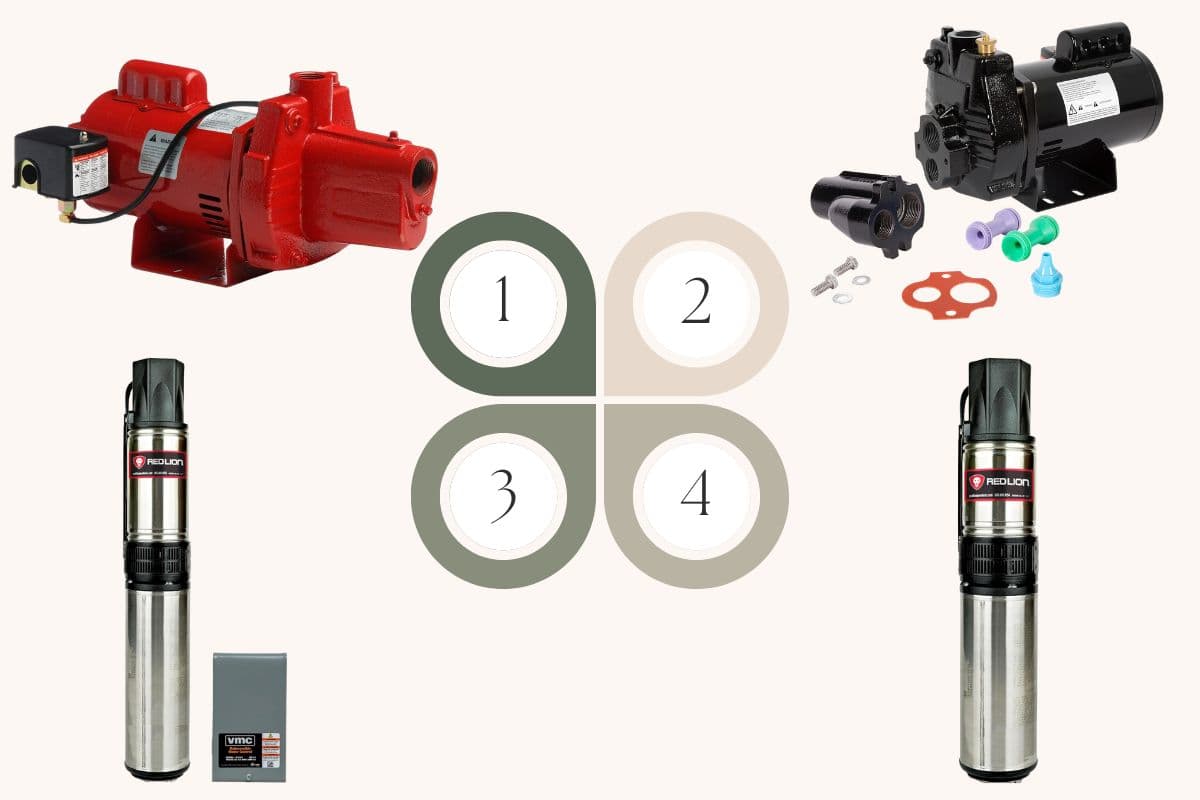
The 4 picks below cover the major buyer segments: the Red Lion RL12G05-2W2V for most homeowners with standard deep wells, the Red Lion RJS-100-PREM for shallow wells, the Red Lion RJC-100 convertible for wells in the 25 to 90 foot range, and the Red Lion RL22G10-3W2V for high-demand deep wells with larger households. For complete installation costs, see the well pump replacement cost guide.
The Depth-First Rule
Before comparing any pumps on price, brand, or specs, determine your well depth from the ground to the static water level. This single measurement decides which type of pump you can use. Wells with water within 25 feet of the surface use shallow well jet pumps mounted above ground. Wells with water deeper than 25 feet require either a submersible pump installed down inside the well casing, or a convertible jet pump (for wells up to about 90 feet).
Buying a shallow well jet pump for a well deeper than 25 feet is one of the most common and most expensive mistakes in well pump purchasing. The pump will run continuously trying to lift water it physically cannot reach, and the motor burns out in weeks. If you do not know your well depth, a well service company will measure it for $50 to $150 before installation. Do this first. Everything else in this guide flows from that one number.
How Well Pumps Actually Work
Most people buy the wrong pump because they ask the wrong first question. The first question is not “which brand is best” or “how much should I spend.” The first question is “how deep is my water,” because the answer determines whether you can use a pump that costs $290 or whether you need one that costs $620, and getting it wrong means a pump that burns out in weeks. Once depth is settled, everything else (flow rate, horsepower, brand, features) becomes a straightforward sizing exercise.
A well pump moves water from an underground aquifer up into your house plumbing. Residential wells use one of two pump types, and the choice is determined by physics, not preference.
Shallow Well Jet Pumps (Wells Up to 25 Feet)
Jet pumps sit above ground, typically in the basement, garage, or a dedicated pump house. A suction pipe runs down into the well casing. The pump uses centrifugal force and a venturi jet to pull water up through the suction pipe. Because water cannot be pulled up more than about 25 feet by atmospheric pressure (this is the physical limit of suction lift at sea level), jet pumps only work for shallow wells.
Advantages: Easy to service (accessible above ground), lower upfront cost, simple to replace without specialized tools. Disadvantages: Limited to shallow wells, requires priming, less energy efficient than submersibles, noisier because the motor is in the living space.
Submersible Pumps (Wells Over 25 Feet, Up to 250+ Feet)
Submersible pumps sit underwater at the bottom of the well casing. The motor and pump body are a sealed unit roughly 3 to 4 inches in diameter and 2 to 4 feet long. Because the pump pushes water up from below rather than pulling it from above, depth is not a physical limit. A submersible in a 250-foot well pushes water up just as reliably as one in a 100-foot well.
Advantages: Works at any residential well depth, more energy efficient, quieter (motor is underground), longer service life. Disadvantages: Harder to service (pump must be pulled up from the well), higher upfront cost, replacement typically requires a contractor with a pump hoist.
Convertible Jet Pumps (Wells Up to 90 Feet)
Convertible jet pumps bridge the gap between shallow and deep well applications. They use a two-pipe system with a foot-valve assembly lowered into the well. Convertible pumps work for wells up to about 90 feet deep and stay above ground like shallow jet pumps. They are less efficient than submersibles for the same depth but easier to service and less expensive to replace.
Advantages: Works for wells between 25 and 90 feet, above-ground serviceability, single pump covers a wide depth range. Disadvantages: Less efficient than a submersible for deeper wells, installation is more complex than shallow jet (requires foot valve and two pipes down the well).
Quick Decision Matrix by Well Depth
| Well Depth | Pump Type | Typical Cost (Pump Only) | Expected Life |
|---|---|---|---|
| 0 to 25 feet | Shallow well jet pump | $290 to $500 | 10 to 15 years |
| 25 to 90 feet | Convertible jet pump | $380 to $700 | 10 to 15 years |
| 90 to 250 feet (4″ casing) | Submersible pump | $370 to $1,400 | 10 to 25 years |
| Over 250 feet | Submersible pump (higher HP) | $800 to $2,500 | 10 to 25 years |
For complete installation cost including labor, wiring, and accessories, see our well pump replacement cost guide.
Sizing Your Well Pump: GPM and Horsepower
After pump type, the next two decisions are flow rate (GPM) and horsepower (HP). Both are determined by how much water your household actually uses, not by what feels like a safer overspend.
GPM Calculation
Flow rate is measured in gallons per minute. For a residential well, calculate your required GPM by counting your home's plumbing fixtures. Each fixture counts as 1 GPM:
- Every bathroom sink
- Every bathtub or shower
- Every toilet
- Every kitchen sink
- Any outside hose bibb that uses well water
- Washing machine
- Dishwasher
A typical 3-bedroom home with 2 bathrooms, a kitchen, a laundry room, and 2 outside faucets totals 10 to 12 fixtures, requiring a 10 to 12 GPM pump. A larger 4-bedroom home with 3 bathrooms and an outdoor irrigation loop may need 15 to 22 GPM. Do not undersize: a pump that cannot keep up with household demand runs constantly and burns out early. Do not massively oversize either: an overpowered pump short-cycles and wears out the pressure tank prematurely (see our guide on well pump short cycling).
Horsepower Sizing
Horsepower needed depends on well depth, not household size. The deeper the well, the higher the HP required to push water to the surface and through the house plumbing at adequate pressure.
| Well Depth | Typical HP Needed |
|---|---|
| Up to 100 feet | 1/2 HP |
| 100 to 200 feet | 3/4 HP |
| 200 to 300 feet | 1 HP |
| 300 to 450 feet | 1.5 HP |
| Over 450 feet | 2 HP or larger |
The depth measurement that matters is “total dynamic head,” which includes the vertical lift plus pressure losses in the pipe plus the required tank pressure (usually 30 to 50 PSI). A well installer or pump supplier can calculate this precisely if you give them your well depth, desired pressure, and pipe size.
Our Top Picks at a Glance
| Pump | Best For | Type | Well Depth | Price Range |
|---|---|---|---|---|
| Red Lion RL12G05-2W2V | Most homeowners with standard deep wells | Submersible, 1/2 HP, 2-wire | Up to 250 ft | $370 to $550 |
| Red Lion RJS-100-PREM | Shallow wells, cabins, budget-conscious buyers | Shallow well jet, 1 HP | Up to 25 ft | $290 to $420 |
| Red Lion RJC-100 | Wells in the 25 to 90 ft range | Convertible jet, 1 HP | 25 to 90 ft | $380 to $520 |
| Red Lion RL22G10-3W2V | Deep wells, larger households, irrigation | Submersible, 1 HP, 3-wire | Up to 300+ ft | $620 to $880 |
The 4 Best Well Pumps
Red Lion RL12G05-2W2V Submersible Deep Well Pump
Best for: Most homeowners with a 4-inch or larger residential well between 50 and 250 feet deep who need reliable, proven hardware at a reasonable price point.
Price: $370 to $550 · Type: Submersible, 1/2 HP, 2-wire · Max depth: 250 feet
Compatibility: Fits 4-inch diameter wells or larger. Rated for depths up to 250 feet. Requires a 230-volt dedicated circuit. NSF/ANSI 372 certified for potable water.
Household size: 2 to 4 people, standard 2-bathroom home with typical fixture count.
Pros: Widely considered the best-selling residential well pump in America for a reason. Stainless steel construction resists corrosion over decades. Built-in check valve prevents backflow and reduces pump cycling. Two-wire design eliminates the need for a separate control box, simplifying installation and reducing failure points. NSF/ANSI 372 potable water certification. Replacement parts are readily available because the pump has been in continuous production for years.
Cons: At 1/2 HP, this pump handles wells up to 250 feet but struggles at the deeper end of that range. Wells deeper than 200 feet benefit from a 3/4 HP or 1 HP upgrade. The 12 GPM flow rate is adequate for most 2-bathroom homes but may be tight for 4+ bathroom homes with simultaneous fixture use. Installation into the well requires specialized hoisting equipment for most DIY-ers.
Verified specifications
Red Lion RJS-100-PREM Shallow Well Jet Pump
Best for: Homes with shallow wells under 25 feet, cabins, cottages, small farms, and rural buyers who want a serviceable above-ground pump at budget-friendly pricing.
Price: $290 to $420 · Type: Shallow well jet, 1 HP · Max lift: 25 feet
Compatibility: For shallow wells with water level within 25 feet of the ground surface. Dual voltage (115V or 230V, factory set to the customer's choice). Must be installed above ground in a protected location (basement, garage, pump house).
Household size: 2 to 5 people, full residential plumbing with normal fixture counts.
Pros: Cast iron casing is rugged and handles years of service with minimal corrosion. Glass-filled thermoplastic impeller and diffuser resist wear from sediment. Includes a factory pre-set 30/50 pressure switch and pressure gauge, which saves $30 to $50 in additional parts. Dual voltage is a meaningful flexibility advantage because it allows installation in homes wired for either 115V or 230V. Field-serviceable with common tools and a $30 overhaul kit replaces the impeller, seal, and nozzle when wear eventually occurs.
Cons: Only works for shallow wells (under 25 feet). Installing this pump on a well deeper than 25 feet means it will run continuously trying to lift water it physically cannot reach, and the motor will burn out quickly. Above-ground installation means the pump is noisier than a submersible (roughly 70-80 dB when running) and must be protected from freezing in cold climates. Requires priming before initial startup and after power outages in some cases.
Verified specifications
Red Lion RJC-100 Convertible Jet Pump
Best for: Wells in the 25 to 90 foot range where a shallow well jet will not work but a submersible feels like overkill, or homeowners who prefer above-ground serviceability even at greater depths.
Price: $380 to $520 · Type: Convertible jet, 1 HP · Max depth: 90 feet
Compatibility: Convertible design works for both shallow wells (under 25 feet, configured as single pipe) and deep wells (25 to 90 feet, configured as two-pipe with deep well injector included). Includes the deep well injector kit in the box.
Household size: 2 to 4 people, standard residential plumbing.
Pros: The deep well injector kit comes included, which most competitors sell separately for $60 to $120 additional. Above-ground installation means the pump is accessible for service, repair, and inspection without pulling anything from the well. Handles wells from 0 to 90 feet, which covers the vast majority of homes not in regions with very deep water tables. Cast iron construction. 30/50 pressure switch included.
Cons: Less efficient than a submersible for deeper wells (60 to 90 foot range). Homeowners in that range who prioritize efficiency and quiet operation often step up to a submersible instead. Above-ground installation must be protected from freezing. Noisier than submersibles. Installation requires running a two-pipe system down the well (suction pipe and pressure pipe) which is more complex than installing a single pipe for a submersible.
Verified specifications
Red Lion RL22G10-3W2V Submersible Deep Well Pump
Best for: Deep wells, larger households with 3-4 bathrooms, homes with irrigation or livestock watering needs, or any application requiring high flow at depth.
Price: $620 to $880 · Type: Submersible, 1 HP, 3-wire · Max depth: 300+ feet
Compatibility: Fits 4-inch diameter wells or larger. Rated for depths up to 300+ feet. Requires a 230-volt dedicated circuit. 3-wire configuration includes a control box. NSF/ANSI 372 certified for potable water.
Household size: 4 to 8 people, 3-4 bathroom homes, homes with light irrigation loads.
Pros: Nearly double the flow rate of the standard 1/2 HP Red Lion (22 GPM vs 12 GPM), making this the right choice for larger households or homes with simultaneous fixture demand (multiple showers running at once, irrigation while household is using water). The 1 HP motor handles deeper wells and higher total dynamic head than the 1/2 HP option. Stainless steel construction. Built-in check valve and suction screen. Same Red Lion parts ecosystem as the other recommended pumps, which makes warranty service and replacement parts easy. NSF/ANSI 372 certified.
Cons: 3-wire configuration requires the included control box to be installed above ground at the well head or pressure tank, adding complexity compared to 2-wire designs. The control box itself is a potential failure point that 2-wire pumps eliminate. The 22 GPM flow rate is overkill for typical 2-bathroom homes and may cause short-cycling issues if the pressure tank is undersized. Significantly more expensive than the 1/2 HP option ($620 to $880 vs $370 to $550), so only worth the upgrade if your home actually needs the extra capacity.
Verified specifications
How to Pick the Right Pump for Your Well
The decision process is mechanical rather than intuitive. Work through these four questions in order.
Question 1: What Is Your Static Water Level?
The static water level is the depth from the ground to the top of the water in the well when no pumping is happening. This is NOT the total well depth. A 300-foot well may have a static water level of only 80 feet if the well drills down into a well-saturated aquifer. Check your well report (if you have one) or have a well service company measure it for $50 to $150.
- If static water level is under 25 feet: pick a shallow well jet pump (RJS-100-PREM).
- If static water level is 25 to 90 feet: pick a convertible jet pump (RJC-100) or a submersible (RL12G05-2W2V).
- If static water level is over 90 feet: pick a submersible (RL12G05-2W2V for up to 200 feet, Red Lion RL22G10-3W2V for over 200 feet or homes with high simultaneous demand).
Question 2: How Many Fixtures Does Your Home Have?
Count all plumbing fixtures at 1 GPM each (see the sizing section above). Most 2-bathroom homes need 10 to 12 GPM. Most 3-4 bathroom homes need 15 to 18 GPM. Irrigation or livestock watering adds 5 to 15 GPM on top of household demand.
Match your count to the pump's rated GPM at the specific depth of your well. All major manufacturers publish performance curves showing GPM at various depths. The GPM drops as depth increases, so a pump rated “12 GPM” at 40 feet of lift may only deliver 8 GPM at 150 feet of lift.
Question 3: What Is Your Household Growth Trajectory?
If you plan to add a bathroom, install irrigation, or expand the home in the next 5 years, size the pump for the expanded use case. Retrofitting a larger pump later costs the same as the original installation plus 100% of a new pump.
Question 4: What Is Your Well Casing Diameter?
Most residential wells have 4-inch or 6-inch casings. Submersible pumps are sold in 3-inch, 3.5-inch, and 4-inch diameters. A 4-inch pump will not fit in a 3-inch casing (rare in newer wells but exists in older ones). Measure the interior diameter of your well casing or check the well driller's report before buying. Getting this wrong means the pump cannot be installed at all.
When to Hire a Professional vs DIY Install
Well pump installation is not like changing a faucet. Submersible installation in particular involves specific risks that DIY enthusiasm does not overcome.
DIY-Friendly Scenarios
A shallow well jet pump replacement in a basement or pump house can reasonably be a DIY project for a homeowner comfortable with plumbing and electrical work. The pump sits above ground, connections are accessible, and the worst-case failure mode (a leak or a non-functioning pump) is recoverable without major risk. Budget 4 to 8 hours for the first-time installer.
Call a Professional For
Submersible pump installation in a well deeper than 100 feet requires a pump hoist truck and specialized torque wrenches to tighten joints that will sit underwater for 10 to 25 years. A single leak at depth means pulling the entire pump back up to fix it, which is a 4 to 6 hour job with specialized equipment. Most homeowners correctly opt to pay a licensed well contractor $400 to $1,200 for installation labor on top of the pump cost. See our well pump replacement cost guide for regional pricing.
Electrical work connecting the pump to a 230V circuit also requires licensed electrical work in most jurisdictions. Well pumps are typically on their own dedicated circuit with specific wire gauge requirements based on pump distance and HP.
Safety Warnings
- Never work on a well pump with power connected. Lock out the circuit breaker before any work.
- Never install a shallow well jet pump in a damp or flooding basement without GFCI protection.
- Never attempt to service submersible pump wiring underwater or while the pump is in the well.
- Never pull a submersible pump from a well without confirming the safety rope is rated for the pump weight plus pipe weight.
Need a licensed well contractor?
If your project involves a submersible pump installation deeper than 100 feet or any 230V electrical work, hiring a vetted well contractor protects both the $370 to $1,400 pump investment and the long-term reliability of your water system. Get free quotes from licensed well contractors near you.
Total Cost of Well Pump Replacement
Pump purchase price is only part of the total installation cost. The full budget includes pump, wire, pipe, labor, and often a new pressure tank.
| Line Item | DIY Cost | Professional Install Cost |
|---|---|---|
| Pump | $290 to $1,400 | $290 to $1,400 |
| Submersible pump wire | $100 to $300 | Included in labor |
| Well pipe and fittings | $80 to $250 | Included in labor |
| Pressure switch (if replacing) | $25 to $60 | Included in labor |
| Pressure tank (if replacing) | $200 to $500 | $400 to $900 installed |
| Labor | N/A | $400 to $1,200 |
| Pump hoist truck call | N/A | Usually included in labor |
| Total range | $500 to $2,500 | $1,100 to $4,500 |
For detailed installation cost breakdowns by region and pump type, see our well pump replacement cost guide.
Common Mistakes When Buying a Well Pump
Buying the wrong pump type for your well depth. This is the number one mistake. Running a shallow well jet pump on a deep well or vice versa leads to pump failure within weeks. Always confirm static water level before buying.
Massive HP over-sizing. Buying a 2 HP pump for a 100-foot well with a 2-bathroom house wastes electricity every month for the life of the pump and often causes short cycling that wears out the pressure tank. Size the pump to the job.
Ignoring NSF certification. Pumps sold for potable water should be NSF/ANSI 372 (lead-free components) and NSF/ANSI 61 (drinking water system components) certified. All four pumps reviewed here meet these standards. Imported no-name pumps from unknown brands sometimes do not. For reference on private well water safety standards, the Centers for Disease Control and Prevention publishes official private well guidance including testing and maintenance recommendations.
Skipping the pressure tank when replacing a pump. A 15-year-old pressure tank paired with a brand-new pump leads to the new pump short-cycling because the old tank has lost its air charge. If the pressure tank is 10+ years old, replace it at the same time. See our best pressure tanks review.
Mismatching voltage. A 230V pump will not run on a 115V circuit, and running a 115V pump on 230V damages the motor immediately. Confirm the circuit voltage before buying.
Forgetting the control box for 3-wire submersibles. 3-wire submersibles like the Red Lion RL22G10-3W2V require a control box (included in the box from Red Lion). 2-wire submersibles like the Red Lion RL12G05-2W2V do not. Buying a 3-wire pump from a brand that does not include the control box and forgetting to budget for a $100 to $200 control box is common.
Frequently Asked Questions
How do I know if I need a shallow well pump or a deep well submersible pump?
The determining factor is your well's static water level, which is the depth from the ground surface to the top of the water when the pump is not running. If the static water level is 25 feet or less, a shallow well jet pump works and is the most affordable option. If the static water level is more than 25 feet, a shallow well jet pump cannot physically lift water that far because of atmospheric pressure limits, and you need either a convertible jet pump (for depths up to 90 feet) or a submersible pump installed down in the well (for any depth up to 250+ feet). If you do not know your well's static water level, a well service company can measure it for $50 to $150, and this measurement should be the first step before buying any pump.
What size well pump do I need for a typical 3-bedroom home?
A typical 3-bedroom home with 2 bathrooms, a kitchen, a laundry room, and 2 outside faucets has 10 to 12 plumbing fixtures total, requiring a well pump rated at 10 to 12 gallons per minute (GPM) at the operating depth of the well. Count your fixtures at 1 GPM per fixture: every sink, toilet, shower, tub, outside hose bib, washing machine, and dishwasher. For horsepower, wells under 100 feet deep need a 1/2 HP pump, wells 100-200 feet deep need 3/4 HP, and wells 200-300 feet deep need 1 HP. The Red Lion RL12G05-2W2V (1/2 HP, 12 GPM, 4-inch submersible) covers this typical use case for wells up to 200 feet deep and is one of the best-selling residential well pumps in America.
How long does a well pump last?
A well-installed submersible well pump typically lasts 10 to 25 years, with all-stainless-steel pumps reaching the upper end of that range and budget pumps lasting closer to 10 to 15 years. Shallow well jet pumps typically last 10 to 15 years because they operate above ground and experience more thermal cycling and wear than submerged units. Factors that shorten pump life include: running dry from water table drops, sand or sediment in the water, voltage fluctuations, short-cycling from a failed pressure tank, and mineralized water that corrodes the pump body. Proper sizing and installation typically double the life of a pump compared to an oversized, overworked, or poorly installed unit.
Can I install a well pump myself or do I need a professional?
A shallow well jet pump installation in a basement or pump house is a reasonable DIY project for a homeowner comfortable with plumbing and 230V electrical work, taking 4 to 8 hours for a first-time installer. Submersible pump installation in a well deeper than 100 feet typically requires professional installation because it involves specialized pump hoist equipment, underwater-rated wiring connections that must last 10 to 25 years without leaks, and electrical work on a dedicated 230V circuit that requires licensed electrical work in most jurisdictions. The labor cost for professional installation ranges from $400 to $1,200 on top of the pump cost. Most homeowners with deep wells correctly opt for professional installation because a single installation error means pulling the pump back up, which is a 4 to 6 hour job with specialized equipment.
What is the difference between a 2-wire and 3-wire submersible well pump?
A 2-wire submersible well pump has the starting mechanism built into the pump itself, requiring only two power wires plus a ground (three wires total) running from the surface down to the pump. A 3-wire submersible has an external starting mechanism housed in a control box installed at the pressure tank or near the well head, requiring three power wires plus a ground (four wires total) between the pump and the control box. 2-wire pumps are simpler to install (no control box required), have fewer components to fail, and are generally the better choice for 1/2 HP to 1 HP residential applications. 3-wire pumps are often required for horsepower ratings of 1 HP and above because the larger motors benefit from the external starting capacitor in the control box, and they are also easier to service because electronic components are accessible above ground rather than underwater.
Why are all 4 of the recommended well pumps Red Lion brand?
Red Lion (manufactured by Franklin Electric) consistently delivers the best balance of price, reliability, and parts availability across the full range of residential well pump applications, from shallow wells to deep wells to convertible jet pumps. Other well-respected brands include Goulds, Grundfos, and Flotec, but Goulds and Grundfos premium pumps cost 50 to 100 percent more than equivalent Red Lion models without delivering meaningfully better residential performance, and Flotec is a budget brand owned by Pentair that does not match Red Lion's stainless steel construction or warranty terms in the equivalent price tier. Sticking with one brand also simplifies parts inventory and repair if multiple components need replacement over the 10 to 25 year life of the pump system. For wells in extremely sandy geology, iron-rich water, or applications requiring 1.5 HP or larger, Goulds and Grundfos premium models can be worth the price upgrade, and a licensed well contractor can specify those alternatives based on your specific water conditions.
How much does it cost to replace a well pump including labor?
Professional well pump replacement costs $1,100 to $4,500 total including the pump, wiring, pipe, labor, and pump hoist service. The breakdown: pump $290 to $1,400, submersible wire $100 to $300, pipe and fittings $80 to $250, labor $400 to $1,200. If the pressure tank is also being replaced at the same time (recommended if the tank is over 10 years old), add $400 to $900 for the tank and installation. Shallow well jet pump replacements are meaningfully cheaper because no specialized pump hoist is needed, typically running $600 to $1,500 total installed. DIY replacement of a shallow well jet pump reduces the total cost to $500 to $900 for materials only. DIY replacement of a submersible pump is possible but requires renting a pump hoist truck for $200 to $400 per day.
Do I need to replace my pressure tank when I replace my well pump?
You should replace the pressure tank at the same time as the pump if the tank is more than 10 years old, or if the tank is showing signs of failure (short-cycling pump, waterlogged tank that has lost its air pre-charge, or rust on the tank shell). A failing pressure tank causes the new pump to short-cycle (turn on and off rapidly), which dramatically shortens the life of the new pump from 15+ years down to 2 to 5 years. Replacing both at the same time costs $400 to $900 extra for the tank, but protects the $370 to $1,400 pump investment. If the pressure tank is less than 5 years old, verify its air pre-charge is correct (typically 2 PSI below the pump cut-in pressure) and reuse it with the new pump.
Glossary
Submersible well pump
A submersible well pump is a sealed pump and motor unit installed inside the well casing underwater at the bottom of the well, typically 3 to 4 inches in diameter and 2 to 4 feet long. Submersible pumps push water up to the surface rather than pulling it with suction, which allows them to work at any residential well depth from 25 feet to 500+ feet. The pump is connected to the surface through a discharge pipe and a waterproof electrical cable. Submersible pumps typically last 10 to 25 years depending on construction quality, and require professional installation because servicing involves pulling the pump up from the well with a specialized pump hoist truck.
Jet pump
A jet pump is a well pump installed above ground (usually in a basement, garage, or pump house) that uses a venturi jet and suction pipe to pull water up from the well. Jet pumps are limited by atmospheric pressure to a maximum suction lift of about 25 feet, which restricts them to shallow wells with water within 25 feet of the ground surface. Jet pumps are cheaper than submersibles, easier to install and service, and do not require specialized hoisting equipment. Common residential shallow well jet pump configurations include 1/2 HP and 1 HP models at prices ranging from $250 to $500. Noisier than submersible pumps and must be protected from freezing temperatures.
Convertible jet pump
A convertible jet pump is a hybrid well pump that can be installed as either a shallow well jet pump (single-pipe configuration) or a deep well jet pump (two-pipe configuration with a deep well injector kit). Convertible jet pumps work for wells from 0 to approximately 90 feet deep, bridging the gap between shallow well jet pumps (limited to 25 feet) and submersible pumps (typically used for wells over 25 feet). Convertible jet pumps stay above ground like shallow jet pumps, which makes them easier to service than submersibles, but less efficient than a submersible for wells deeper than 50 feet. The Red Lion RJC-100 is a popular convertible jet pump that includes the deep well injector kit in the box.
Static water level
Static water level is the depth from the ground surface to the top of the water in the well casing when no water is being pumped out. Static water level determines which type of well pump is physically capable of working in a given well. Wells with a static water level of 25 feet or less can use shallow well jet pumps (above ground). Wells with a static water level greater than 25 feet require either convertible jet pumps (up to 90 feet) or submersible pumps (any depth). Static water level is different from total well depth: a 300-foot well can have a static water level of only 80 feet if the aquifer is well-saturated. Static water level can shift by 10 to 50 feet seasonally depending on drought and local water table conditions.
GPM (gallons per minute)
GPM stands for gallons per minute and measures the flow rate that a well pump delivers at a specific operating pressure and depth. Residential well pumps typically produce 8 to 25 GPM at the pressure tank, with the exact rating depending on pump horsepower, well depth, and multi-stage configuration. To size a pump correctly, count every plumbing fixture in the house (each sink, toilet, shower, tub, outside hose bib, washing machine, dishwasher) at 1 GPM per fixture, and match the total to the pump's rated GPM at your well's depth. A pump rated “12 GPM” on the box is typically measured at a shallow lift (40 feet) and produces less than 12 GPM at deeper lifts, which is why pump performance curves matter for deep wells.
Total dynamic head (TDH)
Total dynamic head is the combined pressure a well pump must overcome to deliver water at the desired flow rate, measured in feet. Total dynamic head includes vertical lift from the water level to the surface, plus vertical lift from the surface to the highest fixture in the house, plus friction losses in the pipe, plus the required operating pressure at the pressure tank (typically 30 to 50 PSI). Total dynamic head determines the horsepower required for the pump. A well-sized pump matches its performance curve to the actual total dynamic head of the specific installation rather than rating the pump by depth alone. Pump installers and pump suppliers calculate TDH precisely when specifying a pump for a new well or replacement.
NSF/ANSI 61 and 372 certification
NSF/ANSI 61 and NSF/ANSI 372 are the two primary certifications for well pumps and plumbing components that contact drinking water. NSF/ANSI 61 certifies that the pump materials do not leach harmful contaminants into the water. NSF/ANSI 372 certifies that the pump is lead-free per the Reduction of Lead in Drinking Water Act. All four pumps reviewed in this guide meet these standards. Pumps without NSF certification may still function mechanically but are not certified for potable water use and can introduce contaminants into the household water supply. Well pumps sold for irrigation, livestock watering, or industrial applications sometimes lack NSF certification and should not be installed on a well supplying drinking water.
2-wire vs 3-wire submersible pump
A 2-wire submersible pump has the starting capacitor and relay built into the pump body underwater, requiring only two power wires plus a ground running from the pressure tank down to the pump. A 3-wire submersible pump has an external starting mechanism housed in a control box installed above ground near the pressure tank, requiring three power wires plus a ground between the control box and the pump. 2-wire pumps are simpler and have fewer components that can fail, which makes them the better choice for most residential 1/2 HP to 3/4 HP applications. 3-wire pumps are typical for 1 HP and above because larger motors benefit from the external starting capacitor, and 3-wire pumps are generally easier to service because the electronic components are accessible above ground rather than underwater. Mixing 2-wire and 3-wire components is not possible; the pump and the wiring configuration must match.
Pump short cycling
Pump short cycling is when a well pump turns on and off rapidly (every 30 seconds to 2 minutes) instead of running for longer sustained periods. Short cycling is almost always caused by a failed pressure tank that has lost its air pre-charge or developed a leak in its internal bladder. A well-functioning pressure tank stores 5 to 20 gallons of pressurized water, allowing the pump to refill the tank and then shut off for 10 to 30 minutes before the next cycle. When the tank fails, there is no stored water and the pump must turn on every time a faucet opens, resulting in dramatic pump wear. Short cycling reduces pump life from 15+ years to 2 to 5 years and is the most common reason for premature pump failure. See the full well pump short cycling troubleshooting guide for diagnosis and fixes.
Related Guides
Get Homeowner Tips in Your Inbox
Well maintenance tips, water quality guides, and seasonal reminders from The Well Guide. Free to your inbox.
By subscribing you agree to receive emails from The Home Guide Network. We respect your privacy. Unsubscribe anytime. Privacy Policy
Get Expert Help
Connect with a licensed well contractor in your area for a free, no-obligation quote on your well pump project.