Quick answer:
A private well is a controlled access point into groundwater stored in an underground aquifer. Your well system moves that water from below ground into your home through five connected stages: the well itself (the hole and casing), the pump (which lifts the water), the pressure tank (which stores water under pressure), the water treatment equipment (which removes contaminants specific to your water), and your home plumbing (which distributes water to every fixture). Understanding how these stages connect and interact is what separates a well owner who catches problems early from one who faces expensive emergencies. This guide covers all of it — how the system works, what every component does, what your water quality is likely to contain based on where you live, what to maintain and when, what the full 20-year cost of well ownership looks like, and where to go deeper on every topic.
Approximately 43 million Americans rely on private wells for their drinking water, according to the U.S. Geological Survey. Unlike municipal water, private wells are not regulated by the EPA, not monitored by any government agency, and entirely the responsibility of the owner. This is both the greatest advantage and the greatest responsibility of well ownership.
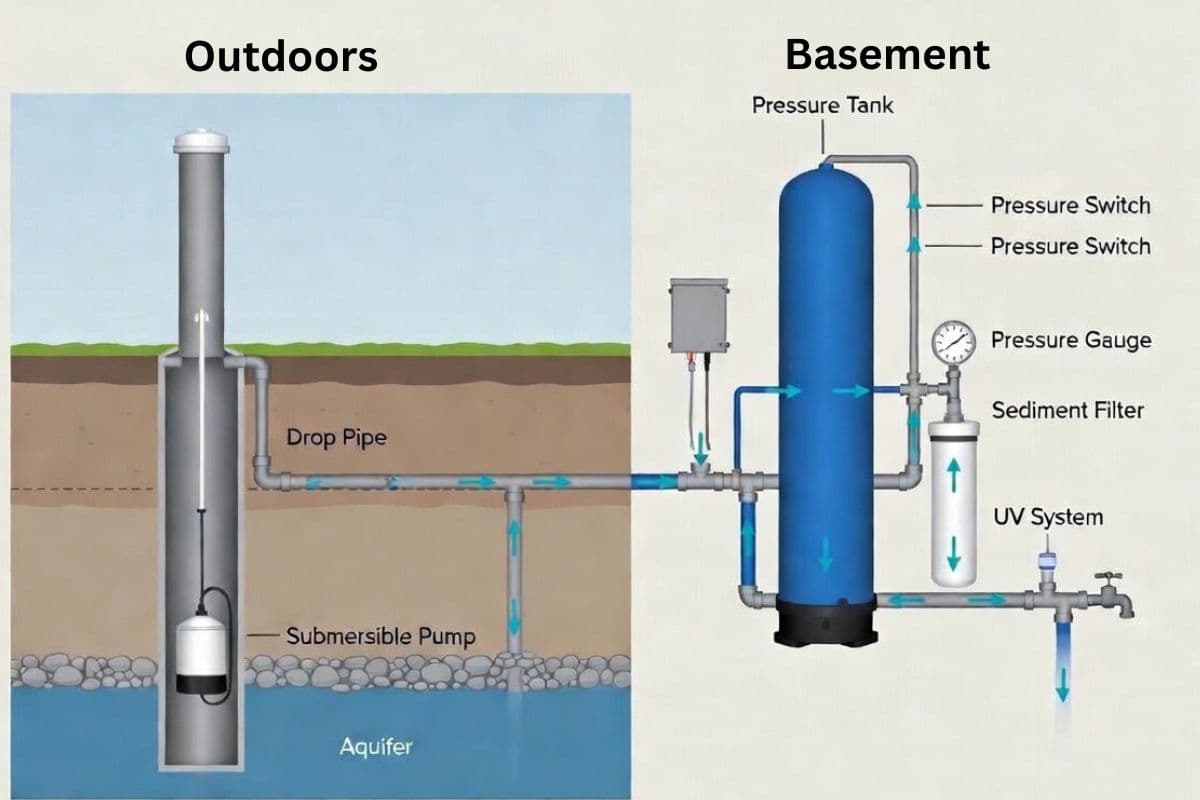
How a Private Well System Works: The Full Flow Path
Most well problems make immediate sense once you understand the complete path water takes from the aquifer to your faucet. Every problem in the system interrupts or degrades some part of this flow.
The Flow Path: Aquifer to Faucet
Aquifer
Underground water-bearing layer
Well
Drilled hole with casing & screen
Pump
Submersible pump lifts water
Pitless Adapter
Sealed frost-proof exit fitting
Underground Water Line
Buried below frost depth
Pressure Tank
Stores pressurized water
Pressure Switch
Cycles pump on/off by PSI
Water Treatment
Filters, UV, softener if needed
Home Plumbing
Distributes to all fixtures
Faucet
Safe water at every tap
The complete flow in sequence: aquifer → well screen → pump → check valve → drop pipe → pitless adapter → underground water line → pressure tank → pressure switch cycle → water treatment (if installed) → home plumbing → faucet.
Aquifer: Groundwater stored in underground layers of sand, gravel, or fractured rock. Rain and snowmelt seep through the soil and slowly recharge the aquifer. Your well is a controlled access point into this stored water. The water table — the upper boundary of the saturated zone — rises and falls with precipitation, drought, and nearby pumping activity.
Well: A drilled hole that extends from the surface down through soil and rock to the water-bearing zone. The well has a steel or PVC casing that lines the borehole, preventing soil and surface water from collapsing into the well or contaminating the water. At the bottom, a well screen or open intake section allows groundwater to enter while excluding sediment.
Pump: Positioned below the water level inside the well casing, the submersible pump pushes water upward through the drop pipe — the pipe running from the pump to the surface. The pump operates on electricity and is the only moving part of the system located underground.
Pitless adapter: The fitting that allows the water line to exit the well casing below frost depth and travel horizontally underground to the house. It creates a watertight, sanitary connection through the well casing wall.
Underground water line: Buried below frost depth, this carries water from the well to the house. The depth varies by region — 4 to 8 feet in the northern United States, shallower in southern states.
Pressure tank: Located in the basement, utility room, or well house, the pressure tank stores water under pressure. A rubber bladder or diaphragm inside the tank separates a pre-charged air pocket from the water. When you open a faucet, water flows from the tank without the pump needing to run. When tank pressure drops to the cut-in setting (typically 30 or 40 PSI), the pressure switch signals the pump to run. The pump runs until pressure reaches the cut-out setting (typically 50 or 60 PSI), then shuts off. This cycle repeats hundreds of times per day in a typical household.
Pressure switch: The electrical switch that monitors system pressure and controls the pump. Set with two pressure points: the cut-in (pump turns on) and cut-out (pump turns off). A typical setting is 40 PSI cut-in / 60 PSI cut-out. The pressure switch is the most frequently replaced component in any well system — they last approximately 10 years and cost $30 to $75 to replace.
Water treatment equipment: Positioned after the pressure tank, treatment equipment addresses contaminants specific to your well water. This may include a sediment filter, iron filter, water softener, UV disinfection system, carbon filter, or reverse osmosis unit. Not every well needs treatment. Treatment needs are determined by water quality testing, not by assumption. The treatment stage is optional but common — the majority of private wells have at least one piece of treatment equipment installed.
Home plumbing: Distributes treated water from the pressure tank to every fixture, appliance, and water heater in the house. On a private well, your home plumbing is the last stage of the system and the stage you interact with every day.
The 12 Components of a Well Water System
Understanding what each component does tells you what it means when something goes wrong.
1. Well Casing
Steel or PVC tube lining the borehole from the surface to below the water-bearing zone. Structural and protective — it prevents the borehole from collapsing and blocks surface contaminants from reaching the water. Modern drilled well casings are 4 to 6 inches in diameter. The casing is grouted (sealed with cement or bentonite) on its exterior from the surface down to prevent surface water from running down the outside of the casing into the water.
2. Well Cap
The sealed cover on top of the casing at ground level. A properly installed well cap is watertight and vermin-proof — it prevents insects, rodents, rainwater, and surface contamination from entering the well. The cap should be 12 inches or more above grade. A loose, cracked, or missing cap is one of the most common causes of bacterial contamination in residential wells.
3. Wellhead
The portion of the casing that extends above ground, including the cap and any electrical conduit. The wellhead should be inspected annually. It should be in a location that drains away from the casing on all sides.
4. Grout Seal
The cement or bentonite material filling the space between the outside of the well casing and the borehole wall. The grout seal prevents surface water from channeling down the outside of the casing and contaminating the aquifer. A failed grout seal is invisible from the surface but allows surface contamination to bypass the protective value of the casing depth entirely.
5. Submersible Pump
The pump is set inside the well casing, typically 10 to 20 feet below the static water level to ensure it remains submerged during drawdown. It operates on 230 volts and pushes water upward. Submersible pumps are sized by horsepower (1/2 HP for shallow low-demand wells, up to 1.5 HP for deep high-demand systems) and gallons per minute output. A pump sized incorrectly for the well's yield will either short-cycle (oversized) or fail to meet demand (undersized).
Service life: 8 to 15 years for a quality submersible pump in normal operating conditions. High iron or sediment content in the water accelerates wear. Replacement cost: $1,000 to $2,500 installed.
See the well pressure tank guide for detail on the relationship between pump sizing and pressure tank performance.
6. Check Valve
A one-way valve installed above the pump that prevents water from draining back down into the well when the pump shuts off. Without a functional check valve, the pump must re-prime on every cycle — increasing wear and causing sputtering at faucets when the system restarts.
7. Pitless Adapter
The sanitary fitting that allows the water line to exit the well casing through a sealed, frost-proof connection below grade. Without a pitless adapter, the water line would have to exit above ground, where it would freeze in cold climates and create a contamination pathway.
8. Pressure Tank
The pressure tank is the most misunderstood component in most residential well systems. Its primary job is not storage — it is cycle control. By maintaining a reservoir of pressurized water, the tank allows a household to draw water without the pump starting on every single water use event. Without a properly functioning pressure tank, the pump would short-cycle (start and stop every few seconds), dramatically reducing pump life.
A bladder tank has a pre-charged air chamber separated from the water by a rubber bladder. The pre-charge pressure should be set to 2 PSI below the pump's cut-in pressure. When the bladder fails, the tank becomes waterlogged — it fills entirely with water, the air cushion is lost, and the pump begins short-cycling. A waterlogged pressure tank is the single most common cause of premature pump failure.
Service life: 10 to 15 years for a quality bladder tank. Replacement cost: $600 to $1,500 installed.
For the complete guide to pressure tank types, sizing, and replacement, see the well pressure tank guide. For replacement costs broken down by tank size, region, and labor, see the pressure tank replacement cost guide.
9. Pressure Switch
The electrical brain of the system. Monitors pressure continuously and closes the circuit to the pump when pressure drops to the cut-in setting. A correctly set pressure switch for a 40/60 system closes the circuit at 40 PSI and opens it at 60 PSI. The pre-charge pressure in the tank must be set 2 PSI below the cut-in pressure — this is the most important single calibration in the well system and the one most often set incorrectly.
Common failures: contacts corrode and the switch fails to close (pump won't run), or contacts weld and the switch fails to open (pump runs continuously and burns out). Replacement: $100 to $200 including labor, and a common DIY repair for comfortable homeowners.
10. Pressure Gauge
A mechanical gauge showing current system pressure in PSI. Located at the tank tee near the pressure switch. Should read between cut-in and cut-out pressure during normal operation. A gauge that reads zero when water is running normally indicates a failed gauge or a severed connection. A gauge that reads below cut-in with the pump running indicates the pump is failing to build pressure. Gauges are inexpensive ($10 to $30) and often the first diagnostic indicator of a deeper problem.
11. Water Treatment Equipment
Treatment equipment varies based on what the water test shows. Common configurations:
A sediment pre-filter protects all downstream equipment from physical damage by sand, silt, and rust particles.
An iron oxidizing filter removes ferrous iron, manganese, and hydrogen sulfide before they reach the softener, appliances, or fixtures.
A water softener removes hardness minerals (calcium and magnesium) that cause scale in pipes, water heaters, and appliances.
A UV disinfection system inactivates bacteria and viruses without chemicals. Requires clear water upstream — turbidity and iron above 0.3 mg/L reduce UV effectiveness.
An under-sink reverse osmosis system addresses dissolved health contaminants (arsenic, nitrates, PFAS, lead) at the point of use for drinking and cooking water.
Treatment equipment is not required for every well. The correct approach is test first, treat second. Buying treatment equipment before testing produces systems that may be treating the wrong contaminants or nothing at all.
For the full treatment decision framework including which system addresses which contaminant, see the well water treatment options guide. For specific product recommendations, see the best whole house water filters review.
12. Well Log
Not a physical component, but the most important document associated with any well. The well log (drilling report) records the well's depth, casing specifications, static water level at construction, original yield in GPM, and the geological formations encountered while drilling. State licensing requirements mean most well logs are filed with the state environmental agency and are retrievable online. Your well log tells you what the well was designed to do — comparing it to current performance reveals any deterioration.
Water Quality by Region: What Your Well Is Likely to Contain
Where your well is located is one of the strongest predictors of what contaminants may be present. This is not deterministic — two neighboring wells can produce completely different water chemistry — but it gives you a starting framework before testing. Testing is always required for certainty.
New England (Maine, Vermont, New Hampshire, Massachusetts, Connecticut, Rhode Island)
Bedrock geology in New England is particularly associated with naturally occurring arsenic, radon, uranium, and manganese. Arsenic from granite and schist formations is the most significant health concern — the USGS has found arsenic above the EPA limit of 10 ppb in a significant percentage of New England bedrock wells. Radon in water is also common and aerosolizes during showering, contributing to inhalation exposure. Iron and hardness are widespread aesthetic issues. pH tends to be low in shallow wells drawing from acidic glacial soils.
Priority tests for New England: Arsenic, radon, uranium, manganese, iron, pH, coliform bacteria, nitrates.
Mid-Atlantic (New York, New Jersey, Pennsylvania, Maryland, Delaware, Virginia, West Virginia)
The glacial geology of the northern mid-Atlantic produces iron, manganese, and hardness as common issues. New Jersey has mandatory water testing at property transfer due to the prevalence of contaminants. Agricultural areas of Pennsylvania and Maryland have elevated nitrate risk from fertilizer and animal waste. Parts of this region have documented PFAS contamination near military bases and industrial sites. Road salt contamination of shallow wells is an emerging issue in heavily salted northern corridors.
Priority tests for Mid-Atlantic: Bacteria, nitrates, iron, manganese, hardness, PFAS (if near industrial or military sites), lead (older homes).
Southeast (North Carolina through Florida, plus Arkansas, Tennessee, Kentucky)
Karst limestone geology in portions of the Southeast — particularly Florida, Georgia, and Tennessee — creates aquifer systems that are highly vulnerable to surface contamination because water moves quickly through the rock with limited natural filtration. Bacterial contamination from failing septic systems travels farther in karst aquifers than in granular aquifers. Agricultural chemicals including nitrates, atrazine, and other pesticides are common in farming regions. Coastal areas face saltwater intrusion as aquifers are depleted.
Priority tests for Southeast: Bacteria, nitrates, pesticides, conductivity (saltwater intrusion indicator in coastal areas), pH.
Midwest (Ohio, Indiana, Illinois, Michigan, Wisconsin, Minnesota, Iowa, Missouri)
The Midwest is the most agriculturally intensive well water region in the United States. Nitrate contamination from corn and soybean fertilization is the most prevalent health contaminant in the region. Atrazine, the most commonly detected pesticide in US groundwater, is pervasive in the corn belt. Iron and hardness from glacial drift aquifers are nearly universal. Manganese levels are elevated in many areas. Some areas of the upper Midwest have elevated arsenic in sandstone aquifers.
Priority tests for Midwest: Nitrates, atrazine and pesticides, iron, manganese, hardness, bacteria, arsenic (Minnesota and Wisconsin in particular).
Great Plains and Mountain West (Kansas, Nebraska, Oklahoma, Colorado, Wyoming, Montana, Idaho)
The High Plains Aquifer (also called the Ogallala Aquifer) underlies much of this region and has seen significant water level declines from decades of intensive agricultural irrigation. The USGS has documented water level declines of more than 150 feet in parts of Kansas, Texas, and Oklahoma. Private domestic wells in this region face increasing risk of going dry as the aquifer is depleted. Naturally occurring arsenic, uranium, and selenium are present in aquifers derived from sedimentary rock. Agricultural nitrates and pesticides are widespread.
Priority tests for Great Plains / Mountain West: Arsenic, uranium, selenium, nitrates, pesticides, and current static water level measurement to assess aquifer decline.
Southwest (Arizona, New Mexico, Nevada, southern California)
Arid aquifers with little recharge produce water with very high total dissolved solids (TDS), extreme hardness, and naturally elevated arsenic and fluoride. The combination of high TDS and high hardness is nearly universal — a water softener or whole-house RO is the norm rather than the exception. Arsenic from volcanic and sedimentary geology is one of the most common contaminants exceeding the EPA limit. Uranium is elevated in some New Mexico and Arizona aquifers. Water tables in the Southwest are declining in many areas.
Priority tests for Southwest: Arsenic, uranium, fluoride, TDS, hardness, nitrates (agriculture areas), bacteria.
Pacific Northwest (Washington, Oregon, northern California)
Volcanic geology in the Pacific Northwest produces water with naturally elevated arsenic in some areas. Iron and manganese are common in basalt aquifers. Agricultural chemicals including nitrates and pesticides are relevant in the Willamette Valley and eastern portions of the region. Radon is elevated in some granitic geology areas. Generally, water quality is better in the Pacific Northwest than in many other regions, but local variation is significant.
Priority tests for Pacific Northwest: Arsenic, iron, manganese, bacteria, nitrates, radon (granite areas).
The Annual Well Maintenance Schedule
Annual maintenance prevents the problems that become expensive emergencies. This is the minimum schedule for a responsible well owner.
Every Spring (March to April)
Water quality test: Collect a sample at a state-certified laboratory. Test at minimum for total coliform bacteria, E. coli, nitrates, and pH. Spring is the highest-risk time for bacterial contamination — snowmelt and heavy spring rain mobilize surface contaminants and can push them toward well casings. Compare results to previous years. See the how to test your well water guide for the complete sampling protocol.
Wellhead visual inspection: Walk to the well. Confirm the cap is secure and intact. Check for any soil settling, frost heave, or erosion around the casing. Look for evidence of surface water pooling near the wellhead. Any pooling within 10 feet of the casing is a contamination risk.
Pressure tank pre-charge check: With the pump off and the pressure tank drained, check the pre-charge pressure using a standard tire gauge at the Schrader valve on top of the tank. It should read 2 PSI below the cut-in pressure. A reading of zero indicates a failed bladder — the tank is waterlogged and should be replaced.
Treatment equipment filters: Replace sediment pre-filter cartridges. Check carbon filter service hours against the manufacturer's recommendation. Check softener salt level and brine tank condition.
Every Fall (September to October)
Winterization check: Confirm all exposed water lines in unheated spaces (crawl space, detached well house, garage) are insulated before the first freeze. Check heat tape on any exposed sections if used. Confirm the pressure tank is located above the frost line.
UV lamp status: If a UV disinfection system is installed, verify the lamp age. UV lamps must be replaced annually regardless of whether they still emit visible light — UV output degrades before visible output fails. A UV lamp that is more than 12 months old is not providing reliable disinfection even if it appears to be working. Annual replacement is the only protection against this silent failure mode.
Flow rate observation: Run water at multiple fixtures simultaneously for 15 minutes and note whether pressure holds or drops. Late summer and fall are the lowest groundwater periods of the year in most of the United States — this is when a marginal well is most likely to show low-yield symptoms. Catching a yield problem in fall allows time to address it before winter.
Every 3 to 5 Years
Professional well inspection: Have a licensed well contractor conduct a full system inspection including a visual of the wellhead, pump amperage draw, pressure switch calibration, pressure tank condition, and a review of your most recent water quality results. This is separate from the DIY annual checks above. A professional can identify deteriorating components before they fail catastrophically.
Extended water quality panel: In addition to the annual bacteria and nitrate test, run an extended panel every 3 to 5 years or after any significant event (flooding, new agricultural activity nearby, changes in taste or odor). Extended panels typically include arsenic, lead, iron, manganese, hardness, TDS, and any contaminants of local concern.
What Fails, When, and What It Costs: The 20-Year Ownership Picture
One of the biggest surprises for new well owners is that the system has predictable failure timelines. Understanding these timelines allows you to plan and budget rather than react to emergencies.
Component Lifespan and Replacement Cost Table
| Component | Typical Lifespan | Replacement Cost (Installed) | Signs of Failure |
|---|---|---|---|
| Submersible pump | 8 to 15 years | $1,000 to $2,500 | No water, low pressure, pump runs constantly |
| Jet pump (shallow well) | 5 to 10 years | $400 to $1,200 | Low pressure, loud operation, failure to prime |
| Pressure tank (bladder) | 10 to 15 years | $600 to $1,500 | Short cycling, waterlogged sound, pressure fluctuation |
| Pressure switch | 8 to 12 years | $100 to $200 | Pump won't start or won't stop |
| Pressure gauge | 5 to 15 years | $30 to $80 | Reads zero or reads incorrectly |
| Well cap | 15 to 25 years | $50 to $200 | Cracked, loose, or missing |
| Check valve | 5 to 15 years | $100 to $300 installed | Pump primes slowly, pressure drops immediately after pump stops |
| UV lamp (annual) | 1 year (mandatory) | $50 to $150 | No visible failure — output degrades silently |
| Sediment filter cartridge | 3 to 6 months | $10 to $40 per cartridge | Pressure drop across filter |
| Carbon filter media | 3 to 5 years | $200 to $500 | Taste and odor return to water |
| Iron filter catalytic media | 5 to 7 years | $300 to $800 | Iron or sulfur breaks through |
| Water softener resin | 15 to 25 years | $200 to $500 | Hardness returns despite regeneration |
| Pitless adapter | 20 to 40 years | $300 to $800 | Leaking at well casing; rare failure |
| Well casing (grout seal) | 30 to 50+ years | Variable — may require new well | Bacteria contamination that persists after shock chlorination |
The Realistic 20-Year Cost of Well Ownership
This table models the expected costs for a standard residential well system in the Northeast or Midwest with moderate iron, average hardness, and no bacterial contamination. Treatment costs vary significantly by water chemistry. The table does not include the initial well drilling cost.
| Year Range | Expected Events | Estimated Cost |
|---|---|---|
| Years 1 to 5 | Annual water tests, filter cartridge replacements, pressure tank pre-charge checks | $600 to $1,500 total ($120 to $300/year) |
| Years 5 to 10 | Pressure switch replacement likely, UV lamp replacements (annual), possible sediment filter housing service | $1,200 to $2,500 total |
| Years 10 to 15 | Pump replacement (end of typical service life), pressure tank replacement, possible water softener resin replacement | $2,500 to $5,000 total |
| Years 15 to 20 | Second pump replacement if lifespan shorter, cap replacement, expanded water quality testing, possible iron filter media replacement | $2,000 to $4,500 total |
| Total 20-year ownership cost | Annual maintenance plus major replacements | $6,300 to $13,500 |
For context, the average American household paying for municipal water spends $600 to $900 per year — $12,000 to $18,000 over 20 years, with no control over rate increases. The 20-year well ownership cost is typically lower and is bounded — the major equipment replacements are predictable and plannable.
Seasonal Water Quality: Why Your Water Changes Through the Year
Most well owners do not know that water quality from a private well is not static. The chemistry of your water changes with the seasons, with drought and wet years, and with long-term aquifer trends. This is normal and expected — but it means annual testing at the same time of year is more meaningful than random testing.
Spring: Highest Contamination Risk
Groundwater levels are typically highest in March and April in most of the United States, per Penn State Extension research on groundwater recharge cycles. Snowmelt and spring rain push surface water into the ground rapidly. Contaminants that accumulated on the surface over winter — road salt, animal waste, agricultural fertilizers applied in fall — move into the groundwater during this recharge period. Spring is when newly introduced bacterial contamination is most likely to appear in a test. It is also when nitrate concentrations in agricultural areas are typically highest.
Testing in early May captures the post-recharge period and is the most conservative time to test for contaminants that move with surface water.
Summer: Lowest Groundwater Levels
Groundwater levels fall from May through August or September in most of the United States as plant transpiration draws water from the soil, reducing recharge, and demand for irrigation increases. This is when marginal wells are most likely to show low yield symptoms. It is also when concentrated contaminants can appear — as water level drops, the remaining water has had more contact time with surrounding rock, sometimes increasing iron, manganese, and TDS concentrations.
Well owners in drought-prone areas should reduce outdoor water use in late summer and watch for the early signs of a well drawing down: brief pressure loss at multiple fixtures simultaneously, air sputtering from faucets, recovery taking longer than usual after heavy use.
Fall: Pre-Winter Assessment Window
Early fall is the correct time to assess the well system before winter. Flow rate tests performed in August or September reflect the worst-case yield conditions for the year. A well that passes a flow rate test in fall is unlikely to struggle in any other season. It is also the time to inspect insulation, heat tape, and any above-grade equipment before freeze risk arrives.
Winter: Freeze Risk in Northern Climates
The primary winter risk for well systems is freezing of above-grade components: exposed water lines in an unheated garage or crawl space, the wellhead if it is exposed and the casing does not extend deep enough, or any component in a poorly insulated well house. The underground water line from the well to the house is protected by burial depth, but shallow utilities or disrupted soil can reduce that protection.
If water pressure drops suddenly in freezing weather without any other explanation, suspect a frozen line before diagnosing pump failure. Pump failure is not caused by cold — freezing damage is a plumbing issue, not a pump issue.
The Complete Well Owner's Annual Maintenance Checklist
This is the named, printable annual checklist for responsible well ownership. Perform these tasks once per year. Spring is recommended as the primary maintenance window.
Water Quality
- □Collect water sample at a state-certified laboratory (minimum: coliform, E. coli, nitrates, pH)
- □Review results against EPA MCLs and compare to prior year's results
- □If any result is above limits: follow the action protocols in the how to test your well water guide
Wellhead
- □Visually inspect the well cap — confirm it is intact, secure, and shows no cracks or gaps
- □Check that the wellhead extends at least 12 inches above grade
- □Confirm the ground slopes away from the casing on all sides
- □Look for any new structures, chemical storage, or activities within 100 feet of the wellhead
Pressure System
- □Turn off pump power and drain the pressure tank
- □Check pre-charge pressure with a tire gauge at the Schrader valve — should read 2 PSI below pump cut-in
- □Restore power and observe two full pressure cycles — pump should start at cut-in, stop at cut-out
- □Tap the tank at multiple heights — should sound hollow; a solid or sloshing sound indicates waterlogging
- □Check the pressure gauge reads within normal operating range
Treatment Equipment
- □Replace sediment filter cartridge
- □Check carbon filter service life and replace if at or past manufacturer's recommendation
- □Check UV lamp installation date — replace if more than 12 months old regardless of whether it still emits light
- □Refill water softener salt if below one-third full; inspect brine tank for salt bridges
- □Check iron filter backwash cycle is running on schedule
When to Call a Professional vs. DIY
Well ownership involves both DIY-appropriate tasks and situations that genuinely require a licensed well contractor. Knowing the difference prevents both unnecessary expense and dangerous DIY attempts.
Appropriate DIY Tasks
Pressure tank pre-charge adjustment, sediment filter cartridge replacement, carbon filter cartridge replacement, UV lamp replacement, pressure switch replacement (comfortable with electrical work), water sample collection for laboratory testing, softener salt refill, and annual wellhead visual inspection.
Require a Licensed Well Contractor
Flow rate testing, pump replacement or adjustment, anything requiring pulling the pump from the well, casing camera inspection, well rehabilitation (cleaning and redevelopment), shock chlorination performed in accordance with well system specifics, diagnosing and addressing persistent bacterial contamination, and any work on the pitless adapter or underground water line.
Warning Signs That Need Immediate Professional Attention
No water at any fixture: Could be pump failure, pressure switch failure, loss of power to the pump, or the well drawing down below the pump. Do not delay — call a well contractor.
Pump runs continuously without building pressure: Pump failure, stuck check valve, broken drop pipe, or the well has gone dry. Running a pump dry destroys it rapidly — turn off the pump circuit and call a contractor.
Sudden brown or discolored water after running clear: Disturbed sediment in the well (could indicate well structure problem), iron bacteria bloom, or pump disturbing the sediment at the bottom of the well. Test the water and contact a contractor.
Sputtering air from faucets followed by water: Failed check valve (most common), waterlogged pressure tank, or the well drawing down temporarily. Usually not an emergency but should be investigated.
Water pressure that builds quickly then rapidly drops: Classic waterlogged pressure tank — the tank has lost its air charge and is providing almost no draw-down storage. Replace the pressure tank.
For detailed diagnostic guides on each of these symptoms, see the well running dry guide and the well pressure tank guide.
Buying a Home With a Well
If you are evaluating a property with an existing well, the due diligence process is fundamentally different from a standard home inspection. A general home inspector typically does not test water quality, measure flow rate, or assess the mechanical condition of the well system to any meaningful depth.
What you need before closing: a dedicated well inspection by a licensed well contractor, a flow rate test, and an independently collected water quality test from a state-certified laboratory.
What your loan type may require: FHA loans require a minimum 3 GPM flow rate, water quality meeting EPA standards, and minimum separation distances between the well and septic system. VA and USDA loans have mandatory water testing requirements. Conventional loans typically require testing only if the appraiser flags a concern.
For the complete homebuyer's guide including the full inspection checklist with pass/fail criteria, specific negotiation dollar amounts for every type of well problem, walk-away conditions, and a 30-day post-closing checklist, see the buying a house with a well guide.
Private Well Water Quality Testing
Testing is the foundation of responsible well ownership. The EPA does not regulate private wells or test the water in them. You are the only person who will ensure your water is safe.
At minimum, test annually for coliform bacteria, E. coli, nitrates, and pH. These four tests catch the most common and most serious well water problems. Bacteria testing is critical because contamination can appear at any time — a flooding event, a cracked cap, a failing grout seal — and has no taste, odor, or color.
Additional tests are warranted based on your region, your well's geology, and any nearby land use changes. See the regional contaminant guide above for what to test based on where you live.
For the complete testing protocol including how to select a certified lab, how to collect a sample correctly, how to interpret results against EPA MCLs, and what to do when a test comes back positive, see the how to test your well water guide. For at-home test options with honest assessments of what they can and cannot detect, see the best well water test kits review.
Well Water Treatment
No treatment system works for all wells. The correct treatment depends entirely on what your water test shows. A system purchased without a test is either treating the wrong problem or doing nothing useful.
The fundamental decision framework: Is the contaminant a whole-house problem (iron staining on laundry, bacteria at every tap, scale in all pipes) or a drinking water problem (arsenic or nitrates that are only a concern when consumed)? Whole-house problems require point-of-entry treatment. Drinking water problems can often be addressed with a point-of-use RO system at the kitchen tap at a fraction of the cost.
The most common well water treatment stack for a Midwest or Northeast well with iron, hardness, and occasional bacteria: sediment pre-filter, then oxidizing iron filter, then water softener, then UV disinfection system, with an under-sink RO added if arsenic or nitrates are present.
For the complete treatment decision framework mapping every common contaminant to the correct technology, what each system can and cannot remove, and how to sequence a multi-component treatment stack, see the well water treatment options guide. For specific product recommendations, see the best whole house water filters review.
Shock Chlorination
Shock chlorination is the process of introducing a high concentration of chlorine into a well to disinfect it. It is the first-line response to a positive bacteria test result, after a flooding event, after any work on the well that may have introduced contamination, and when a well has not been used for an extended period.
Shock chlorination is not a permanent treatment for ongoing contamination — it is a one-time disinfection event. If the source of contamination (a structural problem with the well, inadequate separation from the septic system, a cracked casing) is not addressed, the bacteria will return.
For the complete procedure including how to calculate the correct bleach amount for your well's diameter and depth, the step-by-step 12-step process, the 24-hour timeline, how to clear the chlorine smell, and the retest protocol, see the shock chlorination guide.
The Pressure Tank System In Depth
The pressure tank is the component most likely to need replacement in the first 15 years of well ownership and the component whose failure has the most immediate impact on the rest of the system. A failed pressure tank — specifically a waterlogged tank — is one of the leading causes of premature pump failure because it forces the pump to short-cycle continuously.
The key maintenance task that prevents waterlogged tanks is the annual pre-charge pressure check. Pre-charge pressure should be 2 PSI below the pump's cut-in pressure. A tank where the pre-charge has bled down to zero is a tank whose bladder has failed — it needs replacement.
For the complete guide to pressure tank types (galvanized, diaphragm, and bladder), sizing formulas, pre-charge adjustment, all failure signs, and the complete replacement procedure, see the well pressure tank guide. For cost breakdowns by tank size, brand, and region, see the pressure tank replacement cost guide.
USGS Groundwater Resources
The USGS Groundwater Atlas of the United States provides detailed maps of aquifer systems, groundwater quality patterns, and water level trends for every region of the country. For any well owner wanting to understand the geological and hydrogeological context of their specific well, the USGS National Water Information System (NWIS) provides real-time and historical groundwater level data from monitoring wells across the country — many of which are located near residential wells and can give context for your local water table trends.
- USGS Groundwater Atlas of the United States — Regional aquifer maps and groundwater quality data
- USGS National Water Information System (NWIS) — Real-time and historical groundwater level monitoring data
Frequently Asked Questions
How does a private well work?
A private well is a drilled hole that extends from the surface down to a water-bearing underground layer called an aquifer. A submersible pump positioned below the water level inside the well pushes water up through a pipe to the surface. The water flows underground into the house and into a pressure tank, which stores it under pressure so water is available without the pump running every time a faucet opens. A pressure switch monitors the tank pressure and cycles the pump on when pressure drops and off when it builds back up. Water then passes through any treatment equipment installed — a sediment filter, iron filter, UV system, or water softener depending on what the water chemistry requires — and distributes through the home's plumbing to every fixture.
How often should I test my well water?
At minimum, once per year for coliform bacteria, E. coli, nitrates, and pH. Spring is the recommended timing — snowmelt and spring rain mobilize surface contaminants and represent the highest contamination risk period of the year. Test more frequently — or test for additional contaminants — after any flooding event, after any work on the well, after any nearby land use change (new agricultural activity, construction, fuel spill), or any time you notice a change in water taste, odor, or appearance. The EPA recommends annual testing for private wells, and it is the only way to catch contamination that has no detectable taste, color, or odor.
What contaminants are most common in private well water?
The most common contaminants vary significantly by region. Bacteria (coliform and E. coli) can affect any well at any time and are universal testing priorities. Nitrates are the most common health contaminant in agricultural areas, exceeding the EPA limit of 10 mg/L in a significant percentage of Midwest wells. Iron and manganese are widespread aesthetic contaminants that cause staining and taste issues. Arsenic occurs naturally in bedrock in New England, the Mountain West, and parts of the Midwest and Southwest. Hard water (calcium and magnesium) affects the majority of wells east of the Rocky Mountains. PFAS contamination is emerging near military bases, airports, and industrial sites nationwide.
How long does a well pump last?
A quality submersible pump in a residential well typically lasts 8 to 15 years. Factors that shorten pump life include: high iron or sediment content in the water (abrasive to pump impellers), a waterlogged pressure tank forcing the pump to short-cycle continuously, the well drawing down and allowing the pump to run dry, and undersizing relative to the well's yield. Regular annual maintenance — specifically keeping the pressure tank properly pre-charged and replacing water treatment media on schedule — is the most effective way to extend pump life toward 15 years rather than 8.
What is the difference between a pressure tank and a water tank?
A pressure tank (also called a well pressure tank or hydropneumatic tank) contains a pre-charged air chamber separated from the water by a rubber bladder. The air acts as a spring, providing the pressurized water storage that allows water to flow without the pump running on every use event. It is sized in gallons but its useful function is measured by its drawdown volume — typically 30 to 40 percent of the total tank volume. A plain water storage tank (cistern) contains only water with no pressurization — it requires a separate booster pump to deliver water under pressure. Pressure tanks are the standard configuration in residential well systems. Cisterns or storage tanks are used in low-yield well situations where the well cannot deliver water fast enough to meet household demand in real time.
How do I know if my well water is safe to drink?
You cannot determine this without testing. Many of the most serious well water contaminants — arsenic, nitrates, PFAS, lead — have no taste, odor, or visible color at concentrations that pose health risks. Clear water that looks and tastes fine can contain arsenic at 30 ppb (three times the EPA limit) without any detectable change in appearance. Annual laboratory testing from a state-certified lab is the only reliable method. Use first-flush sampling protocol for lead (sample before any water has run that morning). If you have never tested your well, that is the single most important action you can take.
What are the signs of well pump failure?
The clearest signs are no water at any fixture, loss of water pressure that gets progressively worse over days or weeks, the pump running continuously without building pressure to the cut-out setting, and loud or unusual sounds from the pump control box. Air sputtering from faucets before water flows can indicate the pump is drawing down the well or a check valve has failed. A sudden loss of all water with no recent freezing weather is almost always a pump failure or loss of power to the pump circuit. See the well running dry guide for the complete diagnostic procedure.
How much does it cost to maintain a well per year?
Annual maintenance for a residential well system with basic treatment equipment runs $200 to $500 per year. This covers a certified lab water quality test ($100 to $300), sediment filter cartridge replacements ($20 to $80), UV lamp replacement ($50 to $150 if applicable), and periodic softener salt ($100 to $200 if applicable). This does not include the lifecycle replacement costs for the pump (every 10 to 15 years at $1,000 to $2,500) and pressure tank (every 10 to 15 years at $600 to $1,500). Building a sinking fund of $100 to $200 per year for these larger replacements makes them manageable when they arrive. Total cost of well ownership over 20 years is typically $6,300 to $13,500 — less than the equivalent cost of municipal water service over the same period in most US cities.
Is well water better than city water?
They serve different needs and have different characteristics. Private well water does not contain chlorine, chloramines, or disinfection byproducts that municipal treatment introduces. Many well owners prefer the taste. Well water is not subject to distribution system failures, boil-water advisories, or utility rate increases. However, private well water also has no guarantee of safety unless the owner tests regularly and treats appropriately. Municipal water is continuously monitored and meets enforceable EPA standards before it reaches your tap. Well water quality depends entirely on local geology, land use, and owner vigilance. A properly tested and treated well can deliver water quality that exceeds municipal standards. An untested and untreated well may contain contaminants that are harmful without the owner's knowledge. For a detailed side-by-side comparison of private well ownership versus municipal water on cost, quality, taste, maintenance, and reliability, see the well water vs. city water guide.
What is the water table and how does it affect my well?
The water table is the upper boundary of the saturated zone in the ground — the depth at which the soil and rock are completely filled with water. Your well extends below the water table so the pump can draw from the saturated zone. The water table is not fixed — it rises in wet seasons (typically highest in early spring in the northern United States) and falls in dry seasons and drought. If the water table drops below the pump's intake, the well goes dry. Shallow wells and unconfined aquifers are more vulnerable to seasonal water table variation than deep bedrock wells in confined aquifers. Significant long-term water table decline — caused by aquifer depletion from intensive agricultural irrigation in areas like the High Plains — can permanently reduce well yield and is a growing issue in some regions of the United States.
What should I do if my water test comes back positive for bacteria?
Do not use the water for drinking or cooking until the problem is resolved. Follow up with a second test immediately using proper sampling protocol to confirm the result — false positives from improper sample collection occur. If the second test also returns positive, contact a licensed well contractor to perform shock chlorination. After chlorination, flush the system completely according to the shock chlorination protocol and retest. If the third test returns positive, the contamination has a structural source — inadequate separation from the septic system, a cracked casing at depth, or a failed grout seal. Source investigation by a licensed contractor is required. See the complete procedure in the shock chlorination guide.
What is the best whole house water filter for well water?
The correct answer depends entirely on your water test results. There is no single best filter for all wells. For iron and manganese under 3 ppm with no bacteria, the Home Master HMF3SDGFEC is the best cartridge-based option. For wells with bacteria plus general contamination, the Aquasana EQ-WELL-UV-PRO-AST combines carbon, KDF, and Class A UV in one system. For mild wells with primarily sediment and taste concerns on a budget, the iSpring WGB32B is the most cost-effective starting point. For the complete matched recommendations including verified specifications, honest limitations, and the multiple-problem treatment stacks, see the best whole house water filters review.
Glossary
Aquifer
An underground layer of permeable rock, sand, or gravel that holds water and allows it to move. Unconfined aquifers are connected to the surface and recharged directly by rain and snowmelt — their water level fluctuates seasonally. Confined aquifers are sandwiched between impermeable layers, are recharged from distant areas, and are less directly affected by local precipitation. Bedrock aquifers in fractured rock are the source for most deep drilled wells. The type of aquifer your well taps determines both the yield characteristics and the contaminant risk profile of the water.
Drawdown
The drop in water level inside a well during active pumping. As the pump removes water from the well, the water level inside the casing drops — this is drawdown. The rate of drawdown depends on both the pump rate and the rate at which the surrounding aquifer can supply water to replace what is being removed. When drawdown reaches the pump intake, the well goes dry temporarily. A flow rate test measures the well's sustained yield and recovery rate by observing how drawdown behaves over an extended pumping period.
Static Water Level
The depth to water in the well measured from the top of the casing when the pump has not run for several hours and the water is at its natural equilibrium. Comparing current static water level to the original static water level recorded in the well log reveals long-term aquifer trends. A deeper current static level than the original indicates water table decline in the area over time.
Short Cycling
The condition in which a well pump turns on and off in rapid succession — every few seconds — rather than running for 1 to 2 minutes per cycle as designed. Short cycling is almost always caused by a waterlogged pressure tank that has lost its air charge and can no longer store meaningful drawdown volume. Every start cycle puts stress on the pump motor; a pump that short-cycles continuously will fail in a fraction of its normal service life. The fix is pressure tank replacement, not pump replacement.
Pitless Adapter
A fitting installed through the wall of the well casing below frost depth that allows the water supply line to exit the well and travel underground to the house while maintaining a watertight, sanitary seal at the casing penetration. Without a pitless adapter, the water line must exit above ground and is vulnerable to freezing and contamination. Pitless adapters are standard in modern drilled wells in any climate where frost penetration is a concern.
Confined vs. Unconfined Aquifer
An unconfined aquifer is directly connected to the surface — precipitation infiltrates downward and recharges it directly. Water levels fluctuate with rainfall and drought. Most shallow wells draw from unconfined aquifers. A confined aquifer is trapped between two impermeable layers and can only be recharged from areas where those layers are absent, often many miles away. Confined aquifers are more stable seasonally but can be significantly affected by heavy pumping that exceeds the recharge rate. Deep artesian wells often tap confined aquifers, where the pressure of the confined water can be high enough to push water toward the surface without pumping.
Grout Seal
The layer of cement or bentonite clay pumped into the space between the outside of the well casing and the borehole wall during well construction. The grout seal prevents surface water, soil water, and shallow contaminated water from channeling downward along the outside of the casing to the water-bearing zone. A failed or incomplete grout seal bypasses all the protective value of casing depth — surface contaminants can reach the water as if the casing were not there.
The Home Guide Network Editorial Team
Our guides are researched and written by the editorial team at The Home Guide Network, an independent publisher covering home systems for homeowners. We cover garages, basements, septic systems, and wells across four dedicated guide sites. Learn more at thehome.guide.