Quick answer:
Neither well water nor city water is universally better. City water is regulated, continuously tested, and requires nothing from you to stay safe — but it costs $500 to $1,200 per year, rates have increased an average of 3.8 percent annually over the past six years, and it may contain chlorine, chloramines, and disinfection byproducts. Well water has no monthly bill, is free of treatment chemicals, and is often preferred for taste — but the safety responsibility falls entirely on you, it requires annual testing and periodic maintenance, and the contaminant risk profile depends on your local geology and land use in ways that city water does not. This guide covers every dimension of the comparison honestly so you can make the right decision for your property and household.
The Fundamental Difference: Who Is Responsible for Safety
This is the most important distinction between the two systems and the one that most comparison guides understate.
With city water, the EPA regulates public water systems under the Safe Drinking Water Act. Your utility is legally required to test the water hundreds of times per year, maintain Maximum Contaminant Levels for over 90 regulated contaminants, and send you an annual Consumer Confidence Report documenting what was found. If something goes wrong, the utility is responsible for fixing it. If levels exceed EPA limits, you are notified. You do not have to think about safety unless something unusual happens.
With a private well, the EPA has no jurisdiction. Federal law does not require you to test your well water. No government agency monitors it. No one will notify you if arsenic in your local aquifer exceeds safe levels. According to the USGS, health-based contaminants are present above safe limits in approximately 23 percent of domestic well samples — yet most well owners have no idea because most wells are never tested for the contaminants most relevant to their local geology.
This is not an argument against well water. It is an argument for understanding what you are taking on. A well owner who tests annually, understands their local contaminant risks, and treats appropriately can have water quality that exceeds what most municipal utilities deliver. A well owner who never tests is accepting an unknown risk that could be zero or could be significant.
Side-by-Side Comparison
| Dimension | Well Water | City Water |
|---|---|---|
| Monthly cost | $0 (no water bill) | $43 average nationally; $19 to $106 depending on location |
| Annual cost | $200 to $500 in maintenance and testing | $500 to $1,200 in water and sewer charges |
| Upfront cost | $5,500 to $20,000 to drill and install | $0 to $5,000+ for connection fees if not already connected |
| Rate increases | None — no utility pricing | 3.8% average annual increase over past 6 years |
| Safety oversight | Owner responsibility | EPA-regulated, continuously monitored |
| Testing requirement | Annual (owner-initiated) | Continuous (utility-performed) |
| Treatment chemicals | None unless installed by owner | Chlorine or chloramines typically used for disinfection |
| Fluoride | Not present unless added | Added in many municipal systems |
| Taste | Often preferred — mineral, no chlorine | Variable — chlorine taste common |
| Hardness | Varies by geology — often hard | Varies by source — treated in some systems |
| Power dependency | Yes — pump needs electricity | No — works during power outages |
| Drought impact | Water table may drop in severe drought | Not directly affected |
| Contaminant risk | Natural (geology-dependent) and human activity (agriculture, industrial) | Natural (source water) and treatment-related (DBPs, lead from pipes) |
| Health responsibility | Entirely the owner's | Utility and EPA |
| Treatment options | Full customization — owner chooses | Limited to point-of-use filters |
| Environmental impact | Low — no treatment chemicals discharged | Higher — chlorine, fluoride, and other chemicals discharged |
| Property value impact | Adds $10,000 to $30,000 in rural markets | Standard — expected by buyers |
| Infrastructure risk | Individual system failure affects only your home | Distribution main breaks, treatment failures affect many homes |
The Cost Comparison in Detail
Cost is the dimension where well ownership is most clearly advantageous over the long term — but the math is more nuanced than “well water is free.”
City Water Annual Cost
The average American family of four pays $78 per month for water service, according to a 2025 Bank of America Institute analysis — approximately $936 per year. Adding sewer service, which averages $50 per month separately in most cities, brings the combined water and sewer bill to approximately $1,500 per year for a typical household.
Rates have increased at an average of 3.8 percent per year for water and 3.2 percent per year for sewer over the past six years, according to Bluefield Research's annual utility rate analysis. A household paying $1,500 today can expect to pay approximately $1,870 in five years and approximately $2,240 in ten years at these trend rates.
Costs vary dramatically by location. The national average monthly water bill ranges from $19 in North Carolina to $105 in West Virginia, reflecting differences in infrastructure age, system size, and regional investment patterns.
Well Water Annual Cost
A private well has no monthly water bill. Annual ownership costs include:
Water quality testing: $100 to $300 per year for a certified laboratory panel covering bacteria, nitrates, pH, and basic chemistry. This is the non-negotiable annual cost for responsible well ownership.
Pressure tank pre-charge check and basic maintenance: $0 if done yourself, $100 to $200 if a contractor does it during an annual system check.
Water treatment maintenance: $100 to $400 per year depending on what treatment equipment is installed — softener salt, filter cartridges, UV lamp replacement.
Periodic professional inspection: $250 to $500 every 3 to 5 years.
Total annual well ownership cost: $200 to $500 per year for most households with basic treatment equipment.
The Break-Even Calculation
Drilling a new well costs $5,500 to $20,000 all-in. At an annual savings of $1,000 to $1,500 per year compared to city water service, a well breaks even in 4 to 15 years depending on drilling cost and local water rates. In high-rate cities or states where water costs exceed $100 per month, the break-even comes faster. In areas with low water rates, it takes longer.
The break-even calculation improves over time because city water rates increase annually while well ownership costs are largely flat (with the exception of periodic pump and tank replacement).
For a household that plans to stay in a property for 10 or more years, well ownership is almost always less expensive than city water over that period.
For homeowners weighing well installation against municipal water connection, our well drilling cost calculator gives a personalized estimate based on expected depth, geology, casing size, pump system, and region to help you compare against quoted municipal connection fees.
Water Quality: Which Is Actually Safer?
This is the question most comparison articles either overclaim or understate. The honest answer requires separating what the research shows from what individual households actually experience.
What City Water Gets Right
Municipal water is treated and tested to EPA standards before it reaches your tap. The treatment process removes bacteria, viruses, and many chemical contaminants from the source water. Your utility is legally required to notify you if any regulated contaminant exceeds its Maximum Contaminant Level. The annual Consumer Confidence Report (available on your utility's website) shows exactly what was found and at what levels.
For a household that does nothing to monitor or treat its water, city water is safer by default — the monitoring and treatment happen without any action on your part.
What City Water Gets Wrong
The EPA regulates 90 contaminants. Thousands of chemicals are present in US water supplies at levels too low to currently trigger regulation or that are not yet regulated at all. PFAS compounds — per- and polyfluoroalkyl substances — were largely unregulated in municipal water until the EPA set Maximum Contaminant Levels in 2024. PFAS from industrial sites, military bases, and firefighting foam contaminate municipal water supplies in hundreds of communities nationwide.
Lead is another example. The EPA's Lead and Copper Rule requires utilities to take action when lead exceeds 15 ppb in 10 percent of sampled taps. But there is no safe level of lead exposure for children. Homes with older lead service lines or lead solder in their plumbing can have significant lead concentrations that the utility's compliance monitoring does not capture. The Flint, Michigan water crisis was an extreme version of a problem that exists at lower levels in thousands of older municipal systems.
Disinfection byproducts are a third category. Chlorine and chloramines added during treatment react with organic matter in the water to form trihalomethanes and haloacetic acids — compounds with documented associations with bladder cancer and other health effects at long-term exposure levels. The EPA regulates these compounds, but the regulatory limits allow some exposure.
What Well Water Gets Right
A properly tested and treated private well can produce water free of chlorine, chloramines, disinfection byproducts, and fluoride. The water travels from the aquifer directly to your tap without passing through miles of aging distribution pipes where lead and other contaminants can leach in. You have full visibility into exactly what your water contains and full control over how it is treated.
What Well Water Gets Wrong
According to USGS research on water quality from domestic wells, health-based contaminants are present above safe limits in approximately 23 percent of sampled wells — and most well owners do not know this because they have never tested for the relevant contaminants. The most common health-relevant contaminants found in private wells are arsenic (naturally occurring in bedrock in many regions), nitrates (from agricultural fertilizers and animal waste), radon (from uranium-bearing rock formations), and bacteria (from surface contamination pathways).
The critical distinction is that these contaminants are identifiable through testing and most are treatable. A well owner who tests annually and understands their local geology can manage these risks effectively. A well owner who has never tested is simply unaware of whatever is or is not in their water.
The Honest Summary
City water provides a baseline safety guarantee backed by regulation, continuous testing, and legal accountability. Private well water can meet or exceed that baseline — but only if the owner actively maintains that standard through testing and treatment. The safety advantage of city water is the default monitoring it provides. The safety advantage of well water is the absence of treatment chemicals and distribution system contamination risks — available to owners who test and treat proactively.
Taste: The Dimension Where Wells Usually Win
Taste is subjective, but the pattern is consistent enough to be worth stating. In blind taste tests and in surveys of people who have lived with both systems, well water is more often preferred — particularly in areas where the municipal system uses chloramine disinfection rather than chlorine. Chloramines produce a more persistent taste and odor than chlorine and do not dissipate from water the way chlorine does when water is left to sit or filtered through an activated carbon pitcher.
Well water tastes of whatever minerals are in the local aquifer. In areas with moderate mineral content and no iron, manganese, or hydrogen sulfide, well water is typically described as clean, fresh, and mineral. In areas with high iron, it tastes metallic. With hydrogen sulfide, it smells of rotten eggs. With high TDS or hardness, it can taste flat or slightly salty.
Neither of these is an inherent property of the water source — they are properties of the specific geology and can be addressed with appropriate treatment. See the well water tastes bad guide for the complete diagnostic guide. See the well water treatment options guide for treatment solutions.
The taste advantage for well water assumes the water has been tested and any aesthetic contaminants are addressed. Untreated well water with high iron or sulfur does not taste good. Treated well water with those contaminants removed typically tastes noticeably better than chlorinated city water to most people who have experienced both.
Maintenance and Responsibility
This is where the well vs. city water choice has the most practical day-to-day implications.
City Water Maintenance
Essentially zero maintenance falls to the homeowner for the water supply itself. You pay your bill, the utility handles treatment and delivery, and you call the utility if there is a problem. The only homeowner-side maintenance is replacing whole-house filters or softeners if you choose to install them.
Well Water Maintenance
Annual tasks include: water quality testing at a certified laboratory, pressure tank pre-charge check, sediment filter cartridge replacement, UV lamp replacement (if a UV system is installed), softener salt refill (if a softener is installed).
Every 3 to 5 years: professional well inspection, extended water quality panel.
Every 10 to 15 years: pump replacement ($1,000 to $2,500), pressure tank replacement ($600 to $1,500).
Most of these tasks are straightforward and DIY-capable for a homeowner who takes the time to understand their system. The annual water test is the most important and takes 30 minutes of your time plus the lab fee. None of these tasks are technically demanding. But they require you to be an engaged owner of your water system rather than a passive consumer of a service.
For homeowners who value set-it-and-forget-it simplicity, city water is genuinely preferable. For homeowners who are willing to engage with annual maintenance in exchange for the financial and quality advantages, a well is a better fit.
Reliability: Power, Drought, and Infrastructure
Power Outage
City water: Not affected by power outages in most cases. Municipal water systems use elevated storage tanks and pressurized distribution mains that maintain pressure without active pumping during normal outages.
Well water: The submersible pump requires electricity. A power outage means no water until power is restored or a generator is connected. This is a meaningful disadvantage in areas with frequent outages. A generator transfer switch specifically for the well pump circuit costs $300 to $800 installed and solves this completely.
Drought
City water: Not directly affected by local drought. Municipal systems draw from large reservoirs, surface water sources, and regional groundwater that are managed for drought resilience. Usage restrictions may be imposed during severe droughts but supply interruption is rare.
Well water: Shallow wells drawing from unconfined water table aquifers can be affected by drought as the water table drops. Deep bedrock wells in confined aquifers are significantly more resilient. The risk depends on well depth, aquifer type, and drought severity. See the well running dry guide for signs and solutions.
Infrastructure Failure
City water: Distribution main breaks, treatment plant problems, or contamination events can affect thousands of customers simultaneously. Boil-water advisories are issued when contamination is detected. Large-scale failures are rare but are resolved by the utility, not by individual homeowners.
Well water: Failures affect only your property. A pump failure means you have no water until a contractor replaces it, typically within 1 to 2 days in most areas. There is no cascading failure that affects neighbors. You are both the sole customer and the sole responsible party.
Environmental Considerations
City water requires significant energy and chemical inputs for treatment and pumping. Chlorine and other treatment chemicals are discharged in treated wastewater. Infrastructure construction and maintenance require substantial material inputs. The environmental footprint is distributed across all rate-paying customers.
Private wells use no treatment chemicals if the water quality is naturally acceptable. The pump uses electricity — approximately $100 to $400 per year for a typical residential well, according to industry estimates. There are no chemical discharge concerns for the household water use itself. The aquifer is a shared resource, and heavy pumping during drought conditions can affect neighboring wells — a real but manageable concern.
Who Should Choose Well Water
Well water is the better choice when:
- ✓You are buying a rural or semi-rural property where city water connection is not available or would cost thousands in connection fees
- ✓You plan to stay in the property for 10 or more years, making the break-even on drilling cost advantageous
- ✓You are willing to test annually and engage with the maintenance requirements
- ✓You prefer water free of chlorine, chloramines, and disinfection byproducts
- ✓You are in an area where local geology produces naturally good water quality
- ✓Water rates in your area are high and increasing rapidly
Who Should Choose City Water
City water is the better choice when:
- ✓You want water safety managed by someone else with no annual testing responsibility
- ✓You are renting, plan to sell within a few years, or have no need for the long-term cost advantage
- ✓You are in a dense urban or suburban area where a well would be anomalous at resale
- ✓You live in an area where local geology produces problematic water requiring expensive treatment on a well
- ✓You experience frequent power outages and do not want to manage a generator backup for water supply
What If You Have Both Options?
Some properties — typically on the suburban fringe or in areas where municipal service is expanding — have access to both a private well and municipal water. In these cases:
Use the well if: The well produces clean water with acceptable quality results, the system is in good condition, and you are willing to maintain it. The long-term cost advantage and quality control are significant.
Connect to city water if: The well is failing or producing water with significant quality problems that are expensive to treat, if city water connection fees are reasonable, or if you are planning to sell and buyers in your market prefer municipal water.
Keep both if possible: Some homeowners use well water for irrigation and outdoor use (free) while using city water for drinking and indoor use (monitored). This hybrid approach works where both systems are accessible and the regulatory situation in your area permits it.
The Regional Dimension
The well vs. city water comparison is not the same in every region because the baseline quality of both sources varies significantly by location.
New England: Bedrock aquifers frequently contain naturally elevated arsenic and radon, so a well may require more treatment investment than average. City water in many New England communities draws from surface water sources with different quality profiles.
Midwest: Wells face elevated nitrate risk from fertilizer runoff. Municipal systems in these areas face the same source water pressures but treat for nitrates before delivery.
Southwest: Both well water and city water face challenges from high TDS, hardness, and naturally elevated arsenic. The choice between them is less about quality and more about availability and cost.
Mid-Atlantic and Southeast: Wells often produce good-quality water with minimal treatment needs, and city water in many smaller communities has documented quality issues from aging infrastructure.
The regional contaminant profile for your specific location is the most important factor in this decision that general guides cannot answer for you. Your state health department and county environmental records are the best sources for local groundwater quality data.
Frequently Asked Questions
Is well water safer than city water?
Neither is universally safer. City water is regulated, continuously tested, and meets EPA standards for over 90 contaminants — you do not have to do anything to maintain that baseline. Private well water is unregulated and unmonitored unless the owner tests it. However, a well owner who tests annually and treats appropriately can produce water that exceeds city water quality — free of chlorine, disinfection byproducts, lead from distribution pipes, and contaminants that are present but not yet regulated in municipal systems. Safety in city water is the default. Safety in well water is the result of the owner's engagement.
Is well water cheaper than city water?
Yes, over the long term. There is no monthly water bill for well water. Annual maintenance costs $200 to $500 for testing, filter replacement, and routine maintenance — significantly less than the average household's $1,500 per year in combined water and sewer charges. The upfront drilling cost of $5,500 to $20,000 is recouped through savings over 4 to 15 years depending on local water rates and drilling depth. In areas with high water rates or where rates are rising rapidly, the financial advantage of well water is substantial.
Does well water taste better than city water?
Most people who have lived with both systems prefer the taste of well water, primarily because it does not contain chlorine or chloramines used for disinfection in municipal systems. Well water tastes of the minerals in the local aquifer — typically clean and fresh in areas with moderate mineral content. However, well water with high iron, manganese, or hydrogen sulfide tastes metallic or sulfurous until treated. The taste advantage assumes the water has been tested and any aesthetic contaminants addressed.
What are the disadvantages of well water?
Well water requires the owner to take full responsibility for safety — annual testing, understanding local contaminant risks, installing and maintaining appropriate treatment. The pump requires electricity, meaning power outages can interrupt water supply. Shallow wells can be affected by drought and seasonal water table variation. Unexpected equipment failures (pump, pressure tank) are unplanned expenses of $1,000 to $2,500 when they occur. The homeowner is the sole person responsible for noticing and addressing water quality problems.
What are the disadvantages of city water?
City water costs $500 to $1,500 per year in combined water and sewer charges, with rates increasing at approximately 3.8 percent annually. It typically contains chlorine or chloramines for disinfection, which affect taste and produce disinfection byproducts. Distribution pipes — especially in older cities — can leach lead and other metals into the water between the treatment plant and your tap. You have no control over treatment decisions made by the utility and no ability to customize what is removed or left in.
How do you know if you have well water or city water?
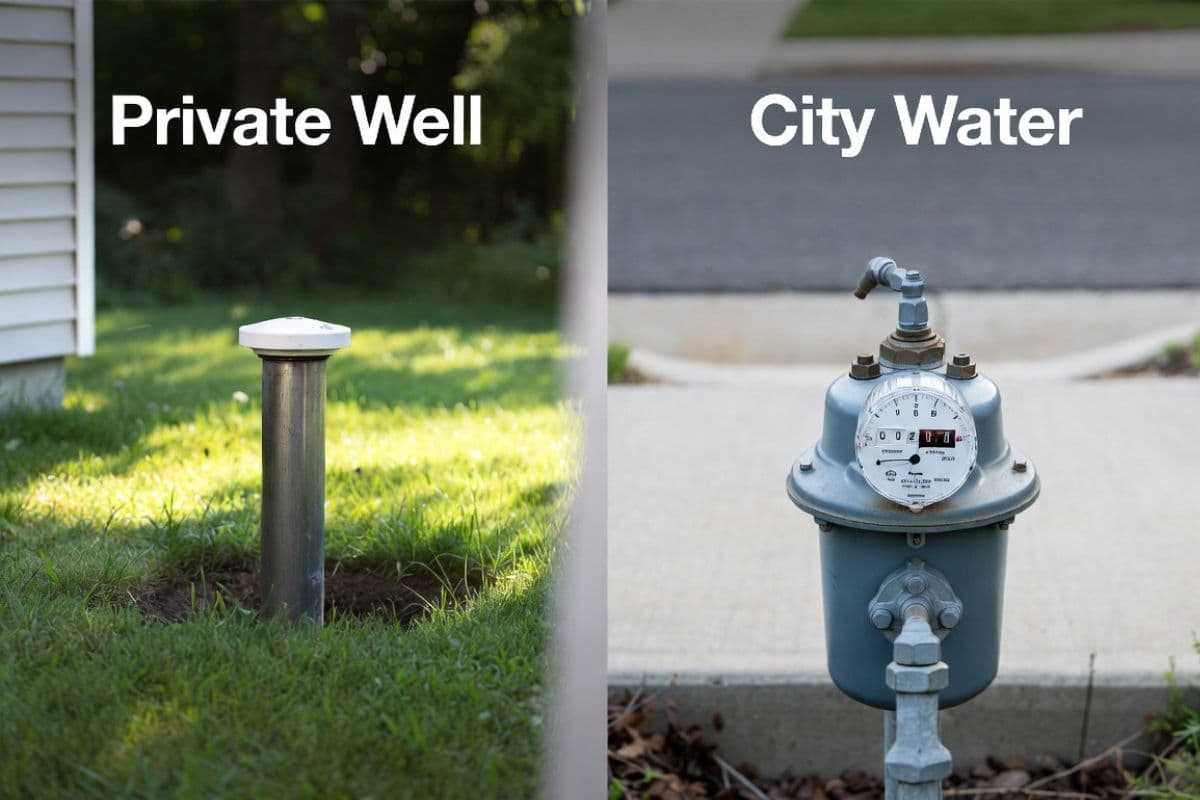
If you have never received a water bill from a municipal utility, you almost certainly have well water. Visual confirmation: a well cap (a sealed pipe or cap extending above ground somewhere on your property) and a pressure tank (a large tank, typically blue or grey, in your basement or utility room). If you are unsure, contact your county health department or the nearest utility — they can tell you immediately whether your address is connected to municipal service.
Can you switch from well water to city water?
Yes, if municipal water service is available at your property's location. Connection typically requires paying a connection or tap fee ($1,000 to $10,000 or more depending on the municipality), running a water service line from the main to your house, and retiring the well according to your state's well abandonment requirements (typically sealing the casing with concrete or grout). Whether switching is worthwhile depends on the condition of your existing well, local water rates, and your timeline in the property.
Does having a well affect home value?
In rural and semi-rural markets where wells are normal and expected, a private well adds $10,000 to $30,000 to property value relative to a comparable property without a reliable water source. The key factors are documented water quality (recent test results) and system condition (pump and pressure tank age and function). A well with clean test results and a recently serviced system is a clear asset. A well with unknown water quality or aging equipment is a liability until documented.
Glossary
Consumer Confidence Report (CCR)
An annual water quality report that EPA requires all public water systems serving 25 or more people to provide to their customers. The CCR details the source of the water, what contaminants were detected, at what levels, and how those levels compare to EPA Maximum Contaminant Levels. It is the primary transparency mechanism for city water quality.
Maximum Contaminant Level (MCL)
The highest concentration of a contaminant permitted in public drinking water under EPA Safe Drinking Water Act regulations. The EPA has established MCLs for over 90 contaminants. Private wells are not regulated by MCLs, but they serve as the standard reference for evaluating whether well water is safe.
Disinfection Byproducts (DBPs)
Chemical compounds formed when disinfectants — primarily chlorine and chloramines — react with organic matter naturally present in source water. The most common regulated DBPs are trihalomethanes (THMs) and haloacetic acids (HAAs). Long-term exposure above regulatory limits is associated with increased bladder cancer risk. DBPs are a city water-specific concern.
Aquifer
An underground layer of permeable rock, sand, or gravel that holds and transmits water. Both private wells and many municipal water systems draw from aquifers. An unconfined aquifer is connected to the surface and vulnerable to surface contamination. A confined aquifer is sealed between impermeable layers and is more protected.
Safe Drinking Water Act (SDWA)
The federal law passed in 1974 that establishes the framework for regulating the quality of public drinking water in the United States. Critically, the SDWA applies only to public water systems serving 25 or more people. Private wells serving fewer than 25 people are explicitly not regulated under the SDWA.
External Resource
The EPA's Private Wells guidance at epa.gov/privatewells and the EPA's Local Drinking Water Information page at epa.gov/ccr provide complementary resources — the first for well owners understanding their responsibilities, and the second for finding the Consumer Confidence Report for any municipal water system in the United States. Reading both gives you a complete picture of what each water source is actually providing.
Related Guides
Get Expert Well Help
Connect with qualified well professionals in your area. Free quotes, no obligation.