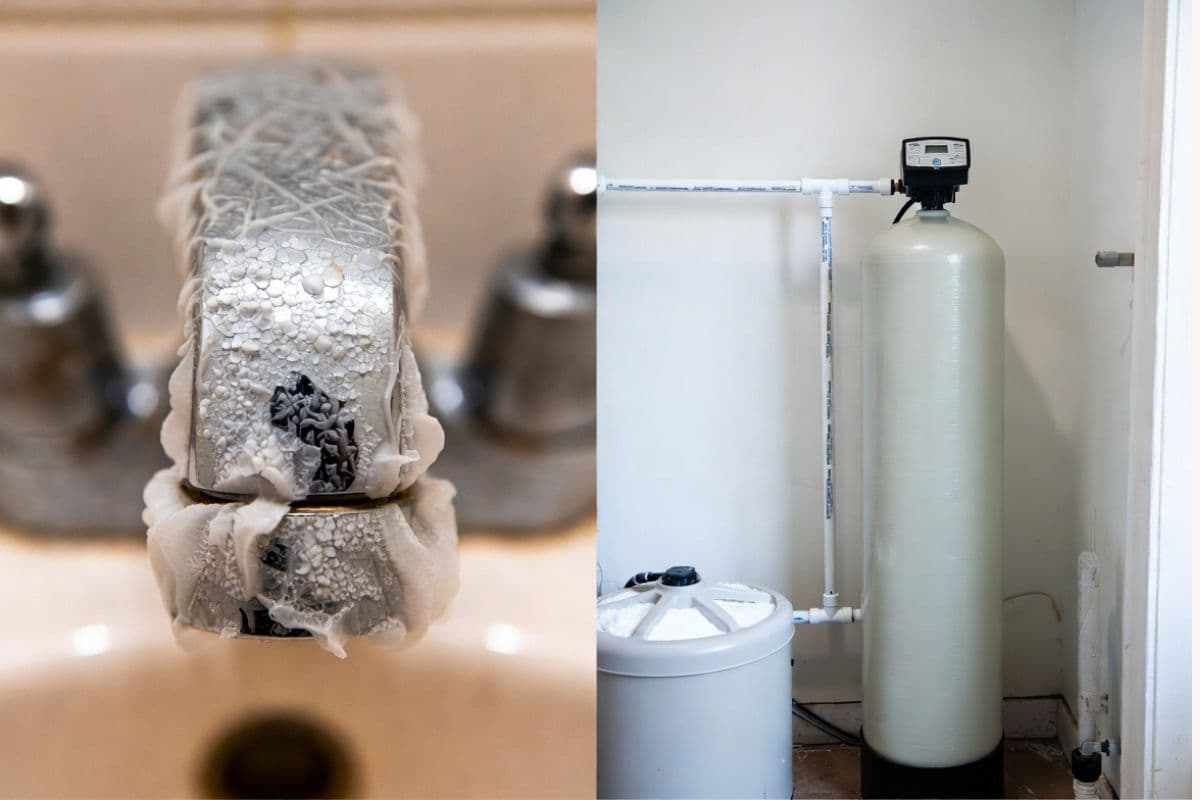
Quick answer: Hard water in private wells is caused by calcium and magnesium dissolved from limestone, dolomite, and other mineral-bearing rock as groundwater moves through the aquifer. Water above 7 grains per gallon (120 mg/L) causes visible scale on fixtures and reduces appliance efficiency. Water above 10.5 GPG causes significant damage to water heaters, plumbing, and appliances without treatment. The USGS estimates more than 85 percent of the United States has hard water, and private wells — which receive no softening treatment before reaching your home — are the highest-risk source. The correct treatment for most well owners is a water softener, but the sequence matters: iron must be removed before the softener, not the other way around.
What Makes Well Water Hard
Hardness is not contamination. It is the concentration of dissolved calcium and magnesium ions that naturally enter groundwater as it percolates through rock formations. Limestone and dolomite are the primary sources — groundwater in contact with these formations dissolves calcium carbonate and magnesium carbonate and carries them into the aquifer.
Unlike municipal water, which undergoes treatment at a central facility before delivery, private well water reaches your home exactly as it comes from the aquifer. There is no treatment step that removes hardness along the way. If your local geology produces hard water — and in most of the United States it does — your well water arrives hard.
The USGS Hardness of Water study found that water hardness varies dramatically across the country but that the hardest water in the United States is concentrated in the Midwest, Great Plains, and Southwest — areas where limestone and chalk formations are common or where evaporation concentrates dissolved minerals. The Northeast has moderate to hard water in many areas from glacial drift aquifers. The Pacific Northwest and parts of the Southeast tend toward softer water.
Understanding Hardness Measurements
Hardness is measured in two units in the United States. Both appear in water test results and softener specifications.
Grains per gallon (GPG) is the standard unit used by water softener manufacturers and most US water treatment professionals. It measures the weight of calcium carbonate equivalent dissolved minerals per gallon of water. One grain equals approximately 64.8 milligrams.
Parts per million (PPM) or milligrams per liter (mg/L) is the unit used in laboratory water quality reports and most scientific publications. PPM and mg/L are numerically identical.
The conversion: 1 GPG = 17.1 PPM. To convert a lab result from PPM to GPG, divide by 17.1.
The Hardness Scale
| Hardness Category | GPG | PPM (mg/L) | What You Notice |
|---|---|---|---|
| Soft | 0 to 3.5 GPG | 0 to 60 PPM | No issues; soap lathers well |
| Moderately hard | 3.5 to 7 GPG | 60 to 120 PPM | Faint spots on dishes; slight reduction in soap lather |
| Hard | 7 to 10.5 GPG | 120 to 180 PPM | Visible scale on fixtures; soap scum; dry skin and hair |
| Very hard | 10.5 to 14.5 GPG | 180 to 250 PPM | Heavy scale buildup; appliance efficiency loss; strong soap scum |
| Extremely hard | Above 14.5 GPG | Above 250 PPM | Ongoing damage to pipes and appliances; treatment strongly recommended |
The Minnesota Department of Health recommends considering a water softener at hardness levels above 7 GPG. At hardness above 250 to 300 PPM (approximately 15 to 17 GPG), a softener becomes a practical necessity to protect plumbing and appliances.
How to Test for Hardness Before Calling Anyone
You do not need to pay a contractor or send a sample to a laboratory to get a reliable hardness measurement. Two at-home methods work well:
Test strips: Hardness test strips are available at hardware stores and online for $10 to $20. Dip the strip in a glass of cold water from the kitchen tap, compare the color to the provided chart, and read the result in GPG or PPM. Accuracy is within one to two GPG — sufficient to determine whether hardness is soft, moderate, hard, or very hard and whether treatment is warranted.
Drop count titration kit: A liquid test kit provides more precision than strips. You add drops of a reagent to a water sample until the color changes from red to blue. Each drop represents a specific hardness level, and you count the drops to calculate the GPG. Kits cost $15 to $30 and are accurate to within 0.5 GPG.
Sample collection for either test: Collect from a cold water tap, first thing in the morning before any water has run. Avoid collecting from a tap that has been recently running. This gives the most representative sample of the water as it comes from the well, not water that has been sitting in the pipes.
Why test from the kitchen tap rather than the outside hose bib: The kitchen tap serves the water you drink and use to cook. The outside tap is typically plumbed before the pressure tank in some configurations. Always test at the point of use, not at the source.
The Real Cost of Untreated Hard Water on a Well System
This is the section most hard water guides skip. Scale does not just affect dish spotting — it costs well owners money in ways that accumulate over years.
Water Heater
The Department of Energy has documented that scale accumulation inside a water heater tank reduces heating efficiency by 4 percent for every 5 GPG of hardness in the water. At 10 GPG hardness, a water heater operates at approximately 8 percent below its rated efficiency — you are paying 8 percent more in energy costs than the same heater would cost in soft water. At 20 GPG, efficiency loss approaches 16 percent.
Beyond energy cost, scale buildup shortens water heater lifespan. A water heater rated for 12 to 15 years can fail in as few as 8 years in very hard water conditions as scale accumulates at the bottom of the tank, creates hot spots, and damages the tank lining. Replacement costs $1,000 to $3,000 installed.
Submersible Pump
This is the hard water cost unique to well owners that city water customers never face. A well pump moves water upward from the aquifer against significant head pressure, and scale can accumulate in the pump impellers, pump body, and on the well screen at the bottom of the casing. Scale on pump impellers reduces pump efficiency and output over time. Scale on the well screen restricts the rate at which groundwater enters the well, which manifests as declining yield. This is why a well that tested at 5 GPM when new may test at 2 to 3 GPM 15 years later in a hard water area without treatment — the restriction is partly scale, not just aquifer decline.
Pressure Tank and Plumbing
Scale coats the inside of water lines, narrowing their internal diameter progressively. In a home with 15 GPG water and no softener, pipes that remain in service for 20 years accumulate measurable scale deposits that reduce flow rate and increase the pressure differential the pump must work against. This is invisible from the outside but shows up as gradually declining water pressure throughout the house.
Appliances
Dishwashers, washing machines, and water heaters all operate less efficiently in hard water. Research cited by the Department of Energy shows that appliances operating in very hard water (above 15 GPG) may need replacement 30 to 50 percent earlier than their rated lifespans. A dishwasher rated for 10 years failing at 6 to 7 years represents an unbudgeted $500 to $1,500 expense.
Cumulative Cost Estimate
For a household with 15 GPG untreated well water over a 20-year period, the combined cost of premature appliance replacement, increased water heater energy use, additional detergent consumption (hard water requires 30 percent more detergent for equivalent cleaning results), and pipe maintenance adds up to $4,000 to $8,000 compared to the same household with treated soft water. A quality water softener costs $800 to $2,500 installed and has an annual salt cost of $100 to $200. The math strongly favors treatment at hardness levels above 10 GPG.
The Iron and Hardness Problem: Why Most Well Guides Get It Wrong
This is the content gap that makes this guide different from every generic hard water article written for city water users.
Iron and hardness almost always co-occur in well water. Both calcium/magnesium and iron dissolve from the same rock formations. A well that has hard water almost always has at least some dissolved iron. And the relationship between iron and hardness treatment is the single most important thing to understand before buying any equipment.
A water softener cannot treat iron-bearing water the way most manufacturers suggest. The Penn State Extension, in their guidance on iron and manganese in private water systems, states that softeners are generally only recommended for iron removal when the dissolved iron concentration is below 5 mg/L (5 ppm) and the water has not been exposed to any oxidizing conditions (air, chlorine) that would convert dissolved ferrous iron to particulate ferric iron. Oxidized (ferric) iron will foul the softener resin within months, dramatically reducing the softener's effective hardness removal and requiring expensive resin cleaning or replacement.
Every 1 ppm of dissolved iron in the water effectively adds the equivalent of 3 to 5 GPG of additional burden on the softener resin. A softener rated for 32,000 grains of hardness capacity will exhaust that capacity much faster when iron is present because iron clings to the resin beads more aggressively than calcium or magnesium.
The Correct Treatment Sequence for Wells With Iron and Hardness
For wells where both iron and hardness are present — which is most wells in hard water regions — the correct sequence is:
Sediment pre-filter
Protects all downstream equipment from physical particles.
Iron removal system
Oxidizing filter, air injection system, or greensand filter depending on iron concentration and type — removes iron before it reaches the softener.
Water softener
Removes hardness from iron-free water, allowing the resin to operate at rated capacity and last its full service life.
Installing a softener without upstream iron removal in a well with more than 1 to 2 ppm of iron will result in resin fouling within 1 to 3 years, leading to iron breakthrough (orange water downstream of the softener), reduced softening effectiveness, and the need for expensive resin cleaning with a product like Iron Out.
For the complete guide to iron removal equipment options and the full treatment decision tree for wells with multiple contaminants, see the well water treatment options guide.
The Sodium Addition: What the Softener Does to Your Drinking Water
A water softener works by exchanging calcium and magnesium ions for sodium ions. The softened water is low in hardness minerals but higher in sodium than the raw well water. The amount of sodium added is directly proportional to the hardness removed.
The calculation: A water softener adds approximately 8 milligrams of sodium per liter for every grain per gallon of hardness removed. At 15 GPG hardness (fully softened): 15 × 8 = 120 mg/L of sodium added per liter of drinking water.
The EPA secondary drinking water guideline for sodium is 20 mg/L for taste. At 120 mg/L added sodium, softened water from a 15 GPG well significantly exceeds this guideline and may have a noticeably salty taste.
For most healthy adults, this additional sodium is clinically insignificant — the American Heart Association's daily sodium limit of 2,300 mg per day is unlikely to be exceeded from water alone even at 120 mg/L. However, for individuals on physician-prescribed low-sodium diets (for hypertension, heart disease, or kidney conditions), and for infants whose formula is mixed with tap water, sodium from softened water is a real concern.
Two solutions:
Potassium chloride instead of sodium chloride as the regenerant salt. Softeners can use potassium chloride (KCl) instead of sodium chloride (NaCl) in the brine tank. Potassium chloride adds potassium rather than sodium — a mineral most Americans consume too little of. It costs approximately 30 to 50 percent more per bag than sodium chloride but eliminates the sodium concern entirely. Most standard softeners can use either salt with no modification.
Point-of-use reverse osmosis for drinking water. An under-sink RO system at the kitchen tap removes virtually all sodium from softened water along with any other dissolved contaminants. Cost: $200 to $600 installed. This is the most common approach — soften the whole house for scale protection, use RO water for drinking and cooking.
See the well water treatment options guide for the full sodium calculation and treatment framework.
The Brine Discharge Concern for Well Owners
This is the hard water treatment consideration that is unique to private well owners and absent from virtually every softener guide written for the general market.
When a water softener regenerates, it flushes the accumulated calcium and magnesium from the resin beads using a concentrated brine solution (salt dissolved in water). This brine is discharged to the drain and ultimately to the septic system or municipal sewer. In most configurations for well-served properties, the discharge goes to a septic system.
The septic concern: The New Hampshire Department of Environmental Services notes that brine discharge from water softeners can affect groundwater quality in high-density rural areas with shallow wells. Sodium and chloride from brine that enters the soil through a septic system can reach neighboring wells, particularly shallow dug or bored wells. The impact depends on local soil type, distance to neighboring wells, and the frequency of regeneration.
For well owners with septic systems in areas with dense rural development and shallow wells, efficiency-optimized softeners that minimize brine volume — demand-initiated regeneration (DIR) systems that regenerate only based on actual water usage rather than on a fixed schedule — are preferable to timer-based systems. DIR systems use 25 to 50 percent less salt per year than timer-based systems, which also reduces brine discharge volume.
Salt-Free Conditioners: What They Can and Cannot Do
Salt-free water conditioners (also called template assisted crystallization or TAC systems, or salt-free softeners) are marketed as an alternative to traditional ion exchange softeners. Understanding exactly what they do and do not do is essential before buying.
What salt-free conditioners do: They use a specialized media to convert dissolved calcium and magnesium into microscopic crystals that remain suspended in the water but do not adhere to pipe surfaces or heating elements. This prevents scale formation in pipes and water heaters. No salt is added. No sodium is introduced. No brine is discharged.
What salt-free conditioners do not do: They do not remove calcium and magnesium from the water. The water remains technically hard — hardness minerals are still present. Soap will still not lather as well as it does with softened water. There will still be spots on dishes and glass. Skin and hair will not feel as noticeably different as they do with truly softened water.
When a Salt-Free Conditioner Is Appropriate
- •Hardness is moderate (7 to 12 GPG) and the primary concern is scale in pipes and the water heater rather than soap performance and laundry results
- •Environmental concerns about salt discharge are significant
- •Iron is absent or below 0.5 ppm (most salt-free systems are more sensitive to iron than standard softeners)
- •The property is in an area with discharge restrictions on softener brine
When a Traditional Ion Exchange Softener Is Necessary
- •Hardness is above 12 to 15 GPG
- •Iron co-occurs with hardness above 1 ppm (after iron removal upstream)
- •Complete softening for laundry, skin, and soap performance is the goal
- •Manganese is present (TAC systems do not address manganese effectively)
Choosing the Right Softener Size: The Calculation
Undersizing a softener causes it to regenerate too frequently, wasting salt. Oversizing causes it to regenerate on time rather than on demand, which can allow the resin to sit too long between regenerations and reduces efficiency.
The Sizing Formula
Daily grain demand = Water hardness (GPG) × Number of people in household × 75 gallons per person per day
Multiply by 7 for weekly demand. Add 30 percent buffer for efficiency margin.
Worked Example: Family of 4, well water at 12 GPG
- Daily demand: 12 GPG × 4 people × 75 gallons = 3,600 grains per day
- Weekly demand: 3,600 × 7 = 25,200 grains
- With 30% buffer: 25,200 × 1.3 = 32,760 grains
This household needs a softener with at least 32,000 grain capacity — a standard 32,000-grain unit is appropriate.
The iron adjustment: If iron is present above 1 ppm and not removed upstream, add 3 to 5 GPG to your hardness number before calculating. Iron places additional burden on the resin and requires a larger effective capacity. This is another reason why removing iron upstream is preferable to treating it with the softener — it allows the softener to be sized correctly for actual hardness without the iron penalty.
Annual Maintenance for a Well Water Softener
A water softener on a private well requires more attention than the same softener on city water because well water typically has more variables — occasional turbidity, iron, and fluctuating hardness.
Monthly
Check salt level in the brine tank. Maintain salt at least half-full. Check for salt bridges (a crust that forms across the top of the salt preventing it from dissolving) by pressing down with a broom handle — a bridge will feel solid rather than giving way to loose salt. Break any bridge with the handle before it cuts off the regeneration cycle.
Every 3 to 6 Months
If iron is present even at low levels, treat the softener resin with a resin cleaner such as Iron Out. This removes iron accumulation from the resin beads before it impairs hardness removal capacity. Do not skip this step if your well water has iron above 0.3 ppm.
Annually
Check the brine valve and injector for mineral buildup. Verify the regeneration settings match your current water usage — if household size changes, update the settings. Collect a water test before and after the softener to confirm it is still achieving adequate hardness reduction. A post-softener result of 0 to 1 GPG is the target.
Every 3 to 5 Years
Have a licensed water treatment professional service the control valve, inspect the resin for signs of fouling or degradation, and verify the brine tank is clean and the float mechanism is functioning correctly.
For a personalized water softener cost estimate based on your home size, occupancy, and region, use our well water treatment cost calculator.
Frequently Asked Questions
How do I know if my well water is hard?
Test it with a hardness test strip ($10 to $20 at hardware stores) or a drop count titration kit ($15 to $30). Collect the sample from the cold kitchen tap before any water has run that morning. Results in GPG: below 3.5 is soft, 3.5 to 7 is moderately hard, 7 to 10.5 is hard, above 10.5 is very hard. Visual signs of hard water include white chalky scale around faucet bases and showerheads, spots on dishes and glasses after washing, poor soap lather, and stiff laundry.
Is hard well water safe to drink?
Yes. Calcium and magnesium — the minerals that cause hardness — are not health hazards. The EPA does not set a Maximum Contaminant Level for hardness because it has no direct health effects. At very high levels (above 400 to 500 PPM) hard water may have a bitter taste or mineral flavor, but it is safe to consume. The health concern associated with water softeners is the sodium added to the water during the softening process, which is relevant for people on sodium-restricted diets. See the sodium calculation section above.
Can a water softener remove iron from well water?
A standard water softener can remove small amounts of dissolved ferrous iron — typically up to 2 to 3 ppm in favorable conditions. However, using a softener as the primary iron removal method causes resin fouling over time, dramatically shortens the resin's effective life, and produces inconsistent results. The correct approach is to remove iron with a dedicated oxidizing filter upstream of the softener, then use the softener only for hardness. For wells with iron above 1 ppm, this sequence is essential.
What is the white buildup on my faucets and showerheads?
Scale — deposits of calcium carbonate and magnesium carbonate that precipitate out of the water when it evaporates or is heated. The same deposits accumulate inside your water heater, dishwasher, washing machine, and pipes — just invisibly. Vinegar dissolves calcium carbonate and is effective for cleaning surface scale from faucets and showerheads. Soak the fixture or a cloth wrapped around it in undiluted white vinegar for 30 to 60 minutes, then scrub. This addresses the visible symptom but not the underlying water quality.
How much salt does a water softener use per month?
Salt usage depends on water hardness, daily water consumption, and softener efficiency. A typical family of four with 10 GPG water uses approximately 6 to 10 pounds of salt per regeneration cycle and regenerates 2 to 3 times per week — approximately 50 to 120 pounds of salt per month. Higher hardness or larger households use more. Demand-initiated regeneration softeners reduce salt use by 25 to 50 percent by regenerating only when needed based on actual water usage, not on a fixed schedule. Salt costs $5 to $10 per 40-pound bag for sodium chloride; potassium chloride costs $20 to $30 per 40-pound bag.
Do I need a water softener if I have a salt-free conditioner?
A salt-free conditioner prevents scale formation but does not remove hardness minerals from the water. If scale on pipes and the water heater is your only concern and hardness is below 12 to 15 GPG, a conditioner may be adequate. If you also want improved soap lather, softer-feeling skin and hair, and better laundry results — which require actual removal of calcium and magnesium from the water — a traditional ion exchange softener is necessary. Salt-free conditioners do not soften water; they condition it. The distinction matters for what outcome you should expect.
How often should I test my well water for hardness?
Test hardness annually as part of your overall well water quality test. Hardness in a given well is typically stable year-to-year because it reflects the mineral content of the aquifer, which does not change rapidly. However, if you notice changes in scale formation, soap performance, or softener salt consumption, retest immediately. Extended drought can slightly increase hardness as the water table drops and water spends more time in contact with rock. After any flooding event, retest for bacteria before testing for other parameters.
What causes hard water to smell or taste different?
Hardness itself (calcium and magnesium) does not produce taste or odor. If your hard well water has a metallic taste, the cause is likely iron or manganese — both often co-occur with hardness in wells. If it has a sulfur or rotten egg smell, hydrogen sulfide is present — a separate contaminant not addressed by softening. If it tastes salty after softening, the softener is adding sodium during the ion exchange process — this is expected and addressed by using potassium chloride salt or adding a point-of-use RO system for drinking water. See the well water tastes bad guide for the complete taste and odor diagnostic.
Glossary
Grains Per Gallon (GPG)
The standard unit of water hardness measurement in the United States, used by water softener manufacturers and water treatment professionals. One grain equals approximately 64.8 milligrams of calcium carbonate equivalent. The conversion from laboratory PPM results to GPG is: divide PPM by 17.1. A water test result of 170 PPM is approximately 10 GPG — hard water that warrants softener consideration.
Ion Exchange
The chemical process used by traditional water softeners to remove hardness. Water passes through a bed of synthetic resin beads that are charged with sodium or potassium ions. Calcium and magnesium ions in the water have a stronger attraction to the resin beads than sodium or potassium ions and replace them, releasing sodium or potassium into the water. The resin beads eventually become saturated with calcium and magnesium and must be regenerated by flushing with concentrated brine, which restores the sodium or potassium charge.
Scale
The hard, chalky deposits of calcium carbonate and magnesium carbonate that precipitate from hard water when it is heated or evaporates. Scale is the visible manifestation of water hardness — on faucets, showerheads, and glass it appears as white or grey deposits; inside water heaters, pipes, and appliances it accumulates as a rock-like layer that reduces efficiency, restricts flow, and shortens equipment lifespan. Scale formation accelerates at higher temperatures, which is why water heaters are disproportionately damaged by hard water.
Demand-Initiated Regeneration (DIR)
A water softener control system that regenerates the resin based on actual water volume processed rather than on a fixed time schedule. DIR softeners measure how much water has been softened since the last regeneration and trigger a regeneration cycle when the resin capacity approaches exhaustion. Compared to timer-based regeneration, DIR systems use 25 to 50 percent less salt, produce less brine discharge, and more reliably prevent hardness breakthrough because they respond to actual usage patterns rather than assuming constant daily consumption.
Resin Fouling
The accumulation of iron, manganese, or other metals on water softener resin beads that reduces the resin's ion exchange capacity and softening effectiveness. Even small amounts of iron in the source water — as little as 0.3 to 0.5 ppm — will gradually foul resin beads over months to years if not addressed with periodic resin cleaning treatments. Severe fouling requires either chemical cleaning with a resin cleaner or complete resin replacement, which costs $200 to $500 for a residential softener. Installing an iron removal filter upstream of the softener prevents resin fouling entirely.
External Resource
The USGS Water Hardness in the United States map and supporting data at usgs.gov/water-science-school provides the most comprehensive publicly available reference for regional hardness patterns across the country, sourced from thousands of groundwater sampling locations. Use it to understand whether your region's geology typically produces hard or soft groundwater before testing your specific well.