Some links on this page are affiliate links. If you purchase through them, we may earn a small commission at no extra cost to you. This does not affect our recommendations.
Quick answer:
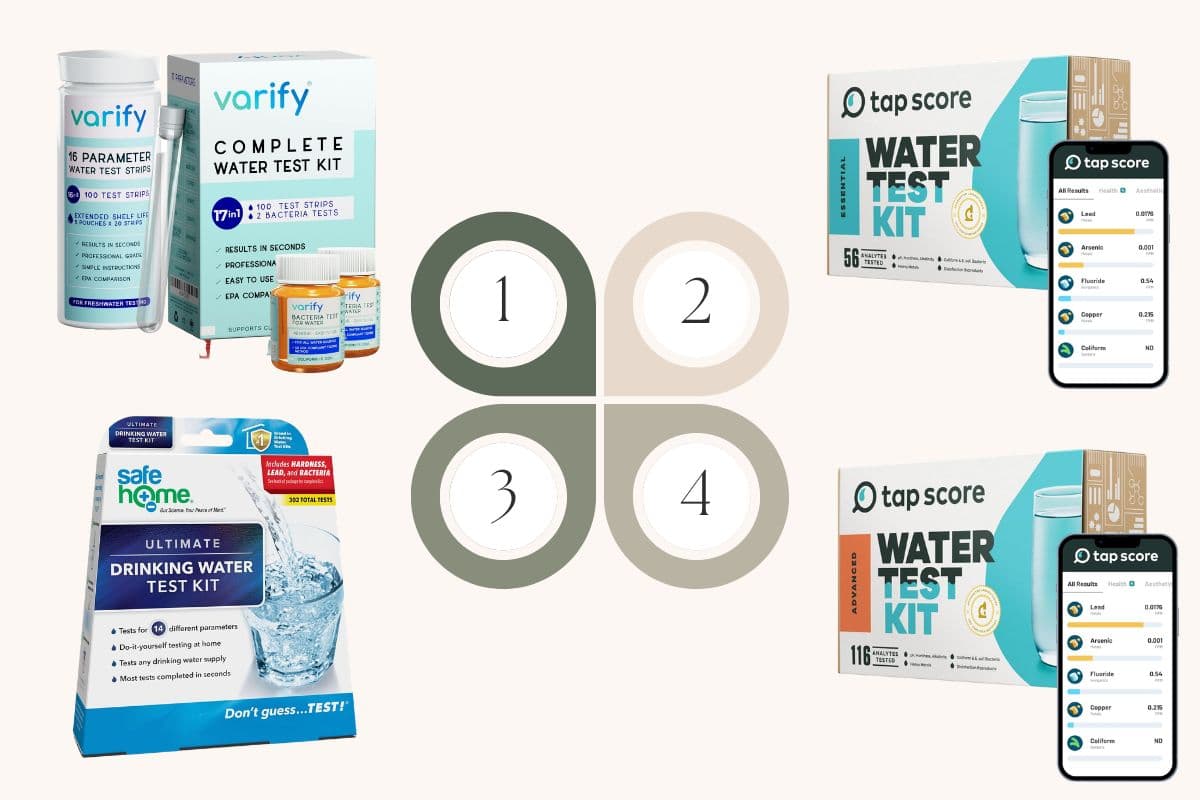
Every private well owner needs two types of test: a certified lab test once a year to establish a baseline and catch invisible health threats, and a DIY strip test on hand for quick checks between lab tests. For the annual lab test, the Tap Score Essential Well Water Test (about $193, 50-plus analytes, results in 5 business days from lab receipt) is the best option for most households. If you are near farmland, an industrial facility, or a military base, upgrade to the Tap Score Advanced Well Water Test (about $290, 116 analytes, adds VOCs and industrial chemicals). For the most comprehensive one-time baseline ever done on a well, the Safe Home ULTIMATE (about $380 to $499, 200 parameters) covers everything including 130 volatile and semi-volatile organic compounds. For daily or weekly DIY monitoring between lab tests, the Varify 17-in-1 (about $25 to $32, 100 strips plus 2 bacteria tests) is the best strip kit available on Amazon.
Well water is not regulated. No government agency tests your private well or tells you when something is wrong. The EPA recommends annual testing at minimum, but the testing itself is entirely the homeowner's responsibility. Most well owners test their water either never or once, which means most well owners do not know what is in their water. A USGS study found 13 percent of private wells exceed at least one federal health standard. Arsenic, nitrates, lead, bacteria, and PFAS can all be present in water that looks, smells, and tastes completely normal. The only way to know is to test.
This review covers the four best well water test kits available on Amazon, explains what each one does well and where it falls short, and tells you exactly which one to buy based on your situation.
Lab Tests vs. DIY Strips: Buy Both
This is the question everyone asks first and the answer is not one or the other. You need both, for different purposes, and they are not interchangeable.
Certified lab tests send your water sample to an EPA/NELAC/ISO-certified laboratory where trained chemists run it through instruments that can detect contaminants at parts per billion or parts per trillion. The results are quantitative (not just present or absent, but how much), legally recognized, and compared directly to EPA Maximum Contaminant Levels. Lab tests catch the things that matter: arsenic at 8 ppb, nitrates at 12 mg/L, lead at 18 ppb, coliform at detectable levels. These numbers tell you whether your water is safe and how close you are to the limits that protect health.
DIY strip tests use colorimetric chemistry. You dip a strip in water, wait 60 seconds, and compare the color change to a printed chart. Results are approximate ranges, not precise concentrations. A strip might tell you iron is in the 1 to 3 mg/L range. It will not tell you that iron is exactly 2.1 mg/L or that iron bacteria are present (which requires a different test entirely). Strip tests cannot detect arsenic, radon, PFAS, or most VOCs at relevant concentrations. They have real value for monitoring whether your water treatment system is working, checking for obvious problems between annual lab tests, and screening water quality after events like flooding or nearby construction. They do not replace lab tests for health-critical decisions.
The correct approach: Annual lab test as the foundation. DIY strips as the between-tests monitoring tool. Use lab results to understand what is in your water and calibrate your concern level. Use strips to watch for changes from that baseline.
What to Look for in a Well Water Test Kit
Before evaluating any specific product, these five factors help you assess any kit you encounter.
Lab certification is mandatory for health decisions. Look for EPA, NELAC/TNI, and ISO 17025 certification. A lab holding these certifications has been independently audited for accuracy and quality control. The certification should be verifiable on the lab's public website, not just claimed in product copy. An uncertified lab's results cannot be reliably compared to EPA MCLs.
More analytes is not always better. Kits advertising “tests for 200 contaminants” sometimes pad the list with parameters that have no realistic chance of appearing in residential well water. A kit testing 50 relevant analytes accurately is more useful than one testing 500 with lower precision. Always find the published analyte list and confirm it covers contaminants relevant to your area.
Prepaid return shipping changes the total cost. Kits requiring you to arrange your own return shipping are often cheaper at the listed price but more expensive in total. Overnight shipping for bacteria-containing samples runs $40 to $70. A kit listed at $150 with no shipping included often costs more in total than a $193 kit with prepaid labels both ways.
The report format determines whether results are actionable. A raw spreadsheet with concentrations in micrograms per liter is accurate but not useful for most homeowners. The best lab kits compare every result against EPA limits, flag exceedances in plain language, explain health implications, and recommend specific treatments. Ask to see a sample report before you buy.
NELAC and TNI refer to the same certification. NELAC (National Environmental Laboratory Accreditation Conference) became TNI (The NELAC Institute) in 2009. Both names appear in marketing copy. Both represent the same accreditation standard.
How We Chose These Four
Every kit on this list meets all of the following criteria:
Certified laboratory (for the lab tests): The lab processing your sample holds EPA, NELAC, ISO 17025, and/or multi-state certification. This is not optional. An uncertified lab produces results that are not comparable to EPA standards and may not be accurate. Avoid any kit whose lab certification you cannot verify.
Transparent analyte list: Every contaminant the kit tests for is listed before you buy. Kits that advertise “tests for hundreds of contaminants” without listing them are marketing noise. More analytes does not mean better results if the additional analytes are industrial chemicals with no realistic chance of appearing in residential well water.
Prepaid return shipping (for lab tests): Lab kits that require you to arrange and pay for overnight shipping cost significantly more than advertised. The kits on this list include prepaid return shipping labels.
Real-world accuracy: For DIY strip kits, independent head-to-head comparisons against certified lab results inform the recommendation. Not all strip kits perform as advertised.
No free water test from a treatment company: This cannot be said often enough. If a water softener company, filter company, or any water treatment business offers you a free water test, decline. These tests are designed to identify problems that justify buying their products. They are not objective assessments of your water quality. Use an independent certified laboratory.
The Four Best Well Water Test Kits
Tap Score Essential Well Water Test
Best for: Annual baseline testing for most private well households
Type
Certified lab
Analytes
50+
Turnaround
5 business days
Price
~$193
Lab certification: EPA, NELAC, ISO 17025, state-certified. Includes: Collection bottles, sampling instructions, prepaid return shipping label, online account access to results.
What it tests: The Essential Well Water Test covers the core contaminants the EPA recommends testing annually: total coliform bacteria, E. coli, nitrates, and general water chemistry. It also covers the heavy metals most commonly elevated in private wells, including arsenic, lead, manganese, iron, copper, barium, chromium, and uranium. Hardness, alkalinity, pH, and total dissolved solids are included. The full analyte list is published on the Tap Score and Amazon product pages before you buy.
The report: This is what separates Tap Score from every other lab kit. The results arrive as an interactive report in your online account, not a raw data spreadsheet. Every analyte result is evaluated against EPA standards with a clear pass or fail reading. Results that exceed health thresholds are flagged with explanation and treatment recommendations written by PhD scientists. The report is designed to be understood by a homeowner, not a water chemist. Tap Score also offers direct chat access to PhD scientists who answer questions about your specific results at no additional cost.
Turnaround: Tap Score publishes a 5-business-day turnaround from the date the lab receives your sample. Shipping to the lab takes 2 to 4 days depending on location, so total time from collection to results is typically 7 to 10 days.
Limitations: The Essential kit does not include VOCs (volatile organic compounds), disinfection byproducts, pesticides, or PFAS. If you are near agricultural land, an industrial facility, a gas station, or a military base, you need the Advanced kit described below. The Essential is the right starting point for a well with no known risk factors for chemical contamination beyond naturally occurring minerals.
What this kit will not catch: PFAS, VOCs from fuel or solvents, pesticides, herbicides, radon, and most industrial chemicals. If any of these are relevant to your location, upgrade to the Advanced kit or add a separate PFAS panel.
Why it is the top pick: Wirecutter has recommended Tap Score as the top home water test kit. The combination of certified lab accuracy, the most readable and useful results report of any kit available, prepaid shipping both ways, and direct PhD scientist support for questions makes this the strongest value in annual well water testing for most households.
Who should buy it: Every private well owner who has never tested or has not tested in more than a year. Households in areas without known industrial or agricultural contamination. Anyone who wants a comprehensive annual health check on their well water without testing for every possible contaminant.
Check Price on AmazonTap Score Advanced Well Water Test
Best for: Wells near agricultural land, industrial sites, military bases, or with prior contamination concerns
Type
Certified lab
Analytes
116
Turnaround
5 business days
Price
~$290
Lab certification: EPA, NELAC, ISO 17025, state-certified. Includes: Collection bottles and vials, sampling instructions, prepaid return shipping labels, online account access.
What it adds over the Essential: The critical addition is volatile organic compounds (VOCs) — a class of industrial chemicals that includes benzene, toluene, trichloroethylene (TCE), tetrachloroethylene (PCE), and MTBE. These chemicals enter groundwater from underground storage tank leaks (gas stations), industrial spills, dry cleaning operations, and landfill leachate. They migrate through groundwater over long distances. A well a half-mile from a gas station can have VOC contamination the owner never suspects. The Advanced kit also adds disinfection byproducts and additional oil-and-gas-related indicators.
Who specifically needs this kit: If your well is within 1 mile of a gas station, dry cleaner, industrial facility, landfill, or auto repair shop, the VOC panel is not optional, it is necessary. If you are within 10 miles of a military installation or airport, VOC testing plus ideally a separate PFAS panel covers the key exposure risks. If any neighbor has reported water quality problems, if you have noticed any petroleum or solvent smell in your water, or if your well is in an area with documented groundwater contamination history, this is your kit.
The report: Same interactive format as the Essential. Every result compared against EPA standards, flagged detections explained with treatment recommendations, PhD support for questions.
Limitations: The Advanced kit does not include PFAS (“forever chemicals”). PFAS require a separate specialized test using EPA Method 533 or 537.1 that Tap Score offers as a standalone addition. If PFAS is a concern due to proximity to military bases, airports, or industrial facilities, order the PFAS panel separately or consider the Safe Home ULTIMATE below.
What this kit will not catch: PFAS, radon, uranium, and the full semi-volatile organic compound panel in the Safe Home ULTIMATE. For most residential wells these gaps are not material, but they matter near nuclear facilities or in high-uranium geology.
Why it earns the second position: For well owners in any area with agricultural or industrial land use, the $97 upgrade from the Essential to the Advanced is the right call. VOC contamination is invisible, odorless, and can be present at dangerous levels without any detectable change in water quality. One lab test catches it before long-term exposure causes harm.
Who should buy it: Well owners near farms, feedlots, gas stations, dry cleaners, industrial facilities, military bases, airports, or any documented contaminated site. Households with a first test showing unexpected results who want a more complete picture. Anyone buying a home with a well and doing due diligence before purchase.
Check Price on AmazonSafe Home ULTIMATE Drinking Water Test Kit
Best for: The most comprehensive one-time baseline ever done on a well, new home purchases, or wells with unknown history
Type
Certified lab
Analytes
200
Turnaround
7-10 business days
Price
~$380-$499
Lab certification: EPA certified, ISO 17025 (Environmental Laboratories, Inc., Madison, IN, in business since 1983). Includes: Water collection vessels, free return shipping, online account access to color-coded report.
What it is: The Safe Home ULTIMATE is the most comprehensive consumer water test available. Its 200 parameters include the most extensive VOC panel of any consumer kit, covering 130 volatile and semi-volatile organic compounds, pesticides, herbicides, plasticizers, and carcinogenic industrial compounds. The 31 metals panel is broader than any other kit on this list. If it is in water and a lab can detect it, this kit tests for it.
The report: Safe Home provides a color-coded report comparing every result to EPA MCLs. Results are available in your online account within 7 to 10 business days of lab receipt. The format is less conversational than Tap Score's interactive report but is highly detailed and structured clearly enough for a non-specialist to interpret.
The value argument: Bob Vila's testing review made the point that is worth repeating: the per-parameter cost of the ULTIMATE is roughly $2, which is the same per-parameter cost as a $30 DIY strip kit testing 15 parameters. For a homeowner buying a house with a well and no testing history, the $380 to $499 ULTIMATE gives you more complete information than any other single test available, with certified lab accuracy across all 200 parameters. One time, you know everything.
Limitations: The ULTIMATE does not test for PFAS using modern EPA Method 533 or 537.1. PFAS require a specialized test not currently available as part of any 200-parameter bundle. If PFAS is a concern, add a separate PFAS-specific panel. The ULTIMATE also requires overnight return shipping that you arrange (not included), which adds $40 to $70 depending on location. Factor this into the total cost.
What this kit will not catch: PFAS at the 4 ppt sensitivity required by EPA Method 533 or 537.1. The ULTIMATE does not use these specialized extraction methods. It also does not include a radon water test. Add standalone tests for PFAS and radon if either is a concern.
Who should buy it: Anyone buying a home with a well and no prior testing history — this is the best single test for due diligence before purchase. Well owners who have never done a comprehensive test and want a complete picture once. Wells in areas with industrial or agricultural history where you want coverage of every possible chemical class. Anyone whose water has unexplained odors, tastes, or colors that prior tests have not explained.
Check Price on AmazonVarify 17-in-1 Complete Drinking Water Test Kit
Best for: DIY monitoring between annual lab tests, post-event screening, and filter performance checking
Type
DIY strips
Parameters
17 + bacteria
Turnaround
60 sec / 48 hr
Price
~$25-$32
Includes: 100 test strips, 2 bacteria test vials, color comparison chart, instructions.
What it is: Varify is the strongest well-focused DIY strip kit available on Amazon. The 100 strips give you 100 individual tests at under $0.30 per strip, making it practical to test monthly or after any event that might affect water quality. The two included bacteria test vials use a colorimetric growth media: fill the vial, wait 48 hours, yellow means no coliform bacteria detected, green means coliform bacteria present. For a DIY bacteria screen, this is as good as strips get — though a positive result always needs confirmation from a certified lab.
Accuracy context: No strip test is as accurate as a certified lab. The Varify strips provide approximate ranges (0 to 0.5 mg/L, 0.5 to 1 mg/L, 1 to 3 mg/L, and so on) rather than precise concentrations. The color-matching process introduces some subjectivity, and results should be photographed immediately because colors fade within minutes. Independent testing by Family Handyman described the Varify as having exceptional accuracy for a strip kit, particularly for pH, nitrates, and hardness.
What it cannot detect: Arsenic, radon, uranium, PFAS, VOCs, pesticides, and most other chemical contaminants are not detectable by strip tests at concentrations relevant to health. Do not use strip results to make decisions about whether your water is safe for drinking. Use strip results to watch for changes from your last lab test baseline and to verify that treatment systems are working.
Practical uses for well owners:
- Monthly iron and manganese checks if you have a treatment system
- Post-flood or post-storm initial screening before you get lab results back
- Confirming that a new water softener is removing hardness as expected
- Checking pH and hardness seasonally in areas with variable water chemistry
- The bacteria test as a quick screen when water looks or smells off (always confirm positives with a lab)
Who should buy it: Every private well owner, alongside an annual lab test. Households with iron or manganese treatment systems that need regular performance verification. Anyone who wants a quick check after flooding, plumbing work, or any change in water quality. New well owners getting a feel for their water while waiting for lab results.
What this kit will not catch: Arsenic, lead below about 15 ppb, PFAS, radon, VOCs, pesticides, and most industrial chemicals. The bacteria test has documented false negative issues at low coliform concentrations — a negative result from the Varify bacteria test is reassuring but not conclusive. Treat any positive result as confirmed and seek lab verification. Treat a negative result as a screening outcome that warrants annual lab confirmation.
Check Price on AmazonStrip Test vs. Lab Test: A Direct Accuracy Comparison
This shows what the same water sample looks like when tested by a certified lab versus a DIY strip kit. The numbers illustrate why strips are useful for monitoring but not for health decisions.
| Parameter | Actual Lab Result | What a Strip Reports | EPA Limit | Decision Risk |
|---|---|---|---|---|
| Arsenic | 8 ppb | Not detectable | 10 ppb MCL | High — near limit, invisible to strips |
| Nitrates | 7.2 mg/L | “0-10 mg/L” range | 10 mg/L MCL | Medium — range includes safe and unsafe |
| Lead | 12 ppb | “Detected” only | 15 ppb action level | High — no quantity, critical for children |
| Iron | 1.8 mg/L | “1-3 mg/L” range | 0.3 mg/L aesthetic | Low — aesthetic only, strips adequate |
| pH | 7.4 | “7.0-7.5” range | 6.5-8.5 target | Low — strips adequate for pH monitoring |
| Hardness | 185 mg/L | “150-250 mg/L” range | No health limit | Low — aesthetic only |
| PFAS (PFOA) | 6.2 ppt | Not detectable | 4 ppt MCL (public systems) | High — above limit, invisible to strips |
| E. coli | Absent | Absent (48 hr test) | Zero allowed | Low for negative results |
The arsenic, lead, and PFAS rows are the critical ones. All three can sit at or above health thresholds and produce a strip result that looks clean. Arsenic at 8 ppb is near the 10 ppb limit and requires reverse osmosis treatment — a strip tells you nothing. PFAS at 6.2 ppt exceeds the EPA's health-based threshold and is completely invisible to any DIY strip product. Lead at 12 ppb is below the action level but above zero and significant for infants — the strip says only “detected” without any concentration.
This does not make strip tests useless. For iron, manganese, hardness, pH, nitrates, and bacteria presence/absence, they are good monitoring tools. The key is knowing which parameters strips can measure reliably and which ones they cannot.
Side-by-Side Comparison
| Kit | Type | Analytes | Turnaround | Price | Best For |
|---|---|---|---|---|---|
| Tap Score Essential Well | Certified lab | 50+ | 5 business days | ~$193 | Annual baseline, most households |
| Tap Score Advanced Well | Certified lab | 116 | 5 business days | ~$290 | Agricultural/industrial proximity |
| Safe Home ULTIMATE | Certified lab | 200 | 7-10 business days | ~$380-$499 | New home purchase, full baseline |
| Varify 17-in-1 | DIY strips | 17 + bacteria | 60 sec (strips), 48 hr (bacteria) | ~$25-$32 | Monitoring between lab tests |
How to Choose the Right Kit for Your Situation
The Real Annual Cost of Testing Your Well
Most homeowners compare the Tap Score Essential at $193 against a $32 strip kit and conclude the lab test is too expensive. That comparison misses how the two products work together as a system.
A complete annual well water monitoring setup: one Tap Score Essential per year ($193) plus one box of Varify 17-in-1 strips ($32) used monthly. Total annual cost: $225. This covers a certified lab baseline plus 12 monthly DIY checks plus 2 bacteria screenings.
On a per-test basis: Varify strips cost $0.32 each. The Tap Score Essential is $193 for one comprehensive annual snapshot. Together they cost less than a single urgent care visit for gastrointestinal illness ($150 to $300), less than commissioning a private lab test for one specific contaminant ($30 to $80 each), and far less than a water softener installed for the wrong contaminant ($800 to $3,500).
The cost of annual well water testing done correctly is lower than the cost of one medical visit for a waterborne illness or one unnecessary treatment system.
| Your Situation | Recommended Kit | Why |
|---|---|---|
| Never tested your well | Tap Score Essential | Covers the most common health-relevant contaminants at a sustainable annual price. Upgrade to Advanced if results show unexpected findings. |
| Buying a home with a well | Safe Home ULTIMATE | 200 parameters against EPA standards gives the most complete picture for due diligence. Add a separate PFAS panel if location warrants. |
| Near gas station, industrial site, or military base | Tap Score Advanced | VOC contamination is your primary risk and the Essential does not cover it. |
| Have a treatment system (iron, manganese, hardness) | Varify 17-in-1 | Monthly monitoring confirms your system is working. An iron filter losing media efficiency shows in strip results before you notice staining. |
| Water changed suddenly | Varify strips first, then Tap Score Advanced | Strips for immediate screening. Lab test for the full picture if the change is dramatic or you suspect contamination. |
| Flooding near your well | Varify bacteria test, then certified lab | Flooding introduces surface contamination. The 48-hour bacteria test is your first action, then order a certified lab test. |
| Pregnant, infant, or immunocompromised household | Tap Score Essential (test more often) | Test annually at minimum. Add a standalone nitrate test if preparing formula. The EPA's 10 mg/L nitrate limit specifically protects infants under 6 months. |
What to Do After You Get Your Results
Everything passes: Keep the report. Note the date. Retest in 12 months. If any results were close to EPA limits (within 25 percent of the MCL), retest at 6 months.
Bacteria detected: Stop drinking the unfiltered water immediately. Use bottled water or boil for drinking and cooking. Identify the contamination pathway: check the well cap, casing, any recent flooding, or septic system proximity. Shock chlorinate the well following your state health department's guidance. Retest at least 2 weeks after disinfection. Do not resume drinking unfiltered water until a retest shows bacteria absent. See the shock chlorination guide for the complete procedure.
Nitrates above 10 mg/L: Do not use for infant formula or during pregnancy. Install a reverse osmosis system for drinking and cooking. Standard carbon filters and water softeners do not remove nitrates.
Arsenic above 5 ppb: Install a reverse osmosis system at the kitchen tap for drinking and cooking. RO systems reduce arsenic by 95 percent or more. If results are above 10 ppb (the EPA MCL), treat this as a priority.
Lead detected at any level: First-draw sampling for lead testing is important: the sample should be the first water out of the tap after sitting idle for 6 to 8 hours. Any detection above 15 ppb requires action. Install a certified lead-removal filter (NSF/ANSI Standard 53) at the point of use. Do not let infants or children drink unfiltered water.
PFAS detected above 4 ppt for PFOA or PFOS: Reverse osmosis and granular activated carbon are the two most effective treatments. Contact your state environmental agency to determine if any remediation programs apply to your area. PFAS contamination is often the result of offsite sources and may qualify for remediation funding.
Frequently Asked Questions
What is the best well water test kit?
For most private well owners, the Tap Score Essential Well Water Test is the best annual lab test. It covers 50-plus analytes including bacteria, heavy metals, nitrates, and general chemistry at around $193 with prepaid return shipping and results in 5 business days from lab receipt. The results report is the most readable and useful of any kit available, with every result compared to EPA standards and flagged detections explained with treatment recommendations. For wells near agricultural or industrial land, upgrade to the Tap Score Advanced, which adds VOCs and industrial chemicals for around $290.
What does a well water test kit test for?
It depends entirely on the kit. The Tap Score Essential tests for 50-plus parameters including bacteria, heavy metals (arsenic, lead, manganese, iron, uranium), nitrates, pH, hardness, and alkalinity. The Tap Score Advanced adds VOCs and industrial chemicals (116 total analytes). The Safe Home ULTIMATE covers 200 parameters including 130 volatile and semi-volatile organic compounds. DIY strip kits like the Varify test for approximate levels of 17 parameters but cannot detect arsenic, PFAS, radon, or most chemical contaminants. Always check the published analyte list before buying any test kit.
How accurate are home well water test kits?
Certified lab kits (Tap Score, Safe Home ULTIMATE) are highly accurate because the actual analysis is performed by certified lab instruments, not by you. Your job is to collect the sample correctly and ship it promptly. DIY strip kits are much less accurate than lab tests. Strips provide approximate ranges, not precise concentrations, and the color-matching process is subjective. Use lab kits for health-critical decisions. Use strip kits for monitoring between lab tests.
How often should I test my well water?
The EPA and CDC recommend testing private well water at minimum once per year for total coliform bacteria, nitrates, total dissolved solids, and pH. A certified lab test that covers all four of these plus heavy metals and other contaminants relevant to your area should be done annually. You should also test immediately after any flooding or heavy rain event, after any work done on the well or plumbing, if you notice any change in taste or odor, and when you move into a home with a well for the first time.
Can I test my well water myself?
Partially. You can use DIY strip kits like the Varify 17-in-1 to screen for approximate levels of 17 parameters at home, and get results in 60 seconds for strips or 48 hours for the bacteria test. However, DIY strips cannot detect arsenic, lead at low concentrations, PFAS, radon, VOCs, or most chemical contaminants at health-relevant levels. For a complete picture of whether your water is safe, a certified lab test is required. Lab kits like Tap Score and Safe Home are easy to use yourself: you collect the sample, ship it in the prepaid packaging, and access your results online.
What well water tests are required when buying a house?
Requirements vary by state and lender. Some states require bacteria and nitrate testing as a condition of sale for homes with private wells. Some mortgage lenders require additional testing. Even if not required, a comprehensive lab test is strongly recommended before buying a home with a well. The Safe Home ULTIMATE (200 parameters) or Tap Score Advanced (116 analytes) are both appropriate for purchase due diligence. The cost of discovering contamination before purchase is far lower than discovering it after.
Is Tap Score worth the price for well water testing?
Yes for most households. The $193 Essential kit costs more than county health department testing (which is free to $50 in many areas) but includes a far more comprehensive analyte list, faster results, an interactive report with treatment recommendations, and PhD scientist support. County health department tests typically cover only bacteria and nitrates. If you live in an area with free or low-cost testing and your only concern is bacteria and nitrates, the county option is fine for those two parameters. For a complete annual health assessment of your well water, Tap Score's combination of accuracy, coverage, and results quality justifies the price.
What does the Varify test strip bacteria test detect?
The Varify bacteria test uses a colorimetric growth media to detect total coliform bacteria over a 48-hour incubation period. If the liquid turns green, coliform bacteria are present. If it stays yellow, no coliform was detected. This is a presence/absence test, not a quantitative count. A positive result means coliform was detected in your sample and warrants immediate follow-up with a certified lab test. A negative result means no coliform was detected in this specific sample under these conditions. It is a useful screening tool but does not replace a certified lab coliform test for legally recognized results or precise health guidance.
Glossary
EPA Maximum Contaminant Level (MCL)
The highest level of a contaminant allowed in public drinking water, set by the EPA under the Safe Drinking Water Act. Private wells are not regulated by the Safe Drinking Water Act, so MCLs are not legally enforceable for private wells. However, MCLs are the best available health-based benchmarks and certified lab reports compare your results against them.
NELAC / TNI Certification
The National Environmental Laboratory Accreditation Conference (NELAC), now administered through The NELAC Institute (TNI), certifies environmental testing laboratories. NELAC/TNI-certified labs meet rigorous quality control standards for accuracy and reliability. Any lab kit recommended for health decisions should use a NELAC or equivalent state-certified lab.
Analyte
A specific substance or parameter that a test measures. A test kit that covers 50 analytes measures 50 individual contaminants or water quality parameters. Analyte count is a useful comparison point but more analytes does not automatically mean better testing if the additional analytes are irrelevant to your well's risk profile.
VOCs (Volatile Organic Compounds)
A class of carbon-based industrial chemicals including benzene, toluene, trichloroethylene (TCE), and MTBE that vaporize easily at room temperature. VOCs enter groundwater from underground storage tank leaks, industrial spills, and dry cleaning operations. They are tasteless and odorless at dangerous concentrations. Standard DIY strip kits cannot detect VOCs. Certified lab testing is required.
First-Draw Sample
For lead testing, a first-draw sample is the first water collected from a faucet after it has sat idle for at least 6 to 8 hours without use. This water has been in contact with plumbing fixtures for the longest time and shows the maximum potential lead exposure from pipes and fixtures.